

I-CBP112 |
Catalog No.GC34078
 One-Click Copy Product Info
|

I-CBP112 is a specific and potent acetyl-lysine competitive protein-protein interaction inhibitor, that inhibits the CBP/p300 bromodomains, enhances acetylation by p300.
Products are for research use only. Not for human use. We do not sell to patients.
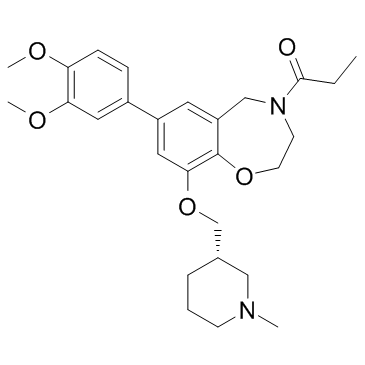
Cas No.: 1640282-31-0
Sample solution is provided at 25 µL, 10mM.
_1-3.$$$39978408@51.jpg');)
_1-9.$$$38538795@65.jpg');)
_1-9.$$$39112701@51.jpg');)
_1-7.$$$37316672@70.jpg');)
_366-372.$$$36198801@70.jpg');)
.$$$38565142@65.jpg');)
_1867-1883.$$$33248023@67.jpg');)
_eads6055.$$$39977546@45.jpg');)
_eadm9805.$$$40080571@45.jpg');)
_eadj3020.$$$39666821@45.jpg');)
_1-20.$$$39757301@28.jpg');)
_1-24.$$$38898113@28.jpg');)
_273-287.$$$36806353@46.jpg');)
_1-16.$$$37156877@44.jpg');)
_1-19.$$$37460805@44.jpg');)
_1291-1307.$$$34518654@46.jpg');)
I-CBP112 is a specific and potent acetyl-lysine competitive protein-protein interaction inhibitor, that targets the CBP/p300 bromodomains.
I-CBP112 significantly enhances acetylation by p300 at the histone H3K18 and H3K23 sites. I-CBP112 stimulated H3K18ac by ~3-fold, I-CBP112 induced enhances acetylation of these same sites by CBP as well as at H4K5. The EC50's of activation of I-CBP112 on p300- and CBP-mediated H3K18 acetylation are ~2 μM[1]. Exposure of human and mouse leukemic cell lines to I-CBP112 results in substantially impaired colony formation and induces cellular differentiation without significant cytotoxicity. Exposure of the BioMAP primary cell panel to I-CBP112 results in a unique response on cytokine and marker protein expression[2].
I-CBP112 significantly reduces the leukemia-initiating potential of mLL-AF9+ AmL cells in a dose-dependent manner in vitro and in vivo. The synergistic effects of I-CBP112 and current standard therapy (doxorubicin) as well as emerging treatment strategies (BET inhibition) provide new opportunities for combinatorial treatment of leukemia and potentially other cancers[2].
[1]. Zucconi BE, et al. Modulation of p300/CBP Acetylation of Nucleosomes by Bromodomain LigandI-CBP112. Biochemistry. 2016 Jul 12;55(27):3727-34. [2]. Picaud S, et al. Generation of a Selective Small Molecule Inhibitor of the CBP/p300 Bromodomain for Leukemia Therapy. Cancer Res. 2015 Dec 1;75(23):5106-19.
Cell experiment: | I-CBP112 is dissolved in DMSO and diluted with appropriate medium before use. Cells (6000 KG1a and 13000 LNCaP cells/well) are plated in 96-well flat-bottom plates approximately 24 h prior to drug treatment. After 24 h, 10–20% fetal bovine serum-containing medium is replaced with 2.5% serum medium, and cells are treated with I-CBP112 in 0.18% DMSO; 0.18% DMSO is shown to have negligible cell growth effects under the conditions used in our experiments. After being exposed to I-CBP112 for 66 h, cells are subjected to a final concentration of 0.476% [3H]thymidine per well and allowed to proliferate for an additional 6 h (exposure to I-CBP112 for a total of 72 h). Cells are harvested, and the counts of 3H in each well are taken relative to those treated with vehicle alone to quantify the effect of the ligand on proliferation[1]. |
Animal experiment: | Mice: Leukemic blasts expressing MLL-AF9 are treated in liquid culture with 5 μM of I-CBP112 for 3 days. Control cells are exposed to the corresponding concentration of the DMSO vehicle. Treated cells are then transplanted into sublethally irradiated syngeneic mice via tail vein injection. Upon the development of signs of disease the mice are sacrificed and analysed[2]. |
References: [1]. Zucconi BE, et al. Modulation of p300/CBP Acetylation of Nucleosomes by Bromodomain LigandI-CBP112. Biochemistry. 2016 Jul 12;55(27):3727-34. | |
| Cas No. | 1640282-31-0 | SDF | |
| Canonical SMILES | COC1=C(OC)C=C(C2=CC(OC[C@H]3CCCN(C)C3)=C(OCCN(C(CC)=O)C4)C4=C2)C=C1 | ||
| Formula | C27H36N2O5 | M.Wt | 468.59 |
| Solubility | DMSO : ≥ 32 mg/mL (68.29 mM) | Storage | Store at -20°C |
| General tips | Please select the appropriate solvent to prepare the stock solution according to the
solubility of the product in different solvents; once the solution is prepared, please store it in
separate packages to avoid product failure caused by repeated freezing and thawing.Storage method
and period of the stock solution: When stored at -80°C, please use it within 6 months; when stored
at -20°C, please use it within 1 month. To increase solubility, heat the tube to 37°C and then oscillate in an ultrasonic bath for some time. |
||
| Shipping Condition | Evaluation sample solution: shipped with blue ice. All other sizes available: with RT, or with Blue Ice upon request. | ||
| Prepare stock solution | |||

|
1 mg | 5 mg | 10 mg |
| 1 mM | 2.1341 mL | 10.6703 mL | 21.3406 mL |
| 5 mM | 426.8 μL | 2.1341 mL | 4.2681 mL |
| 10 mM | 213.4 μL | 1.067 mL | 2.1341 mL |
Step 1: Enter information below (Recommended: An additional animal making an allowance for loss during the experiment)
 g
μL
g
μL
Step 2: Enter the in vivo formulation (This is only the calculator, not formulation. Please contact us first if there is no in vivo formulation at the solubility Section.)
Calculation results:
Working concentration: mg/ml;
Method for preparing DMSO master liquid: mg drug pre-dissolved in μL DMSO ( Master liquid concentration mg/mL, Please contact us first if the concentration exceeds the DMSO solubility of the batch of drug. )
Method for preparing in vivo formulation: Take μL DMSO master liquid, next addμL PEG300, mix and clarify, next addμL Tween 80, mix and clarify, next add μL saline, mix and clarify.
Method for preparing in vivo formulation: Take μL DMSO master liquid, next add μL Corn oil, mix and clarify.
Note: 1. Please make sure the liquid is clear before adding the next solvent.
2. Be sure to add the solvent(s) in order. You must ensure that the solution obtained, in the previous addition, is a clear solution before proceeding to add the next solvent. Physical methods such as vortex, ultrasound or hot water bath can be used to aid dissolving.
3. All of the above co-solvents are available for purchase on the GlpBio website.
Quality Control & SDS
- View current batch:
- Purity: >98.00% Appearance: A solid
- COA (Certificate of Analysis)
- SDS (Safety Data Sheet)
- Datasheet
Average Rating: 5 (Based on Reviews and 2 reference(s) in Google Scholar.)