

IBMX (Synonyms: Isobutylmethylxanthine, 1-Methyl-3-Isobutylxanthine, NSC 165960, SC-2964) |
Catalog No.GC11730
 One-Click Copy Product Info
|

IBMX is a broad-spectrum, non-selective phosphodiesterase (PDE) inhibitor. IBMX inhibits the activities of PDE3, PDE4, and PDE5 (IC50 = 6.5, 26.3, and 31.7μM).
Products are for research use only. Not for human use. We do not sell to patients.
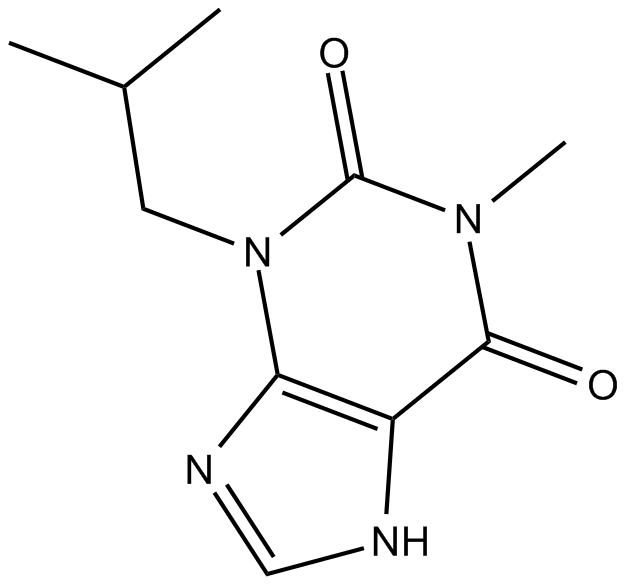
Cas No.: 28822-58-4
Sample solution is provided at 25 µL, 10mM.
IBMX is a broad-spectrum, non-selective phosphodiesterase (PDE) inhibitor. IBMX inhibits the activities of PDE3, PDE4, and PDE5 (IC50 = 6.5, 26.3, and 31.7μM). By inhibiting PDE-mediated hydrolysis of cAMP and cGMP, IBMX increases intracellular cAMP/cGMP levels and activates PKA and PKG signaling pathways. IBMX acts as an adenosine receptor antagonist to block inhibitory signaling of adenosine. IBMX can be used in studies related to adipocyte differentiation, cell signal transduction, glucose metabolism, and neuroscience[1-4].
In vitro, IBMX (0.5mM) treated Caco-2 cells for 12 hours. IBMX promoted LPH biosynthesis and inhibited sucrase-isomaltase activity in the cells[5]. IBMX (15.625–2000μM) alone or in combination with indomethacin treated small cell lung cancer cell lines such as H82 and SW2 for 72 hours. IBMX dose-dependently inhibited the proliferation of small cell lung cancer cells[6].
In vivo, IBMX (0.1–20μmol; single treatment) was topically applied to the shaved dorsal area of female CD-1 mice aged 7-9 weeks. IBMX dose-dependently elevated the levels of epidermal cyclic GMP and cyclic AMP in mice and induced an increase in ornithine decarboxylase activity[7]. IBMX (5 or 10μmol; 0.2mL per application) was topically applied to the shaved dorsal area of CD-1 mice for 30 consecutive weeks. Treatment with 3-isobutyl-1-methylxanthine did not show carcinogenicity[8].
References:
[1] Wu BN, Lin RJ, Lo YC, et al. KMUP-1, a xanthine derivative, induces relaxation of guinea-pig isolated trachea: the role of the epithelium, cyclic nucleotides and K+ channels. Br J Pharmacol. 2004 Aug;142(7):1105-14.
[2] Wei Y, Liao Y, Zavilowitz B, et al. TAngiotensin II type 2 receptor regulates ROMK-like K⁺ channel activity in the renal cortical collecting duct during high dietary K⁺ adaptation. Am J Physiol Renal Physiol. 2014 Oct 1;307(7):F833-43.
[3] Hosseini A, Shafiee-Nick R, Pour Ali Behzad N, et al. Differential metabolic effects of novel cilostamide analogs, methyl carbostiryl derivatives, on mouse and hyperglycemic rat. Iran J Basic Med Sci. 2012 Jul;15(4):916-25.
[4] Crosswhite P, Sun Z. Inhibition of phosphodiesterase-1 attenuates cold-induced pulmonary hypertension. Hypertension. 2013 Mar;61(3):585-92.
[5] Hauri HP, Sander B, Naim H. Induction of lactase biosynthesis in the human intestinal epithelial cell line Caco-2. Eur J Biochem. 1994 Jan 15;219(1-2):539-46.
[6] Lange A, Gustke H, Glassmeier G, et al. Neuronal differentiation by indomethacin and IBMX inhibits proliferation of small cell lung cancer cells in vitro. Lung Cancer. 2011 Nov;74(2):178-87.
[7] Perchellet JP, Boutwell RK. Effects of 3-Isobutyl-1-methylxanthine and Cyclic Nucleotides on 12-O-Tetradecanoylphorbol-13-acetate-induced Ornithine Decarboxylase Activity in Mouse Epidermis in Vivo. Cancer Res. 1981 Oct;41(10):3918-3926.
[8] Perchellet JP, Boutwell RK. Comparison of the effects of 3-isobutyl-1-methylxanthine and adenosine cyclic 3′:5′-monophosphate on the induction of skin tumors by the initiation-promotion protocol and by the complete carcinogenesis process. Carcinogenesis. 1982;3(1):53-60.
| Cell experiment [1]: | |
Cell lines | H82 and SW2 (small cell lung cancer cell lines) |
Preparation Method | Cells were cultured in RPMI-1640 medium supplemented with 10% heat-inactivated fetal bovine serum, 2mM L-glutamine, 100U/ml penicillin and 100μg/ml streptomycin at 37°C, 5% CO₂. Cells were treated with IBMX at indicated concentrations for 72 hours. |
Reaction Conditions | 15.625–2000μM; 72h |
Applications | IBMX inhibited proliferation of H82 and SW2 cells. |
| Animal experiment [2]: | |
Animal models | Female CD-1 mice (7-9 weeks old) |
Preparation Method | Mice were housed in light- and temperature-controlled rooms with free access to food and water, dorsal skin was shaved at least 2 days before treatment, and only mice with no hair regrowth were used. IBMX was dissolved in 96% acetone-4% water and applied topically to the shaved back area in 0.2ml per dose. Mice were sacrificed at designated time points after treatment for epidermal guanosine cyclic 3':5'-monophosphate (cyclic GMP), adenosine cyclic 3':5'-monophosphate (cyclic AMP) and ornithine decarboxylase (ODC) activity assays. |
Dosage form | 0.1-20μmol; topical; single applications |
Applications | IBMX dose-dependently elevated mouse epidermal cyclic GMP and cyclic AMP levels, and induced a 9-fold increase in basal ODC activity. |
References: | |
| Cas No. | 28822-58-4 | SDF | |
| Synonyms | Isobutylmethylxanthine, 1-Methyl-3-Isobutylxanthine, NSC 165960, SC-2964 | ||
| Chemical Name | 3-isobutyl-1-methyl-1H-purine-2,6(3H,7H)-dione | ||
| Canonical SMILES | O=C(N(C)C1=O)N(C2=C1NC=N2)CC(C)C | ||
| Formula | C10H14N4O2 | M.Wt | 222.24 |
| Solubility | ≥ 9.45mg/mL in DMSO; Insoluble in Water | Storage | Store at -20°C |
| General tips | Please select the appropriate solvent to prepare the stock solution according to the
solubility of the product in different solvents; once the solution is prepared, please store it in
separate packages to avoid product failure caused by repeated freezing and thawing.Storage method
and period of the stock solution: When stored at -80°C, please use it within 6 months; when stored
at -20°C, please use it within 1 month. To increase solubility, heat the tube to 37°C and then oscillate in an ultrasonic bath for some time. |
||
| Shipping Condition | Evaluation sample solution: shipped with blue ice. All other sizes available: with RT, or with Blue Ice upon request. | ||
| Prepare stock solution | |||

|
1 mg | 5 mg | 10 mg |
| 1 mM | 4.4996 mL | 22.4982 mL | 44.9964 mL |
| 5 mM | 899.9 μL | 4.4996 mL | 8.9993 mL |
| 10 mM | 450 μL | 2.2498 mL | 4.4996 mL |
Step 1: Enter information below (Recommended: An additional animal making an allowance for loss during the experiment)
 g
μL
g
μL
Step 2: Enter the in vivo formulation (This is only the calculator, not formulation. Please contact us first if there is no in vivo formulation at the solubility Section.)
Calculation results:
Working concentration: mg/ml;
Method for preparing DMSO master liquid: mg drug pre-dissolved in μL DMSO ( Master liquid concentration mg/mL, Please contact us first if the concentration exceeds the DMSO solubility of the batch of drug. )
Method for preparing in vivo formulation: Take μL DMSO master liquid, next addμL PEG300, mix and clarify, next addμL Tween 80, mix and clarify, next add μL saline, mix and clarify.
Method for preparing in vivo formulation: Take μL DMSO master liquid, next add μL Corn oil, mix and clarify.
Note: 1. Please make sure the liquid is clear before adding the next solvent.
2. Be sure to add the solvent(s) in order. You must ensure that the solution obtained, in the previous addition, is a clear solution before proceeding to add the next solvent. Physical methods such as vortex, ultrasound or hot water bath can be used to aid dissolving.
3. All of the above co-solvents are available for purchase on the GlpBio website.
Quality Control & SDS
- View current batch:
- Purity: >98.00% Appearance: A solid
- COA (Certificate of Analysis)
- SDS (Safety Data Sheet)
- Datasheet
Average Rating: 5 (Based on Reviews and 19 reference(s) in Google Scholar.)