

ID-8 |
Catalog No.GC15647
 One-Click Copy Product Info
|

DYRK inhibitor
Products are for research use only. Not for human use. We do not sell to patients.
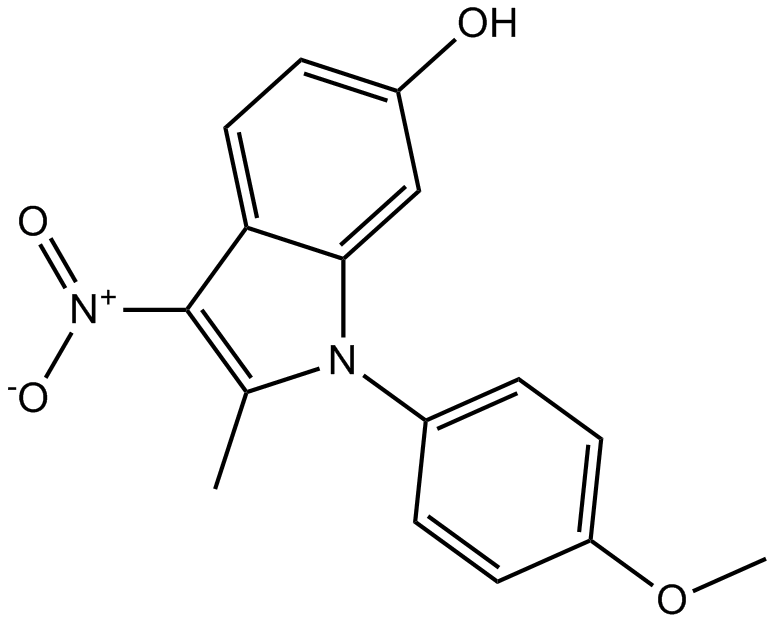
Cas No.: 147591-46-6
Sample solution is provided at 25 µL, 10mM.
_1-3.$$$39978408@51.jpg');)
_1-9.$$$38538795@65.jpg');)
_1-9.$$$39112701@51.jpg');)
_1-7.$$$37316672@70.jpg');)
_366-372.$$$36198801@70.jpg');)
.$$$38565142@65.jpg');)
_1867-1883.$$$33248023@67.jpg');)
_eads6055.$$$39977546@45.jpg');)
_eadm9805.$$$40080571@45.jpg');)
_eadj3020.$$$39666821@45.jpg');)
_1-20.$$$39757301@28.jpg');)
_1-24.$$$38898113@28.jpg');)
_273-287.$$$36806353@46.jpg');)
_1-16.$$$37156877@44.jpg');)
_1-19.$$$37460805@44.jpg');)
_1291-1307.$$$34518654@46.jpg');)
ID-8 is a small molecule inhibitor of DYRK [1].
Dual-specificity tyrosine phosphorylation-regulated kinase (DYRK) is an enzyme that catalyzes autophosphorylation on tyrosine and serine/threonine residues.
ID-8 is a small molecule DYRK inhibitor. In HES2 cells, ID-8 (0.5 μM) increased hESC survival by 1.1%. The combination of ID-8 and Wnt3a increased survival by 1.7% and completely inhibited Wnt-induced morphological differentiation. Also, ID-8 significantly reduced the expression of differentiation marker gene GATA6, GSC, SOX17 and CDX2 induced by Wnt. In hESCs, ID-8 increased Wnt-mediated hESC proliferation and survival via inhibition of DYRKs. Also, DYRK family is direct targets of ID-8 [1]. In embryonic stem cells (ESCs), ID-8 (10 μM) stimulated proliferation in culture without MEFs, serum or LIF. The ID-8 induced ESCs showed the ability to form all three germ layer-derived tissues, such as liver, neurons and muscles. Also, ID-8 increased ESC differentiation and the levels of Nanog, Sox2 and Rex-1 [2]. In mouse ESCs cultured in serum-free medium, ID-8 maintained their self-renewal and pluripotency [3].
References:
[1]. Hasegawa K, Yasuda SY, Teo JL, et al. Wnt signaling orchestration with a small molecule DYRK inhibitor provides long-term xeno-free human pluripotent cell expansion. Stem Cells Transl Med, 2012, 1(1): 18-28.
[2]. Miyabayashi T, Yamamoto M, Sato A, et al. Indole derivatives sustain embryonic stem cell self-renewal in long-term culture. Biosci Biotechnol Biochem, 2008, 72(5): 1242-1248.
[3]. Firestone AJ, Chen JK. Controlling destiny through chemistry: small-molecule regulators of cell fate. ACS Chem Biol, 2010, 5(1): 15-34.
| Cell experiment [1]: | |
|
Cell lines |
D3ES embryonic stem cells (ESCs) |
|
Preparation method |
The solubility of this compound in DMSO is >13.95mg/mL. General tips for obtaining a higher concentration: Please warm the tube at 37℃ for 10 minutes and/or shake it in the ultrasonic bath for a while. Stock solution can be stored below -20℃ for several months. |
|
Reacting condition |
10 μM; more than 1 month |
|
Applications |
In D3ES embryonic stem cells (ESCs) cultured in serum-free media, ID-8 enabled ESCs to proliferate in the undifferentiated state for at least 30 d. Cells maintained in the medium supplemented with ID-8 differentiated into various cell types, such as neurons, muscles, and liver. Removal of ID-8 from the long-term culture led to ESC differentiation. ID-8 reversibly maintained the long-term culture of ESCs by sustaining Nanog gene expression through Sox2-Oct3/4 activation. |
|
References: [1]. Miyabayashi T, Yamamoto M, Sato A, et al. Indole derivatives sustain embryonic stem cell self-renewal in long-term culture. Biosci Biotechnol Biochem, 2008, 72(5): 1242-1248. | |
| Cas No. | 147591-46-6 | SDF | |
| Chemical Name | 1-(4-methoxyphenyl)-2-methyl-3-nitroindol-6-ol | ||
| Canonical SMILES | CC1=C(C2=C(N1C3=CC=C(C=C3)OC)C=C(C=C2)O)[N+](=O)[O-] | ||
| Formula | C16H14N2O4 | M.Wt | 298.29 |
| Solubility | ≥ 13.95mg/mL in DMSO | Storage | Store at -20°C |
| General tips | Please select the appropriate solvent to prepare the stock solution according to the
solubility of the product in different solvents; once the solution is prepared, please store it in
separate packages to avoid product failure caused by repeated freezing and thawing.Storage method
and period of the stock solution: When stored at -80°C, please use it within 6 months; when stored
at -20°C, please use it within 1 month. To increase solubility, heat the tube to 37°C and then oscillate in an ultrasonic bath for some time. |
||
| Shipping Condition | Evaluation sample solution: shipped with blue ice. All other sizes available: with RT, or with Blue Ice upon request. | ||
| Prepare stock solution | |||

|
1 mg | 5 mg | 10 mg |
| 1 mM | 3.3524 mL | 16.7622 mL | 33.5244 mL |
| 5 mM | 670.5 μL | 3.3524 mL | 6.7049 mL |
| 10 mM | 335.2 μL | 1.6762 mL | 3.3524 mL |
Step 1: Enter information below (Recommended: An additional animal making an allowance for loss during the experiment)
 g
μL
g
μL
Step 2: Enter the in vivo formulation (This is only the calculator, not formulation. Please contact us first if there is no in vivo formulation at the solubility Section.)
Calculation results:
Working concentration: mg/ml;
Method for preparing DMSO master liquid: mg drug pre-dissolved in μL DMSO ( Master liquid concentration mg/mL, Please contact us first if the concentration exceeds the DMSO solubility of the batch of drug. )
Method for preparing in vivo formulation: Take μL DMSO master liquid, next addμL PEG300, mix and clarify, next addμL Tween 80, mix and clarify, next add μL saline, mix and clarify.
Method for preparing in vivo formulation: Take μL DMSO master liquid, next add μL Corn oil, mix and clarify.
Note: 1. Please make sure the liquid is clear before adding the next solvent.
2. Be sure to add the solvent(s) in order. You must ensure that the solution obtained, in the previous addition, is a clear solution before proceeding to add the next solvent. Physical methods such as vortex, ultrasound or hot water bath can be used to aid dissolving.
3. All of the above co-solvents are available for purchase on the GlpBio website.
Quality Control & SDS
- View current batch:
- Purity: >99.00% Appearance: A solid
- COA (Certificate of Analysis)
- SDS (Safety Data Sheet)
- Datasheet
Average Rating: 5 (Based on Reviews and 14 reference(s) in Google Scholar.)