

JFD00244 (Synonyms: BML-266) |
Catalog No.GC14686
 One-Click Copy Product Info
|

inhibitor of SIRT2
Products are for research use only. Not for human use. We do not sell to patients.
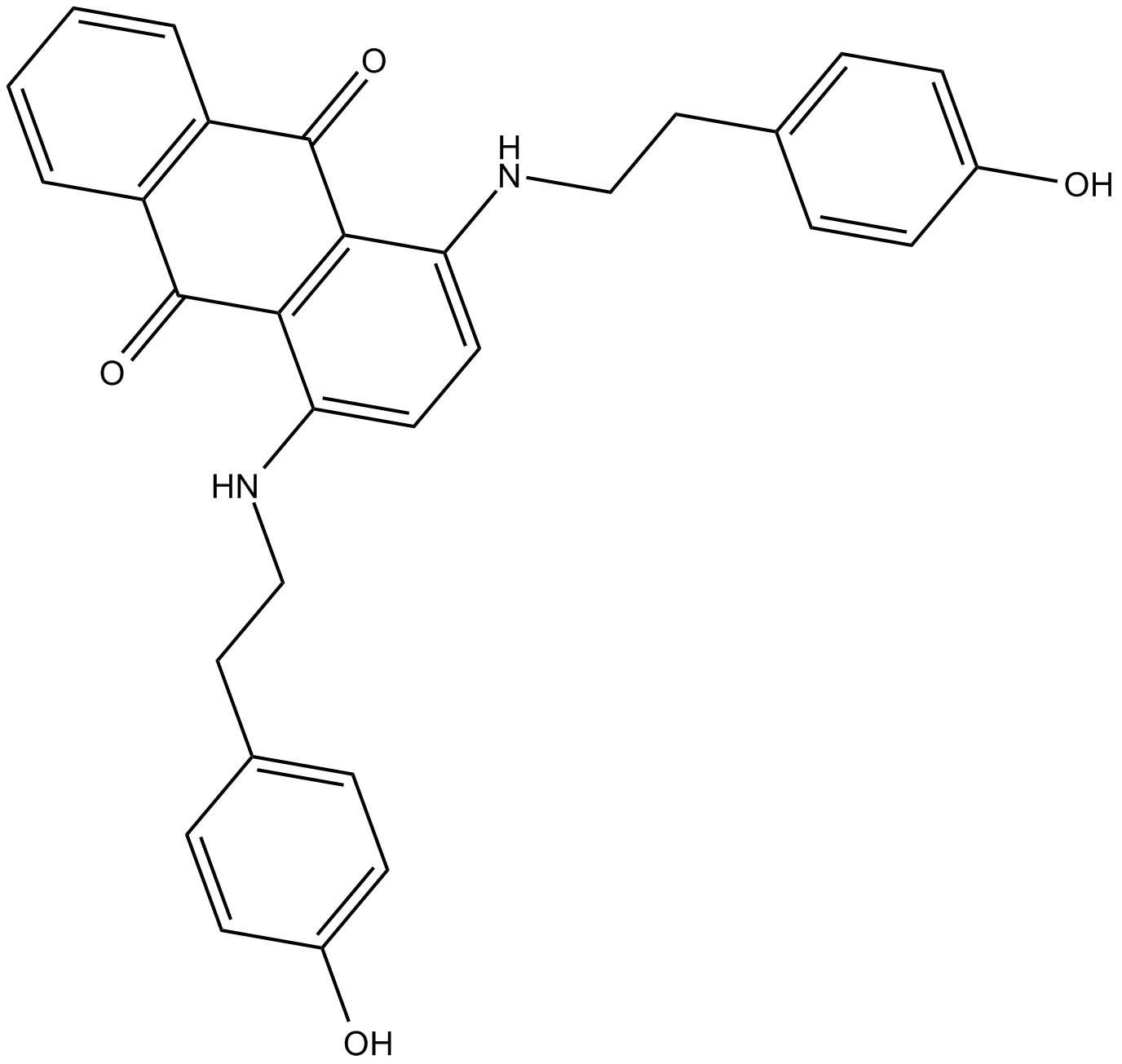
Cas No.: 96969-83-4
Sample solution is provided at 25 µL, 10mM.
_1-3.$$$39978408@51.jpg');)
_1-9.$$$38538795@65.jpg');)
_1-9.$$$39112701@51.jpg');)
_1-7.$$$37316672@70.jpg');)
_366-372.$$$36198801@70.jpg');)
.$$$38565142@65.jpg');)
_1867-1883.$$$33248023@67.jpg');)
_eads6055.$$$39977546@45.jpg');)
_eadm9805.$$$40080571@45.jpg');)
_eadj3020.$$$39666821@45.jpg');)
_1-20.$$$39757301@28.jpg');)
_1-24.$$$38898113@28.jpg');)
_273-287.$$$36806353@46.jpg');)
_1-16.$$$37156877@44.jpg');)
_1-19.$$$37460805@44.jpg');)
_1291-1307.$$$34518654@46.jpg');)
IC50: 56.7 μM
JFD00244 is an inhibitor of SIRT2.
Silent information regulator 2 (Sir2) protein, a nicotinamide adenine dinucleotide (NAD+) dependent class III histone deacetylase (HDAC), is present in prokaryotes and all eukaryotes. Sir2 can catalyze the cleavage of the glycosidic bond between nicotinamide and ADP-ribose of NAD+, followed by transfer of the acetyl group from an acetylated lysine residue to ADP-ribose, leading to free nicotinamide and 2’- and 3’-O-acetyl-ADP-ribose. Sir2 is needed for various cellular functions including cell cycle, metabolism, chromatin silencing, and life span.
In vitro: In a previou study, the molecular modeling and virtual screening were utilized to identify potential compounds, which were then subjected to experimental tests for their SIRT2 inhibitory activity. Five of the 15 tested compounds including JFD00244 displayed inhibitory activity toward SIRT2, resulting in a hit ratio of 33% in a micromolar level. JFD00244 and another analog of the five compounds yielded in vitro IC(50) values of 56.7 and 74.3 microM, respectively. On the basis of these results, a phenol moiety on the active compounds including JFD00244 was suggested to be critical for SIRT2 inhibitory activity. This phenol group, together with a hydrophobic moiety and hydrogen-bonding features, was thus recommended to form an active SIRT2 pharmacophore [1].
In vivo: Up to now, there is no animal in vivo data reported.
Clinical trial: So far, no clinical study has been conducted.
Reference:
[1] Tervo AJ, Kyrylenko S, Niskanen P, Salminen A, Leppnen J, Nyrnen TH, Jrvinen T, Poso A. An in silico approach to discovering novel inhibitors of human sirtuin type 2. J Med Chem. 2004 Dec 2;47(25):6292-8.
| Cas No. | 96969-83-4 | SDF | |
| Synonyms | BML-266 | ||
| Chemical Name | 1,4-bis[[2-(4-hydroxyphenyl)ethyl]amino]-9,10-anthracenedione | ||
| Canonical SMILES | O=C(C1=C2C(NCCC3=CC=C(O)C=C3)=CC=C1NCCC4=CC=C(O)C=C4)C5=C(C=CC=C5)C2=O | ||
| Formula | C30H26N2O4 | M.Wt | 478.5 |
| Solubility | ≤0.3mg/ml in ethanol;30mg/ml in DMSO;30mg/ml in dimethyl formamide | Storage | Store at -20°C |
| General tips | Please select the appropriate solvent to prepare the stock solution according to the
solubility of the product in different solvents; once the solution is prepared, please store it in
separate packages to avoid product failure caused by repeated freezing and thawing.Storage method
and period of the stock solution: When stored at -80°C, please use it within 6 months; when stored
at -20°C, please use it within 1 month. To increase solubility, heat the tube to 37°C and then oscillate in an ultrasonic bath for some time. |
||
| Shipping Condition | Evaluation sample solution: shipped with blue ice. All other sizes available: with RT, or with Blue Ice upon request. | ||
| Prepare stock solution | |||

|
1 mg | 5 mg | 10 mg |
| 1 mM | 2.0899 mL | 10.4493 mL | 20.8986 mL |
| 5 mM | 418 μL | 2.0899 mL | 4.1797 mL |
| 10 mM | 209 μL | 1.0449 mL | 2.0899 mL |
Step 1: Enter information below (Recommended: An additional animal making an allowance for loss during the experiment)
 g
μL
g
μL
Step 2: Enter the in vivo formulation (This is only the calculator, not formulation. Please contact us first if there is no in vivo formulation at the solubility Section.)
Calculation results:
Working concentration: mg/ml;
Method for preparing DMSO master liquid: mg drug pre-dissolved in μL DMSO ( Master liquid concentration mg/mL, Please contact us first if the concentration exceeds the DMSO solubility of the batch of drug. )
Method for preparing in vivo formulation: Take μL DMSO master liquid, next addμL PEG300, mix and clarify, next addμL Tween 80, mix and clarify, next add μL saline, mix and clarify.
Method for preparing in vivo formulation: Take μL DMSO master liquid, next add μL Corn oil, mix and clarify.
Note: 1. Please make sure the liquid is clear before adding the next solvent.
2. Be sure to add the solvent(s) in order. You must ensure that the solution obtained, in the previous addition, is a clear solution before proceeding to add the next solvent. Physical methods such as vortex, ultrasound or hot water bath can be used to aid dissolving.
3. All of the above co-solvents are available for purchase on the GlpBio website.
Quality Control & SDS
- View current batch:
- Purity: >98.00% Appearance: A solid
- COA (Certificate of Analysis)
- SDS (Safety Data Sheet)
- Datasheet
Average Rating: 5 (Based on Reviews and 31 reference(s) in Google Scholar.)