

JTE 013 |
Catalog No.GC12947
 One-Click Copy Product Info
|

JTE 013 is a potent, orally available, and targeted S1P2 antagonist, with an IC50 value of 22±9nM for rat S1P2.
Products are for research use only. Not for human use. We do not sell to patients.
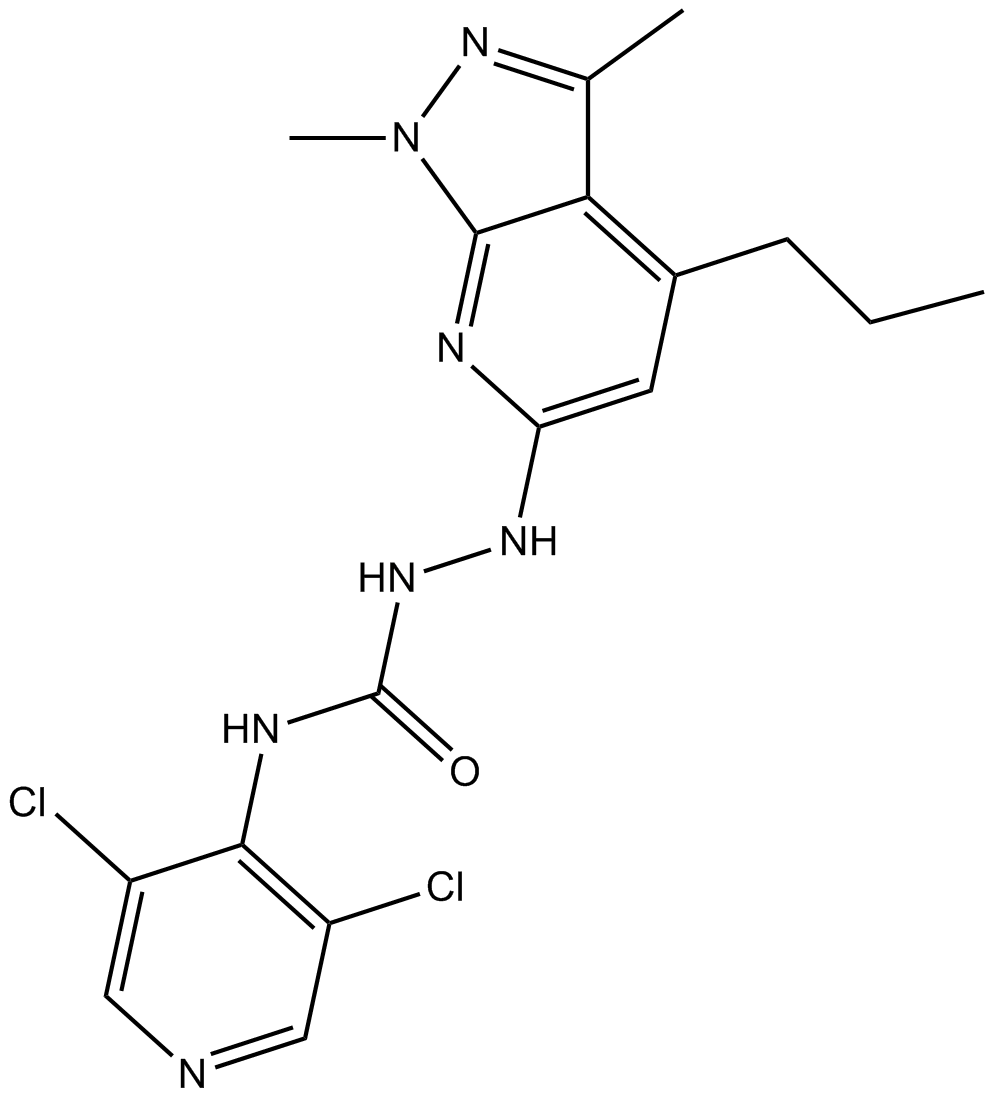
Cas No.: 383150-41-2
Sample solution is provided at 25 µL, 10mM.
JTE 013 is a potent, orally available, and targeted S1P2 antagonist, with an IC50 value of 22±9nM for rat S1P2 [1]. JTE 013 inhibited the production of inflammatory cytokines and S1P, reduced monocyte chemotaxis, and inhibited RANKL-induced osteoclast precursor adhesion and fusion by targeting S1PR2[2]. JTE 013 has been widely used to regulate smooth muscle contraction and attenuate hypoxia-induced pulmonary hypertension in rodents[3].
In vitro, JTE 013 treatment for 72 hours significantly inhibited GH3 cell viability with an IC50 value of 41.17μM [4]. JTE 013 treatment for 3 hours markedly suppressed ceramide production in MV411 cells with an IC50 value of 16.6 ± 2.8µM[5]. Treatment with 10µM JTE 013 for 4h restored the lipopolysaccharide (LPS)-induced decrease in cell viability of human pulmonary microvascular endothelial cells (HPMECs), reduced inflammation levels, and abolished the inhibitory effect of LPS on junction protein levels in HPMECs[6].
In vivo, JTE 013 treatment via intraperitoneal injection (8mg/kg) once every other day for 5 days can reduce bleomycin-induced pulmonary fibrosis and inhibit the expression of RHOA/YAP pathway proteins in lung tissues of mice[7]. Treatment with JTE 013 at a dose of 2mg/kg via intraperitoneal injection every other day for 3 days in mice with bile duct ligation significantly reduced serum total bile acid levels and alleviated cholestatic liver injury[8].
References:
[1] Li M H, Swenson R, Harel M, et al. Antitumor activity of a novel sphingosine-1-phosphate 2 antagonist, AB1, in neuroblastoma[J]. The Journal of Pharmacology and Experimental Therapeutics, 2015, 354(3): 261-268.
[2] Yu H. Targeting S1PRs as a therapeutic strategy for inflammatory bone loss diseases—beyond regulating S1P signaling[J]. International Journal of Molecular Sciences, 2021, 22(9): 4411.
[3] Blankenbach K V, Schwalm S, Pfeilschifter J, et al. Sphingosine-1-phosphate receptor-2 antagonists: therapeutic potential and potential risks[J]. Frontiers in pharmacology, 2016, 7: 167.
[4] Sun H, Hu B, Wu C, et al. Targeting the SPHK1/S1P/S1PR2 axis ameliorates GH‐secreted pituitary adenoma progression[J]. European Journal of Clinical Investigation, 2024, 54(3): e14117.
[5] Pitman M R, Lewis A C, Davies L T, et al. The sphingosine 1-phosphate receptor 2/4 antagonist JTE-013 elicits off-target effects on sphingolipid metabolism[J]. Scientific reports, 2022, 12(1): 454.
[6] Xu Q, Chen J, Zhu Y, et al. JTE-013 alleviates inflammatory injury and endothelial dysfunction induced by sepsis in vivo and in vitro[J]. Journal of Surgical Research, 2021, 265: 323-332.
[7] Zhou J, Song Y, Wang X, et al. JTE-013 alleviates pulmonary fibrosis by affecting the RhoA/YAP pathway and mitochondrial fusion/fission[J]. Pharmaceuticals, 2023, 16(10): 1444.
[8] Wang Y, Aoki H, Yang J, et al. The role of sphingosine 1‐phosphate receptor 2 in bile‐acid–induced cholangiocyte proliferation and cholestasis‐induced liver injury in mice[J]. Hepatology, 2017, 65(6): 2005-2018.
| Cell experiment [1]: | |
Cell lines | Human pulmonary microvascular endothelial cells (HPMECs) |
Preparation Method | HPMECs were cultured at a density of 1×10⁵ cells in endothelial cell medium supplemented with 10% fetal bovine serum (FBS) and 2% endothelial cell growth supplements (ECGS). LPS was used to establish a cell injury model induced by sepsis. After cell confluence reached 90%, the cells were divided into the control group, LPS group, and LPS+JTE 013 group. Cells in the LPS group were treated with LPS (1µg/ml) for 4 hours. Cells in the LPS+JTE 013 group were pretreated with LPS (1µg/ml) and then treated with JTE 013 (10µM) for 4 hours. Cell viability and inflammatory factor levels were analyzed. |
Reaction Conditions | 10µM; 4h |
Applications | JTE 013 treatment restored the decreased cell viability induced by LPS and decreased levels of TNF-α, IL-1β, and IL-6 in HPMECs. |
| Animal experiment [2]: | |
Animal models | BALB/c nude mice |
Preparation Method | GH3 xenograft model was established in BALB/c nude mice, GH3 cells (2.5×10⁶ cells) mixed with Matrigel were subcutaneously implanted into the abdomen of 6-8 weeks old male mice (JTE 013 group, n=6; control group, n=6). Tumor size was measured every 3 days, and tumor volume was estimated as width2×length×0.5. When the tumor volume approached 100mm3, JTE 013 was administered by gavage once daily at a dose of 2.5mg/kg. At the end of the 28-day experiment, all mice were sacrificed and tumors were removed for analysis. |
Dosage form | 2.5mg/kg/day for 28 days; p.o. |
Applications | JTE 013 treatment resulted in a significant inhibition of tumor growth and led to a reduction in body weight in GH3 xenograft mice. |
References: | |
| Cas No. | 383150-41-2 | SDF | |
| Chemical Name | N-(3,5-dichloropyridin-4-yl)-2-(1,3-dimethyl-4-propyl-1H-pyrazolo[3,4-b]pyridin-6-yl)hydrazinecarboxamide | ||
| Canonical SMILES | ClC1=C(C(Cl)=CN=C1)NC(NNC2=CC(CCC)=C3C(N(C)N=C3C)=N2)=O | ||
| Formula | C17H19N7OCl2 | M.Wt | 408.29 |
| Solubility | DMF: 20 mg/ml,DMSO: 20 mg/ml,Ethanol: 30 mg/ml,Ethanol:PBS (pH 7.2) (1:3): 0.25 mg/ml | Storage | Store at -20°C |
| General tips | Please select the appropriate solvent to prepare the stock solution according to the
solubility of the product in different solvents; once the solution is prepared, please store it in
separate packages to avoid product failure caused by repeated freezing and thawing.Storage method
and period of the stock solution: When stored at -80°C, please use it within 6 months; when stored
at -20°C, please use it within 1 month. To increase solubility, heat the tube to 37°C and then oscillate in an ultrasonic bath for some time. |
||
| Shipping Condition | Evaluation sample solution: shipped with blue ice. All other sizes available: with RT, or with Blue Ice upon request. | ||
| Prepare stock solution | |||

|
1 mg | 5 mg | 10 mg |
| 1 mM | 2.4492 mL | 12.2462 mL | 24.4924 mL |
| 5 mM | 489.8 μL | 2.4492 mL | 4.8985 mL |
| 10 mM | 244.9 μL | 1.2246 mL | 2.4492 mL |
Step 1: Enter information below (Recommended: An additional animal making an allowance for loss during the experiment)
 g
μL
g
μL
Step 2: Enter the in vivo formulation (This is only the calculator, not formulation. Please contact us first if there is no in vivo formulation at the solubility Section.)
Calculation results:
Working concentration: mg/ml;
Method for preparing DMSO master liquid: mg drug pre-dissolved in μL DMSO ( Master liquid concentration mg/mL, Please contact us first if the concentration exceeds the DMSO solubility of the batch of drug. )
Method for preparing in vivo formulation: Take μL DMSO master liquid, next addμL PEG300, mix and clarify, next addμL Tween 80, mix and clarify, next add μL saline, mix and clarify.
Method for preparing in vivo formulation: Take μL DMSO master liquid, next add μL Corn oil, mix and clarify.
Note: 1. Please make sure the liquid is clear before adding the next solvent.
2. Be sure to add the solvent(s) in order. You must ensure that the solution obtained, in the previous addition, is a clear solution before proceeding to add the next solvent. Physical methods such as vortex, ultrasound or hot water bath can be used to aid dissolving.
3. All of the above co-solvents are available for purchase on the GlpBio website.
Quality Control & SDS
- View current batch:
- Purity: >99.50% Appearance: A solid
- COA (Certificate of Analysis)
- SDS (Safety Data Sheet)
- Datasheet
Average Rating: 5 (Based on Reviews and 31 reference(s) in Google Scholar.)