

R406 |
Catalog No.GC16796
 One-Click Copy Product Info
|

R406 is an orally available spleen tyrosine kinase (Syk) inhibitor with an IC50 value of 41nM and competitive inhibitor for ATP binding with a Ki of 30nM
Products are for research use only. Not for human use. We do not sell to patients.
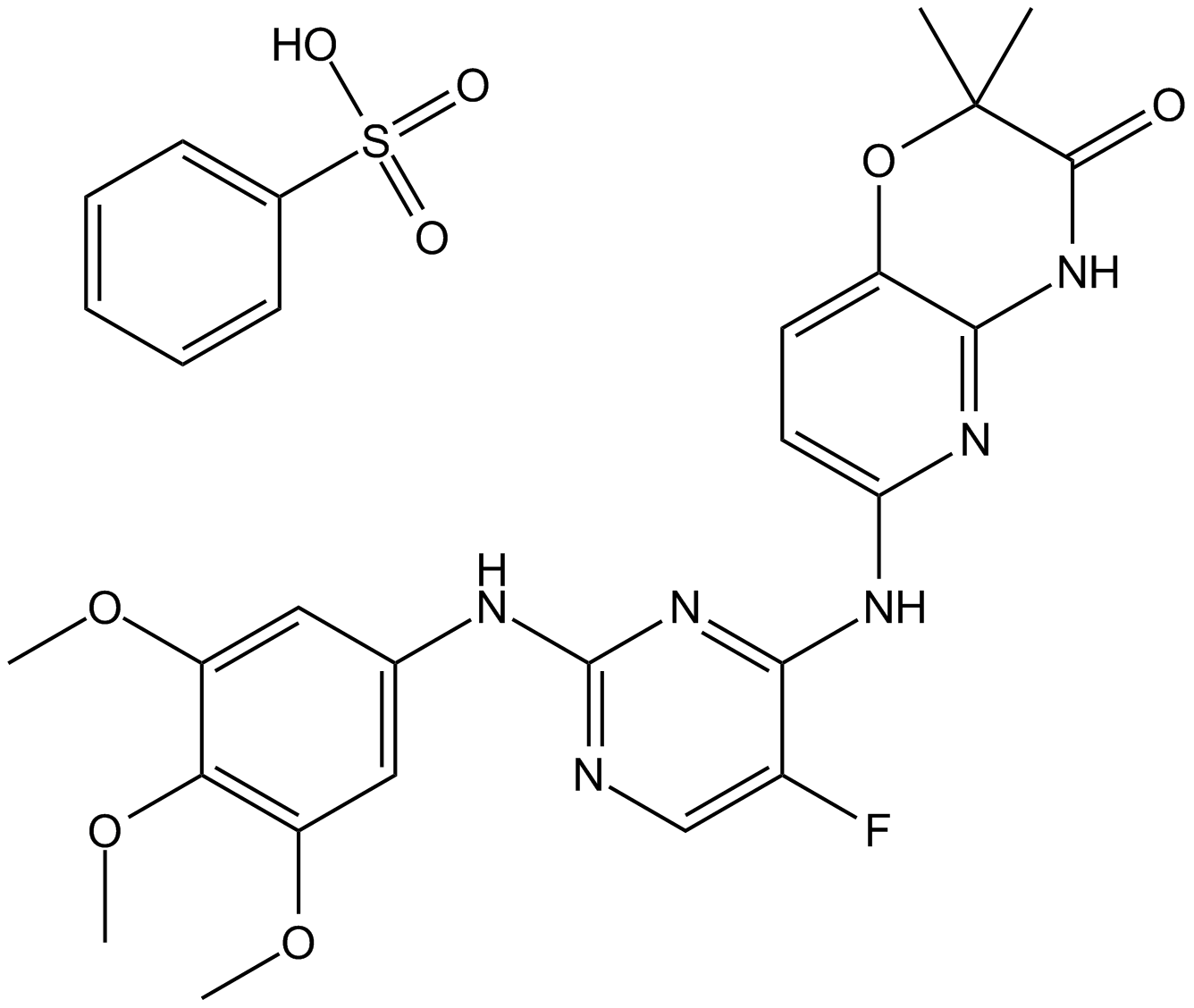
Cas No.: 841290-81-1
Sample solution is provided at 25 µL, 10mM.
R406 is an orally available spleen tyrosine kinase (Syk) inhibitor with an IC50 value of 41nM and competitive inhibitor for ATP binding with a Ki of 30nM[1]. R406 also inhibits the isolated enzymes Lyn with IC50 value of 63nM and Lck with IC50 value of 37nM. Despite similar IC50 values on isolated kinases, R406 shows selectivity in cell-based assays[2].
In vitro, human diploid fibroblasts were treated with 1, 2, 5, 10 and 20μM of R406 for 24 hours in the growth media. R406 induced apoptotic cell death by inhibiting FAK and p38 activity as well as increasing ROS[3]. Two patient-derived glioma stem cell (GSC) lines, GSC-1 (Syk-positive) and GSC-2 (Syk-negative), were treated with 0.75–0.89μM R406 for 72h. R406 significantly inhibited neurosphere formation and triggered apoptosis in GSCs. R406 also induced a metabolic shift from glycolysis to oxidative phosphorylation (OXPHOS) and subsequently production of excess ROS in GSCs[4]. PBMC or purified T cells from chronic lymphocytic leukemia (CLL) patients were pretreated with R406 (0.1 or 1µM) for 30min and then activation markers, cell proliferation and chemotaxis assay were evaluated. R406 impaired the expression of activation markers and cytokine-secretion in response to TCR/CD3 stimulation on T cells. R406 also impaired T cell proliferation in response to TCR/CD3 and IL-15 stimulation and T cell migration in response to CCL21, CCL19 and CXCL12[5].
In vivo, streptozotocin (STZ) induced diabetic mellitus rat models were given with 5 and 10mg/kg/day R406, respectively via gavage administration for 12 consecutive weeks. R406 could ameliorate STZ induced pericyte loss, acellular capillary formation and retinal vascular leakage; exerted protective effect on blood–retinal barrier; attenuated retinal cell apoptosis; and enhanced retinal cell proliferation[6]. Mouse chronic migraine (CM) models were pretreated with R406 (5mg/kg) via intraperitoneal administration. R406 significantly ameliorated pain hypersensitivity in CM mice and decreased the protein levels of both CGRP and c-fos in the vicinity of trigeminal nucleus caudalis. R406 inhibited microglia activation and NLRP3 inflammasome at trigeminal nucleus caudalis sites, accompanied by a down-regulation of mature IL-1β expression[7].
References:
[1] Sylvia Braselmann, Boyle L D, Inoue T, et al. R406, an orally available spleen tyrosine kinase inhibitor blocks fc receptor signaling and reduces immune complex-mediated inflammation. J Pharmacol Exp Ther. 2006 Dec;319(3):998-1008.
[2] Hoon-Suk Cha, Taylor V, Zhao H R, et al. A novel spleen tyrosine kinase inhibitor blocks c-Jun N-terminal kinase-mediated gene expression in synoviocytes. J Pharmacol Exp Ther. 2006 May;317(2):571-8.
[3] Cho H J, Yang E J, Park J T, et al. Identification of SYK inhibitor, R406 as a novel senolytic agent. Aging (Albany NY). 2020 May 7;12(9):8221-8240.
[4] Sun S X, Xue D D, Chen Z J, et al. R406 elicits anti-Warburg effect via Syk-dependent and -independent mechanisms to trigger apoptosis in glioma stem cells. Cell Death Dis. 2019 May 1;10(5):358.
[5] Colado A, Almejún M B, Podaza E, et al. The kinase inhibitors R406 and GS-9973 impair T cell functions and macrophage-mediated anti-tumor activity of rituximab in chronic lymphocytic leukemia patients. Cancer Immunol Immunother. 2017 Apr;66(4):461-473.
[6] Su X, Sun Z H, Ren Q, et al. The effect of spleen tyrosine kinase inhibitor R406 on diabetic retinopathy in experimental diabetic rats. Int Ophthalmol. 2020 Sep;40(9):2371-2383.
[7] Fan Z Z, Su D D, Li Z C, et al. Metformin attenuates central sensitization by regulating neuroinflammation through the TREM2-SYK signaling pathway in a mouse model of chronic migraine. J Neuroinflammation. 2024 Dec 3;21(1):318.
| Cell experiment [1]: | |
Cell lines | Human diploid fibroblasts |
Preparation Method | Cells were seeded in the 24-well plate and respectively treated with 1, 2, 5, 10 and 20μM of R406 for 24 hours in the growth media. |
Reaction Conditions | 1, 2, 5, 10, 20μM; 24h |
Applications | R406 induced apoptotic cell death by inhibiting FAK and p38 activity as well as increasing ROS. |
| Animal experiment [2]: | |
Animal models | Male Wistar rats |
Preparation Method | Rats were randomized into Normal, diabetic mellitus (DM), DM with 5mg/kg R406 and DM with 10mg/kg R406 groups. DM rats were established via injection of streptozotocin (STZ). One week after model establishment, rats in treatment groups received 5mg/kg or 10mg/kg R406 by gavage administration for 12 weeks consecutively. |
Dosage form | 5 or 10mg/kg; gavage administration; daily for 12 weeks. |
Applications | R406 could ameliorate STZ induced pericyte loss, acellular capillary formation and retinal vascular leakage; exerted protective effect on blood–retinal barrier; attenuate retinal cell apoptosis; and enhanced retinal cell proliferation. |
References: | |
| Cas No. | 841290-81-1 | SDF | |
| Chemical Name | benzenesulfonic acid;6-[[5-fluoro-2-(3,4,5-trimethoxyanilino)pyrimidin-4-yl]amino]-2,2-dimethyl-4H-pyrido[3,2-b][1,4]oxazin-3-one | ||
| Canonical SMILES | CC1(C(=O)NC2=C(O1)C=CC(=N2)NC3=NC(=NC=C3F)NC4=CC(=C(C(=C4)OC)OC)OC)C.C1=CC=C(C=C1)S(=O)(=O)O | ||
| Formula | C22H23FN6O5.C6H6O3S | M.Wt | 628.63 |
| Solubility | ≥ 31.45mg/mL in DMSO | Storage | Store at -20°C |
| General tips | Please select the appropriate solvent to prepare the stock solution according to the
solubility of the product in different solvents; once the solution is prepared, please store it in
separate packages to avoid product failure caused by repeated freezing and thawing.Storage method
and period of the stock solution: When stored at -80°C, please use it within 6 months; when stored
at -20°C, please use it within 1 month. To increase solubility, heat the tube to 37°C and then oscillate in an ultrasonic bath for some time. |
||
| Shipping Condition | Evaluation sample solution: shipped with blue ice. All other sizes available: with RT, or with Blue Ice upon request. | ||
| Prepare stock solution | |||

|
1 mg | 5 mg | 10 mg |
| 1 mM | 1.5908 mL | 7.9538 mL | 15.9076 mL |
| 5 mM | 318.2 μL | 1.5908 mL | 3.1815 mL |
| 10 mM | 159.1 μL | 795.4 μL | 1.5908 mL |
Step 1: Enter information below (Recommended: An additional animal making an allowance for loss during the experiment)
 g
μL
g
μL
Step 2: Enter the in vivo formulation (This is only the calculator, not formulation. Please contact us first if there is no in vivo formulation at the solubility Section.)
Calculation results:
Working concentration: mg/ml;
Method for preparing DMSO master liquid: mg drug pre-dissolved in μL DMSO ( Master liquid concentration mg/mL, Please contact us first if the concentration exceeds the DMSO solubility of the batch of drug. )
Method for preparing in vivo formulation: Take μL DMSO master liquid, next addμL PEG300, mix and clarify, next addμL Tween 80, mix and clarify, next add μL saline, mix and clarify.
Method for preparing in vivo formulation: Take μL DMSO master liquid, next add μL Corn oil, mix and clarify.
Note: 1. Please make sure the liquid is clear before adding the next solvent.
2. Be sure to add the solvent(s) in order. You must ensure that the solution obtained, in the previous addition, is a clear solution before proceeding to add the next solvent. Physical methods such as vortex, ultrasound or hot water bath can be used to aid dissolving.
3. All of the above co-solvents are available for purchase on the GlpBio website.
Quality Control & SDS
- View current batch:
- Purity: >98.00% Appearance: A solid
- COA (Certificate of Analysis)
- SDS (Safety Data Sheet)
- Datasheet
Average Rating: 5 (Based on Reviews and 33 reference(s) in Google Scholar.)