

L-(-)-threo-3-Hydroxyaspartic acid |
Catalog No.GC17646
 One-Click Copy Product Info
|

L-(-)-threo-3-Hydroxyaspartic acid is a naturally occurring amino acid derivative with a specific stereochemical configuration. L-(-)-threo-3-Hydroxyaspartic acid is a selective agonist for glutamate receptors, particularly the NMDA receptor.
Products are for research use only. Not for human use. We do not sell to patients.
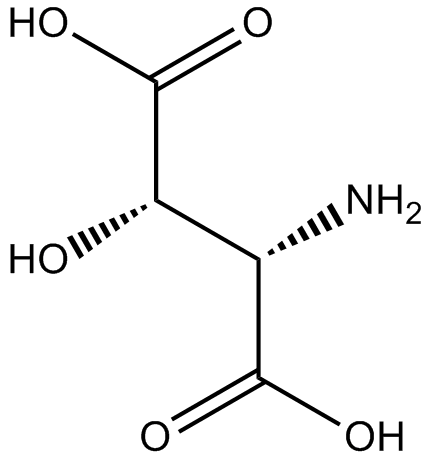
Cas No.: 7298-99-9
Sample solution is provided at 25 µL, 10mM.
_1-3.$$$39978408@51.jpg');)
_1-9.$$$38538795@65.jpg');)
_1-9.$$$39112701@51.jpg');)
_1-7.$$$37316672@70.jpg');)
_366-372.$$$36198801@70.jpg');)
.$$$38565142@65.jpg');)
_1867-1883.$$$33248023@67.jpg');)
_eads6055.$$$39977546@45.jpg');)
_eadm9805.$$$40080571@45.jpg');)
_eadj3020.$$$39666821@45.jpg');)
_1-20.$$$39757301@28.jpg');)
_1-24.$$$38898113@28.jpg');)
_273-287.$$$36806353@46.jpg');)
_1-16.$$$37156877@44.jpg');)
_1-19.$$$37460805@44.jpg');)
_1291-1307.$$$34518654@46.jpg');)
L-(-)-threo-3-Hydroxyaspartic acid is a naturally occurring amino acid derivative with a specific stereochemical configuration. L-(-)-threo-3-Hydroxyaspartic acid is a selective agonist for glutamate receptors, particularly the NMDA receptor[1-2]. L-(-)-threo-3-Hydroxyaspartic acid is primarily used in neuroscience research as a tool compound for studying glutamatergic neurotransmission and receptor pharmacology[3-4].
In vitro, when Xenopus oocytes expressing EAAT4 were incubated with L-(-)-threo-3-Hydroxyaspartic acid (100μM). L-(-)-threo-3-Hydroxyaspartic acid competed with L-aspartate for binding to EAAT4 and induced an inward current[5]. L-(-)-threo-3-Hydroxyaspartic acid (100μM) was directly applied to migrating human U87MG glioma cells on Matrigel for 15 minutes. L-(-)-threo-3-Hydroxyaspartic acid increased the oscillation frequency of cells with spontaneous calcium oscillations and induced calcium oscillations in previously quiescent cells[6].
In vivo, L-(-)-threo-3-Hydroxyaspartic acid (833μM; 0.3±0.1µl) was locally injected into the substantia nigra pars compacta of rats three times a week for three weeks (a total of 9 injections). L-(-)-threo-3-Hydroxyaspartic acid resulting in morphological damage to neurons in the substantia nigra pars compacta[7]. L-(-)-threo-3-Hydroxyaspartic acid (100μM) was locally applied via pressure ejection (50ms pulses) from a glass micropipette near parenchymal arterioles in the somatosensory cortex of anesthetized C57BL/6J mice while monitoring changes in vascular diameter. L-(-)-threo-3-Hydroxyaspartic acid significantly increased arteriole diameter, mimicking the neurovascular coupling response[8].
References:
[1] Hara R, Nakano M, Kino K. One-Pot Production of L-threo-3-Hydroxyaspartic Acid Using Asparaginase-Deficient Escherichia coli Expressing Asparagine Hydroxylase of Streptomyces coelicolor A3(2). Appl Environ Microbiol. 2015 Jun;81(11):3648-54.
[2] Munir M, Correale DM, Robinson MB. Substrate-induced up-regulation of Na(+)-dependent glutamate transport activity. Neurochem Int. 2000 Aug-Sep;37(2-3):147-62.
[3] Jensen AA, Bräuner-Osborne H. Pharmacological characterization of human excitatory amino acid transporters EAAT1, EAAT2 and EAAT3 in a fluorescence-based membrane potential assay. Biochem Pharmacol. 2004 Jun 1;67(11):2115-27.
[4] Wang Z, Li W, Mitchell CK, et al. Activation of protein kinase C reduces GLAST in the plasma membrane of rat Müller cells in primary culture. Vis Neurosci. 2003 Nov-Dec;20(6):611-9.
[5] Shigeri Y, Shimamoto K, Yasuda-Kamatani Y, et al. Effects of threo-beta-hydroxyaspartate derivatives on excitatory amino acid transporters (EAAT4 and EAAT5). J Neurochem. 2001 Oct;79(2):297-302.
[6] Hamadi A, Giannone G, Takeda K, et al. Glutamate involvement in calcium-dependent migration of astrocytoma cells. Cancer Cell Int. 2014 May 19;14:42.
[7] Loopuijt LD. Local application of L- threo-hydroxyaspartate and malonate in rats in vivo induces rigidity and damages neurons of the substantia nigra, pars compacta. J Neural Transm (Vienna). 2002 Oct;109(10):1275-94.
[8] Jackson JG, Krizman E, Takano H, et al, Activation of Glutamate Transport Increases Arteriole Diameter in vivo: Implications for Neurovascular Coupling. Front Cell Neurosci. 2022 Mar 4;16:831061.
| Cell experiment [1]: | |
Cell lines | Human U87MG astrocytoma/glioma cells |
Preparation Method | U87MG cells were maintained in EMEM supplemented with 10% heat-inactivated fetal calf serum (FCS) at 37°C, 5% CO₂. For migration and calcium imaging assays, cells were plated on Matrigel-coated dishes or coverslips. For calcium measurements, cells were loaded with the fluorescent Ca²⁺ indicator Oregon Green 488 BAPTA-1 AM for 45 minutes prior to imaging. The glutamate reuptake inhibitor L-(-)-threo-3-Hydroxyaspartic acid (100μM) was added during the imaging period. |
Reaction Conditions | 100μM; 15min. |
Applications | L-(-)-threo-3-Hydroxyaspartic acid increased the frequency of spontaneous, migration-associated intracellular Ca²⁺ oscillations in oscillating cells and induced Ca²⁺ oscillations in previously quiescent cells. This enhancement of Ca²⁺ signaling contributes to the glutamate-mediated autocrine loop that promotes the migration of astrocytoma cells. |
| Animal experiment [2]: | |
Animal models | Male Sprague-Dawley rats |
Preparation Method | Rats were anesthetized and stereotactically implanted with bilateral guide cannulas above the substantia nigra, pars compacta (SNc). A solution containing either L-(-)-threo-3-Hydroxyaspartic acid alone, L-(-)-threo-3-Hydroxyaspartic acid plus malonate, or vehicle was bilaterally pressure-injected (0.3 ± 0.1 µl over 1 minute) directly into the brain tissue near the SNc. Injections were administered 3 times a week for a total of 9 times over three weeks. Behavior (rigidity, catalepsy, locomotion) was assessed 24 hours after injections. After the treatment period, the rats were sacrificed, and their brains were processed for histological analysis of the SNc. |
Dosage form | 833µM in 0.3 ± 0.1µl; Local pressure injection into the brain; 9 injections over 3 weeks. |
Applications | Local injection of L-(-)-threo-3-Hydroxyaspartic acid plus the mitochondrial inhibitor malonate induced a transient, mild rigidity in rats. The combination treatment resulted in more extensive neuronal damage in the ventral part of the SNc compared to L-(-)-threo-3-Hydroxyaspartic acid treatment alone. The observed neuronal damage was characterized by shrunken nucleoli and faintly stained cytoplasm in the affected neurons, indicating morphological and functional impairment, which may underlie the rigidity behavior. |
References: | |
| Cas No. | 7298-99-9 | SDF | |
| Chemical Name | (2S,3S)-2-amino-3-hydroxysuccinic acid | ||
| Canonical SMILES | O[C@H](C(O)=O)[C@@H](C(O)=O)N | ||
| Formula | C4H7NO5 | M.Wt | 149.1 |
| Solubility | Soluble to 100 mM in 1eq. NaOH | Storage | Store at -20°C |
| General tips | Please select the appropriate solvent to prepare the stock solution according to the
solubility of the product in different solvents; once the solution is prepared, please store it in
separate packages to avoid product failure caused by repeated freezing and thawing.Storage method
and period of the stock solution: When stored at -80°C, please use it within 6 months; when stored
at -20°C, please use it within 1 month. To increase solubility, heat the tube to 37°C and then oscillate in an ultrasonic bath for some time. |
||
| Shipping Condition | Evaluation sample solution: shipped with blue ice. All other sizes available: with RT, or with Blue Ice upon request. | ||
| Prepare stock solution | |||

|
1 mg | 5 mg | 10 mg |
| 1 mM | 6.7069 mL | 33.5345 mL | 67.0691 mL |
| 5 mM | 1.3414 mL | 6.7069 mL | 13.4138 mL |
| 10 mM | 670.7 μL | 3.3535 mL | 6.7069 mL |
Step 1: Enter information below (Recommended: An additional animal making an allowance for loss during the experiment)
 g
μL
g
μL
Step 2: Enter the in vivo formulation (This is only the calculator, not formulation. Please contact us first if there is no in vivo formulation at the solubility Section.)
Calculation results:
Working concentration: mg/ml;
Method for preparing DMSO master liquid: mg drug pre-dissolved in μL DMSO ( Master liquid concentration mg/mL, Please contact us first if the concentration exceeds the DMSO solubility of the batch of drug. )
Method for preparing in vivo formulation: Take μL DMSO master liquid, next addμL PEG300, mix and clarify, next addμL Tween 80, mix and clarify, next add μL saline, mix and clarify.
Method for preparing in vivo formulation: Take μL DMSO master liquid, next add μL Corn oil, mix and clarify.
Note: 1. Please make sure the liquid is clear before adding the next solvent.
2. Be sure to add the solvent(s) in order. You must ensure that the solution obtained, in the previous addition, is a clear solution before proceeding to add the next solvent. Physical methods such as vortex, ultrasound or hot water bath can be used to aid dissolving.
3. All of the above co-solvents are available for purchase on the GlpBio website.
Quality Control & SDS
- View current batch:
- Purity: >98.00% Appearance: A solid
- COA (Certificate of Analysis)
- SDS (Safety Data Sheet)
- Datasheet
Average Rating: 5 (Based on Reviews and 10 reference(s) in Google Scholar.)