

Lamivudine (Synonyms: (-)-BCH 189, 3TC, 2’,3’-dideoxy-3’-Thiacytidine) |
Catalog No.GC10317
 One-Click Copy Product Info
|

Lamivudine is an oral nucleoside analogue, which acts as the nucleoside reverse transcriptase inhibitor, with an EC50 of 0.07±0.02μg/ml for anti-hepatitis B virus (HBV) activity.
Products are for research use only. Not for human use. We do not sell to patients.
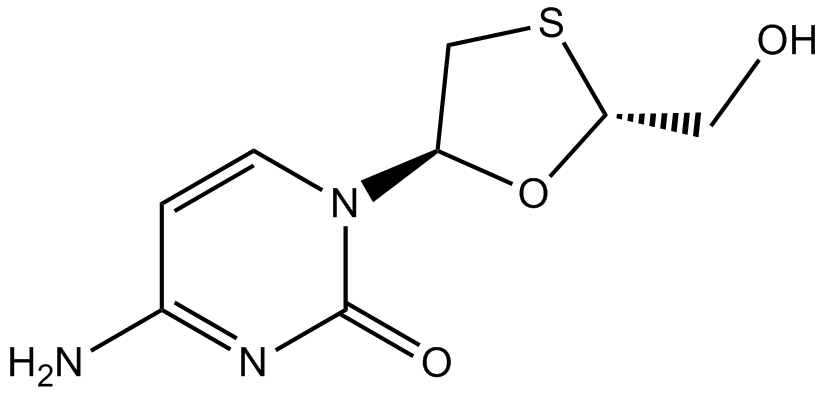
Cas No.: 134678-17-4
Sample solution is provided at 25 µL, 10mM.
_1-3.$$$39978408@51.jpg');)
_1-9.$$$38538795@65.jpg');)
_1-9.$$$39112701@51.jpg');)
_1-7.$$$37316672@70.jpg');)
_366-372.$$$36198801@70.jpg');)
.$$$38565142@65.jpg');)
_1867-1883.$$$33248023@67.jpg');)
_eads6055.$$$39977546@45.jpg');)
_eadm9805.$$$40080571@45.jpg');)
_eadj3020.$$$39666821@45.jpg');)
_1-20.$$$39757301@28.jpg');)
_1-24.$$$38898113@28.jpg');)
_273-287.$$$36806353@46.jpg');)
_1-16.$$$37156877@44.jpg');)
_1-19.$$$37460805@44.jpg');)
_1291-1307.$$$34518654@46.jpg');)
Lamivudine is an oral nucleoside analogue, which acts as the nucleoside reverse transcriptase inhibitor, with an EC50 of 0.07±0.02μg/ml for anti-hepatitis B virus (HBV) activity[1]. Lamivudine undergoes anabolic phosphorylation by intracellular kinases to form Lamivudine 5′-triphosphate, the active anabolite which prevents HIV-1 and HBV replication by competitively inhibiting viral reverse transcriptase and terminating proviral DNA chain extension [2]. Lamivudine has been used in viral and antitumor studies in various cell and animal models[3].
In vitro, Lamivudine treatment at 300μM in HepG2.2.15 cells for 72 hours significantly reduced the expression of MMP-9, HBsAg, HBeAg, and inhibited the replication of HBV[4]. Treatment of 4μg/ml Lamivudine for 6 days significantly inhibted SDAU1005 virus replication in chick embryo fibroblasts (CEFs) without affecting cell viability[5]. Lamivudine treatment with 500μM for 8 days can stimulate the proliferation of dendritic cells (DC) derived from patients with chronic hepatitis B (CHB), promote the secretion of IL-12 and IL-6, and restore cellular immune function[6].
In vivo, Lamivudine treatment via daily gastric infusion (100mg/kg) in senescence-accelerated mouse prone 8 (SAMP8) mice for 4 weeks significantly improved the ageing status of the mice and alleviated the decline in cognitive ability[7]. Oral administration of 2mg/kg Lamivudine daily for one week reduced the severity of gastric ulcers in a mouse model of ethanol-induced gastric ulcers, and improved the histological features of the gastric mucosa and maintained the integrity of the gastric mucosal barrier[8].
References:
[1] Ying, Clercq D, Neyts. Lamivudine, adefovir and tenofovir exhibit long‐lasting anti‐hepatitis B virus activity in cell culture[J]. Journal of viral hepatitis, 2000, 7(1): 79-83.
[2] Perry C M, Faulds D. Lamivudine: a review of its antiviral activity, pharmacokinetic properties and therapeutic efficacy in the management of HIV infection[J]. Drugs, 1997, 53(4): 657-680.
[3] Johnson M A, Moore K H P, Yuen G J, et al. Clinical pharmacokinetics of lamivudine[J]. Clinical pharmacokinetics, 1999, 36(1): 41-66.
[4] Zhang J, Yu H, Sun F Y, et al. Effects of lamivudine on cell proliferation of liver cancer and expressions of HBsAg, HBeAg, and MMP-9 in patients[J]. Eur. Rev. Med. Pharmacol. Sci, 2019, 23: 9093-9098.
[5] Wang Y, Xu S, Li S, et al. Lamivudine inhibits the replication of ALV-J associated acutely transforming virus and its helper virus and tumor growth in vitro and in vivo[J]. Frontiers in Microbiology, 2015, 6: 1306.
[6] Zheng P Y, Zhang D Y, Lu G F, et al. Effects of lamivudine on the function of dendritic cells derived from patients with chronic hepatitis B virus infection[J]. World Journal of Gastroenterology: WJG, 2007, 13(34): 4641.
[7] Li M, Zhao J, Tang Q, et al. Lamivudine improves cognitive decline in SAMP8 mice: Integrating in vivo pharmacological evaluation and network pharmacology[J]. Journal of Cellular and Molecular Medicine, 2021, 25(17): 8490-8503.
[8] Meng X, Liu J, Kang J, et al. Lamivudine protects mice from gastric ulcer by activating PGK1 to suppress ferroptosis[J]. Biochemical Pharmacology, 2024, 227: 116440.
| Cell experiment [1]: | |
Cell lines | HepG2.2.15 cells |
Preparation Method | The HepG2.2.15 cells were cultured with a culture solution of 10% fetal bovine serum in a 37°C incubator with 5% CO2 concentration. They were washed with PBS after 85% of the cells were attached. Then the cells were digested with 1ml of 25% trypsin, and cultured with a concentration of 10% in a culture solution for 48h at 37°C with 5% CO2 concentration for subculture. The cells and supernatants were collected after 72h of Lamivudine intervention (100, 200, and 300μM). The cells were digested with trypsin and centrifuged at 8000r/min for 3min. The supernatant was then discarded, and the cells were collected and resuspended with 200μL of PBS before the detection. The MMP-9, HBsAg, and HBeAg levels were detected using ELISA method. |
Reaction Conditions | 100, 200, and 300μM; 72h |
Applications | Lamivudine treatment significantly inhibited the MMP-9, HBsAg, and HBeAg levels in dose-dependent manner within HepG2.2.15 cells. |
| Animal experiment [2]: | |
Animal models | Kunming mice |
Preparation Method | Healthy male Kunming mice, 4 weeks old (20±2g), were housed in appropriate cages and allowed to adapt to the laboratory environment for one week. The environmental temperature was maintained at 25°C, and the daily light-dark cycle was 12 hours. The animals had free access to water and standard feed pellets. The mice were randomly divided into 4 groups (n = 8). The control group (Control) and the ethanol group (Ethanol) were given 0.9% physiological saline (1mL/100g/day); the positive drug group (CIM) was orally administered cimetidine (80mg/kg/day); the Lamivudine group was orally administered 2mg/kg/day of Lamivudine. The mice were treated continuously for 1 week. Approximately 2 hours after the last administration, the mice were fasted for 24 hours without restricting water intake. The mice in the ethanol group, the ethanol + CIM group, and the ethanol + Lamivudine (2mg/kg) group (1mL/100g body weight) were intragastrically administered anhydrous ethanol. Meanwhile, the remaining mice were intragastrically administered the same volume of physiological saline. 2 hours later, the mice were dislocated at the cervical vertebra and sacrificed, and the gastric tissues were collected for further biochemical and histopathological examinations. |
Dosage form | 2mg/kg/day for 7 days; p.o. |
Applications | Lamivudine treatment improved histopathological features of gastric mucosa in mice under ethanol stress. |
References: | |
| Cas No. | 134678-17-4 | SDF | |
| Synonyms | (-)-BCH 189, 3TC, 2’,3’-dideoxy-3’-Thiacytidine | ||
| Chemical Name | 4-amino-1-[(2R,5S)-2-(hydroxymethyl)-1,3-oxathiolan-5-yl]pyrimidin-2-one | ||
| Canonical SMILES | C1C(OC(S1)CO)N2C=CC(=NC2=O)N | ||
| Formula | C8H11N3O3S | M.Wt | 229.26 |
| Solubility | ≥ 10.5mg/mL in DMSO | Storage | Store at -20°C |
| General tips | Please select the appropriate solvent to prepare the stock solution according to the
solubility of the product in different solvents; once the solution is prepared, please store it in
separate packages to avoid product failure caused by repeated freezing and thawing.Storage method
and period of the stock solution: When stored at -80°C, please use it within 6 months; when stored
at -20°C, please use it within 1 month. To increase solubility, heat the tube to 37°C and then oscillate in an ultrasonic bath for some time. |
||
| Shipping Condition | Evaluation sample solution: shipped with blue ice. All other sizes available: with RT, or with Blue Ice upon request. | ||
| Prepare stock solution | |||

|
1 mg | 5 mg | 10 mg |
| 1 mM | 4.3619 mL | 21.8093 mL | 43.6186 mL |
| 5 mM | 872.4 μL | 4.3619 mL | 8.7237 mL |
| 10 mM | 436.2 μL | 2.1809 mL | 4.3619 mL |
Step 1: Enter information below (Recommended: An additional animal making an allowance for loss during the experiment)
 g
μL
g
μL
Step 2: Enter the in vivo formulation (This is only the calculator, not formulation. Please contact us first if there is no in vivo formulation at the solubility Section.)
Calculation results:
Working concentration: mg/ml;
Method for preparing DMSO master liquid: mg drug pre-dissolved in μL DMSO ( Master liquid concentration mg/mL, Please contact us first if the concentration exceeds the DMSO solubility of the batch of drug. )
Method for preparing in vivo formulation: Take μL DMSO master liquid, next addμL PEG300, mix and clarify, next addμL Tween 80, mix and clarify, next add μL saline, mix and clarify.
Method for preparing in vivo formulation: Take μL DMSO master liquid, next add μL Corn oil, mix and clarify.
Note: 1. Please make sure the liquid is clear before adding the next solvent.
2. Be sure to add the solvent(s) in order. You must ensure that the solution obtained, in the previous addition, is a clear solution before proceeding to add the next solvent. Physical methods such as vortex, ultrasound or hot water bath can be used to aid dissolving.
3. All of the above co-solvents are available for purchase on the GlpBio website.
Quality Control & SDS
- View current batch:
- Purity: >98.00% Appearance: A solid
- COA (Certificate of Analysis)
- SDS (Safety Data Sheet)
- Datasheet
Average Rating: 5 (Based on Reviews and 19 reference(s) in Google Scholar.)