

Lomitapide (Synonyms: AEGR 773, BMS 201038) |
Catalog No.GC16870
 One-Click Copy Product Info
|

Lomitapide is an inhibitor of microsomal triglyceride transfer protein (MTTP), with an IC50 value of 8nM.
Products are for research use only. Not for human use. We do not sell to patients.
Cas No.: 182431-12-5
Sample solution is provided at 25 µL, 10mM.
_1-3.$$$39978408@51.jpg');)
_1-9.$$$38538795@65.jpg');)
_1-9.$$$39112701@51.jpg');)
_1-7.$$$37316672@70.jpg');)
_366-372.$$$36198801@70.jpg');)
.$$$38565142@65.jpg');)
_1867-1883.$$$33248023@67.jpg');)
_eads6055.$$$39977546@45.jpg');)
_eadm9805.$$$40080571@45.jpg');)
_eadj3020.$$$39666821@45.jpg');)
_1-20.$$$39757301@28.jpg');)
_1-24.$$$38898113@28.jpg');)
_273-287.$$$36806353@46.jpg');)
_1-16.$$$37156877@44.jpg');)
_1-19.$$$37460805@44.jpg');)
_1291-1307.$$$34518654@46.jpg');)
Lomitapide is an inhibitor of microsomal triglyceride transfer protein (MTTP), with an IC50 value of 8nM[1]. Lomitapide targets MTTP to block the assembly of apolipoprotein B (Apo B) lipoproteins in the liver and gut[2]. Lomitapide has been widely used as an anticancer agent to inhibit tumor growth and to develop novel combination therapies[3].
In vitro, Lomitapide significantly inhibited the proliferation of SW1990, AsPC-1 and BxPC-3 cells after 72 hours of treatment, with IC50 values of 5.689μM, 7.293μM and 6.962μM, respectively[4]. Treatment with 2.5μM Lomitapide for 48 hours significantly inhibited the viability of HCT116 cells, resulting in a decrease in intracellular ATP levels and an increase in ROS levels, and promoting autophagy in the cells[5]. Treatment with 2μM Lomitapide for 24 hours significantly reduced the permeability of the outer mitochondrial membrane in multiple myeloma (MM) cells and induced mitochondrial dysfunction[6].
In vivo, Lomitapide treatment via intraperitoneal injection at a dose of 20mg/kg (every other day for 10 days) significantly reduced HCT116 xenograft growth in mice without affecting body weight[7]. Oral administration of 0.5mg/kg of Lomitapide daily for 14 consecutive days can improve the neurological recovery of mice with middle cerebral artery occlusion (MCAO) and reduce the loss of neural tissue[8].
References:
[1] Sulsky R, Robl J A, Biller S A, et al. 5-Carboxamido-1, 3, 2-dioxaphosphorinanes, potent inhibitors of MTP[J]. Bioorganic & medicinal chemistry letters, 2004, 14(20): 5067-5070.
[2] Wu H T, Wu B X, Fang Z X, et al. Lomitapide repurposing for treatment of malignancies: A promising direction[J]. Heliyon, 2024, 10(12).
[3] Ivanova A, Wilson T M, Ghannad-Zadeh K, et al. Lomitapide enhances cytotoxic effects of temozolomide in chemotherapy-resistant glioblastoma[J]. JCI insight, 2025, 10(17): e186703.
[4] Wang Y, Zhang S, He H, et al. Repositioning Lomitapide to block ZDHHC5-dependant palmitoylation on SSTR5 leads to anti-proliferation effect in preclinical pancreatic cancer models[J]. Cell death discovery, 2023, 9(1): 60.
[5] Zuo Q, Liao L, Yao Z T, et al. Targeting PP2A with lomitapide suppresses colorectal tumorigenesis through the activation of AMPK/Beclin1-mediated autophagy[J]. Cancer Letters, 2021, 521: 281-293.
[6] Zhang H, Wang H, Hu Y, et al. Targeting PARP14 with lomitapide suppresses drug resistance through the activation of DRP1-induced mitophagy in multiple myeloma[J]. Cancer Letters, 2024, 588: 216802.
[7] Lee B, Park S J, Lee S, et al. Lomitapide, a cholesterol-lowering drug, is an anticancer agent that induces autophagic cell death via inhibiting mTOR[J]. Cell death & disease, 2022, 13(7): 603.
[8] Zheng Y, Hu Y, Han Z, et al. Lomitapide ameliorates middle cerebral artery occlusion‐induced cerebral ischemia/reperfusion injury by promoting neuronal autophagy and inhibiting microglial migration[J]. CNS neuroscience & therapeutics, 2022, 28(12): 2183-2194.
| Cell experiment [1]: | |
Cell lines | HCT116 cells |
Preparation Method | HCT116 cells were cultured in DMEM medium supplemented with 10% fetal bovine serum and penicillin/streptomycin, and were placed in a incubator at 37°C and 5% CO2. The cells were exposed to the specified concentrations of Lomitapide (0, 1.25, 2.5, 5, and 10μM) for 24 hours, 48 hours and 72 hours. Add the WST-1 reagent and measure the absorbance value at a wavelength of 490nm. |
Reaction Conditions | 0, 1.25, 2.5, 5, and 10μM; 24, 48, and 72h |
Applications | Lomitapide treatment inhibited the cell viability of H1299 cells in a dose and time-dependent manner. |
| Animal experiment [2]: | |
Animal models | Male BALB/c nude mice |
Preparation Method | HCT116 cells (2×10⁶) were subcutaneously injected into 6-8 weeks old male BALB/c nude mice. When the average tumor volume reached 50mm3, the mice were randomly divided into two groups (n=6 each). The body weight and tumor diameter of the mice were measured every other day. Tumor volume was measured using a vernier caliper, and tumor volume was calculated according to the formula 0.5×(width)2×(length). Lomitapide treatment groups received 20mg/kg Lomitapide intraperitoneally for 10 days at 2-day intervals, and tumor tissues from mice were collected for analysis. |
Dosage form | 20mg/kg; every other day for 10 days; i.p. |
Applications | Lomitapide treatment significantly reduced tumor xenograft growth in mice without affecting body weight. |
References: | |
| Cas No. | 182431-12-5 | SDF | |
| Synonyms | AEGR 773, BMS 201038 | ||
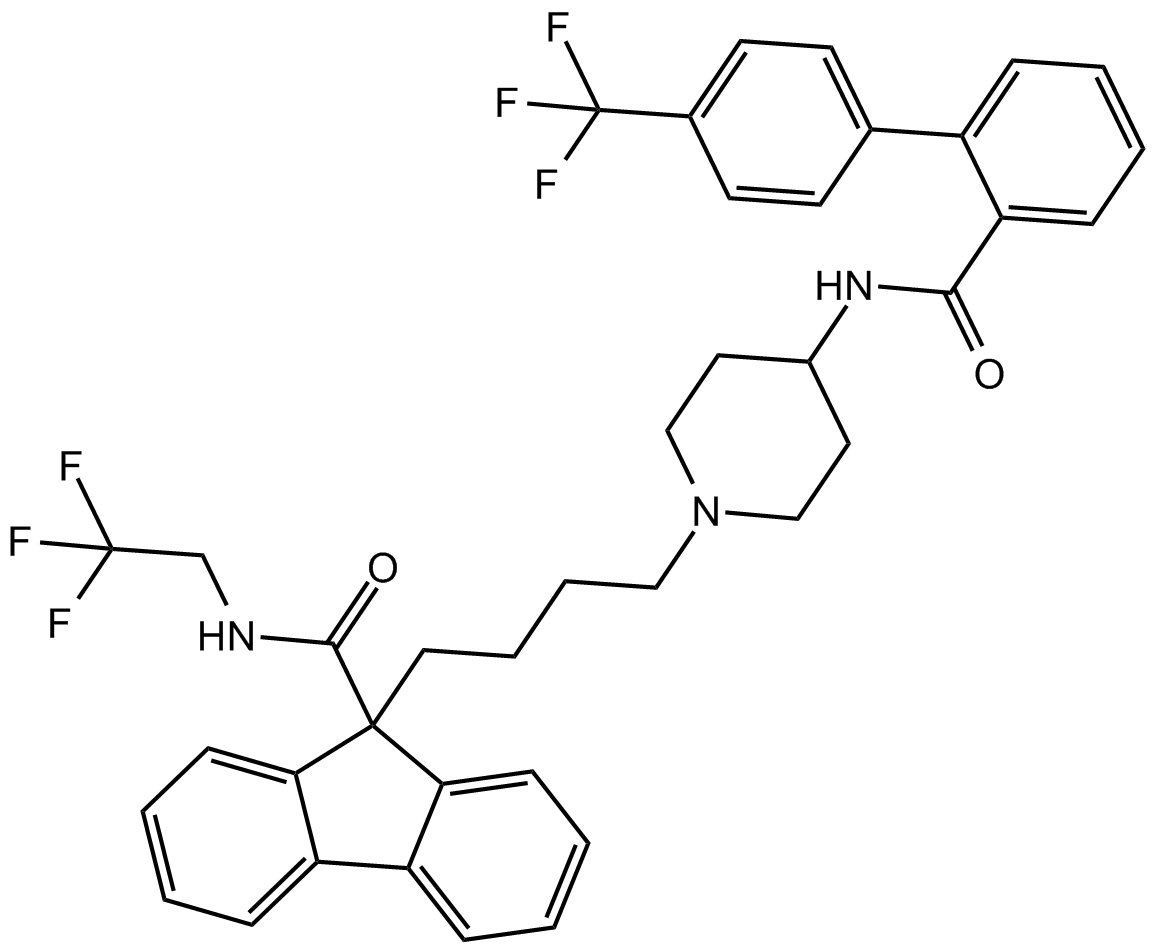
| Chemical Name | N-(2,2,2-trifluoroethyl)-9-[4-[4-[[2-[4-(trifluoromethyl)phenyl]benzoyl]amino]piperidin-1-yl]butyl]fluorene-9-carboxamide | ||
| Canonical SMILES | C1CN(CCC1NC(=O)C2=CC=CC=C2C3=CC=C(C=C3)C(F)(F)F)CCCCC4(C5=CC=CC=C5C6=CC=CC=C64)C(=O)NCC(F)(F)F | ||
| Formula | C39H37F6N3O2 | M.Wt | 692.71 |
| Solubility | ≥ 22.4mg/mL in DMSO | Storage | Store at -20°C, protect from light |
| General tips | Please select the appropriate solvent to prepare the stock solution according to the
solubility of the product in different solvents; once the solution is prepared, please store it in
separate packages to avoid product failure caused by repeated freezing and thawing.Storage method
and period of the stock solution: When stored at -80°C, please use it within 6 months; when stored
at -20°C, please use it within 1 month. To increase solubility, heat the tube to 37°C and then oscillate in an ultrasonic bath for some time. |
||
| Shipping Condition | Evaluation sample solution: shipped with blue ice. All other sizes available: with RT, or with Blue Ice upon request. | ||
| Prepare stock solution | |||

|
1 mg | 5 mg | 10 mg |
| 1 mM | 1.4436 mL | 7.218 mL | 14.4361 mL |
| 5 mM | 288.7 μL | 1.4436 mL | 2.8872 mL |
| 10 mM | 144.4 μL | 721.8 μL | 1.4436 mL |
Step 1: Enter information below (Recommended: An additional animal making an allowance for loss during the experiment)
 g
μL
g
μL
Step 2: Enter the in vivo formulation (This is only the calculator, not formulation. Please contact us first if there is no in vivo formulation at the solubility Section.)
Calculation results:
Working concentration: mg/ml;
Method for preparing DMSO master liquid: mg drug pre-dissolved in μL DMSO ( Master liquid concentration mg/mL, Please contact us first if the concentration exceeds the DMSO solubility of the batch of drug. )
Method for preparing in vivo formulation: Take μL DMSO master liquid, next addμL PEG300, mix and clarify, next addμL Tween 80, mix and clarify, next add μL saline, mix and clarify.
Method for preparing in vivo formulation: Take μL DMSO master liquid, next add μL Corn oil, mix and clarify.
Note: 1. Please make sure the liquid is clear before adding the next solvent.
2. Be sure to add the solvent(s) in order. You must ensure that the solution obtained, in the previous addition, is a clear solution before proceeding to add the next solvent. Physical methods such as vortex, ultrasound or hot water bath can be used to aid dissolving.
3. All of the above co-solvents are available for purchase on the GlpBio website.
Quality Control & SDS
- View current batch:
- Purity: >99.50% Appearance: A solid
- COA (Certificate of Analysis)
- SDS (Safety Data Sheet)
- Datasheet
Average Rating: 5 (Based on Reviews and 24 reference(s) in Google Scholar.)