

MGL-3196 (Synonyms: Resmetirom, VIA-3196) |
Catalog No.GC18243
 One-Click Copy Product Info
|

MGL-3196 is a highly selective and orally active thyroid hormone receptor β (THRβ) agonist with an EC50 value of 0.21μM.
Products are for research use only. Not for human use. We do not sell to patients.
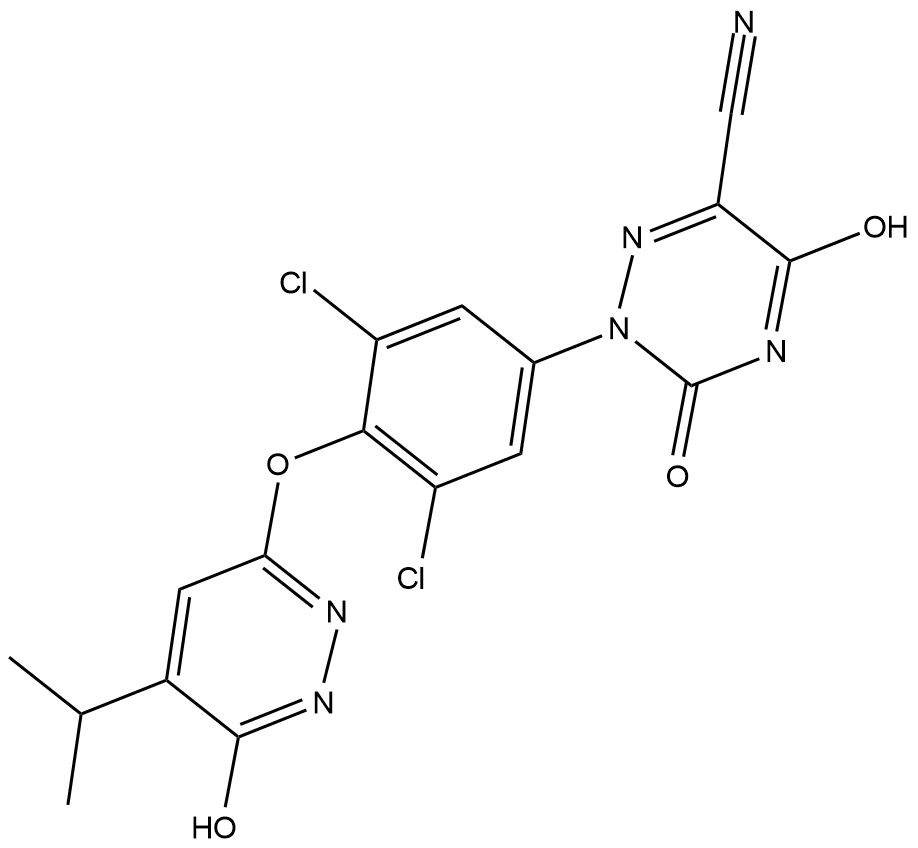
Cas No.: 920509-32-6
Sample solution is provided at 25 µL, 10mM.
_1-3.$$$39978408@51.jpg');)
_1-9.$$$38538795@65.jpg');)
_1-9.$$$39112701@51.jpg');)
_1-7.$$$37316672@70.jpg');)
_366-372.$$$36198801@70.jpg');)
.$$$38565142@65.jpg');)
_1867-1883.$$$33248023@67.jpg');)
_eads6055.$$$39977546@45.jpg');)
_eadm9805.$$$40080571@45.jpg');)
_eadj3020.$$$39666821@45.jpg');)
_1-20.$$$39757301@28.jpg');)
_1-24.$$$38898113@28.jpg');)
_273-287.$$$36806353@46.jpg');)
_1-16.$$$37156877@44.jpg');)
_1-19.$$$37460805@44.jpg');)
_1291-1307.$$$34518654@46.jpg');)
MGL-3196 is a highly selective and orally active thyroid hormone receptor β (THRβ) agonist with an EC50 value of 0.21μM[1]. THRβ is a nuclear receptor that plays a key role in regulating metabolism, growth, and development by binding to thyroid hormones and modulating gene expression[2]. MGL-3196 can be used for the study of nonalcoholic steatohepatitis and cardiovascular diseases[3][4].
In vitro, treatment of HEK-1B1 cells with MGL-3196 (6μM; 48h) significantly induced the expression of THRβ target genes like KLF9 and PCK1 and enhanced mitochondrial respiration[5].
In vivo, MGL-3196 (3mg/kg/day; gavage; 8 weeks) reduced liver weight, circulating triglycerides and total cholesterol, and improved histological signs of steatosis and fibrosis in SPF mice fed a MASH diet[6]. MGL-3196 (1mg/kg/day; orally; 8 weeks) significantly reduced liver weight, improved histological steatosis and lobular inflammation scores, and lowered plasma cholesterol and alanine transaminase (ALT) levels in a mouse model of fatty liver disease induced by the GAN diet[7].
References:
[1] Kelly MJ, Pietranico-Cole S, Larigan JD, et al. Discovery of 2-[3,5-dichloro-4-(5-isopropyl-6-oxo-1,6-dihydropyridazin-3-yloxy)phenyl]-3,5-dioxo-2,3,4,5-tetrahydro[1,2,4]triazine-6-carbonitrile (MGL-3196), a Highly Selective Thyroid Hormone Receptor β agonist in clinical trials for the treatment of dyslipidemia. J Med Chem. 2014;57(10):3912-3923.
[2] Mullur R, Liu YY, Brent GA. Thyroid hormone regulation of metabolism. Physiol Rev. 2014;94(2):355-382.
[3] Keam SJ. Resmetirom: First Approval. Drugs. 2024;84(6):729-735.
[4] Zisis M, Chondrogianni ME, Androutsakos T, et al. Linking Cardiovascular Disease and Metabolic Dysfunction-Associated Steatotic Liver Disease (MASLD): The Role of Cardiometabolic Drugs in MASLD Treatment. Biomolecules. 2025;15(3):324.
[5] Hones GS, Sivakumar RG, Hoppe C, König J, Führer D, Moeller LC. Cell-Specific Transport and Thyroid Hormone Receptor Isoform Selectivity Account for Hepatocyte-Targeted Thyromimetic Action of MGL-3196. Int J Mol Sci. 2022;23(22):13714.
[6] Zhang YH, Xie R, Dai CS, et al. Thyroid hormone receptor-beta agonist HSK31679 alleviates MASLD by modulating gut microbial sphingolipids. J Hepatol. 2025;82(2):189-202.
[7] Zhou M, Li C, Byrne FL, et al. Beneficial effects of MGL-3196 and BAM15 combination in a mouse model of fatty liver disease. Acta Physiol (Oxf). 2024;240(10):e14217.
| Cell experiment [1]: | |
|
Cell lines |
HEK-1B1 cells |
|
Preparation Method |
HEK-1B1 cells were maintained in a DMEM containing 4.5g/L glucose, 1% pyruvate (DMEM+GlutaMAX), 1% ZellShield, and 10% FCS supplemented with 800µg/mL G418. Only those cells in a passage number below 7 were used for the experiments. MGL-3196 were dissolved in DMSO at a concentration of 10mM. 8×10⁵ HEK-1B1 cells were seeded in a 6-well dish and grown to 60-80% confluence overnight. After 24h in the TH-depleted medium, HEK-1B1 cells were treated with MGL-3196 (6μM) or DMSO (control) for another 48h. The total RNA was extracted for gene expression analysis. The oxygen consumption rate (OCR) was measured with an XF24 extracellular analyzer. |
|
Reaction Conditions |
6μM; 48h |
|
Applications |
Treatment of HEK-1B1 cells with MGL-3196 significantly induced the expression of THRβ target genes like KLF9 and PCK1 and enhanced mitochondrial respiration. |
| Animal experiment [2]: | |
|
Animal models |
C57BL/6 SPF mice |
|
Preparation Method |
C57BL/6 SPF mice (6-week-old) were housed in rigid autoclaved cages (6 per cage) under a 12-h light-dark cycle. All mice were firstly fed with a MASH diet containing 21.1% kcal fat, 1.25% kcal cholesterol and 41.0% kcal sucrose by a sugar water solution of 23.1g/L d-fructose and 18.9g/L d-glucose for 16 weeks to induce MASH. For in vivo experiments, each group of the above MASH mice were directly gavaged with 3mg/kg MGL-3196 (daily, the same volume of saline as the solvent control) for 8 weeks. Their body weights and food intake were monitored weekly. Their fecal samples were collected for metagenomic and metabonomic analysis. Ultimately, all mice were euthanized by exsanguination to collect their colonic, serum and hepatic samples to determine serological, standard H&E, Sirius red staining and Oil red O histological analysis, respectively. |
|
Dosage form |
3mg/kg/day; gavage; 8 weeks |
|
Applications |
MGL-3196 reduced liver weight, circulating triglycerides and total cholesterol, and improved histological signs of steatosis and fibrosis in SPF mice fed a MASH diet. |
|
References: |
|
| Cas No. | 920509-32-6 | SDF | |
| Synonyms | Resmetirom, VIA-3196 | ||
| Chemical Name | 2-[3,5-dichloro-4-[[1,6-dihydro-5-(1-methylethyl)-6-oxo-3-pyridazinyl]oxy]phenyl]-2,3,4,5-tetrahydro-3,5-dioxo-1,2,4-triazine-6-carbonitrile | ||
| Canonical SMILES | O=C(N1)N(C2=CC(Cl)=C(OC3=NNC(C(C(C)C)=C3)=O)C(Cl)=C2)N=C(C#N)C1=O | ||
| Formula | C17H12Cl2N6O4 | M.Wt | 435.2 |
| Solubility | DMF: 20 mg/ml,DMSO: 20 mg/ml,Ethanol: 1 mg/ml | Storage | Store at -20°C |
| General tips | Please select the appropriate solvent to prepare the stock solution according to the
solubility of the product in different solvents; once the solution is prepared, please store it in
separate packages to avoid product failure caused by repeated freezing and thawing.Storage method
and period of the stock solution: When stored at -80°C, please use it within 6 months; when stored
at -20°C, please use it within 1 month. To increase solubility, heat the tube to 37°C and then oscillate in an ultrasonic bath for some time. |
||
| Shipping Condition | Evaluation sample solution: shipped with blue ice. All other sizes available: with RT, or with Blue Ice upon request. | ||
| Prepare stock solution | |||

|
1 mg | 5 mg | 10 mg |
| 1 mM | 2.2978 mL | 11.489 mL | 22.9779 mL |
| 5 mM | 459.6 μL | 2.2978 mL | 4.5956 mL |
| 10 mM | 229.8 μL | 1.1489 mL | 2.2978 mL |
Step 1: Enter information below (Recommended: An additional animal making an allowance for loss during the experiment)
 g
μL
g
μL
Step 2: Enter the in vivo formulation (This is only the calculator, not formulation. Please contact us first if there is no in vivo formulation at the solubility Section.)
Calculation results:
Working concentration: mg/ml;
Method for preparing DMSO master liquid: mg drug pre-dissolved in μL DMSO ( Master liquid concentration mg/mL, Please contact us first if the concentration exceeds the DMSO solubility of the batch of drug. )
Method for preparing in vivo formulation: Take μL DMSO master liquid, next addμL PEG300, mix and clarify, next addμL Tween 80, mix and clarify, next add μL saline, mix and clarify.
Method for preparing in vivo formulation: Take μL DMSO master liquid, next add μL Corn oil, mix and clarify.
Note: 1. Please make sure the liquid is clear before adding the next solvent.
2. Be sure to add the solvent(s) in order. You must ensure that the solution obtained, in the previous addition, is a clear solution before proceeding to add the next solvent. Physical methods such as vortex, ultrasound or hot water bath can be used to aid dissolving.
3. All of the above co-solvents are available for purchase on the GlpBio website.
Quality Control & SDS
- View current batch:
- Purity: >99.00% Appearance: A solid
- COA (Certificate of Analysis)
- SDS (Safety Data Sheet)
- Datasheet
Average Rating: 5 (Based on Reviews and 17 reference(s) in Google Scholar.)