

Mibefradil dihydrochloride (Synonyms: Posicor, Ro 405967) |
Catalog No.GC10218
 One-Click Copy Product Info
|

Mibefradil dihydrochloride is a calcium channel antagonist which can block both T-type and L-type calcium channels and the IC50 of Mibefradil dihydrochloride for T-type and L-type calcium current are 0.7μM and 2μM, respectively.
Products are for research use only. Not for human use. We do not sell to patients.
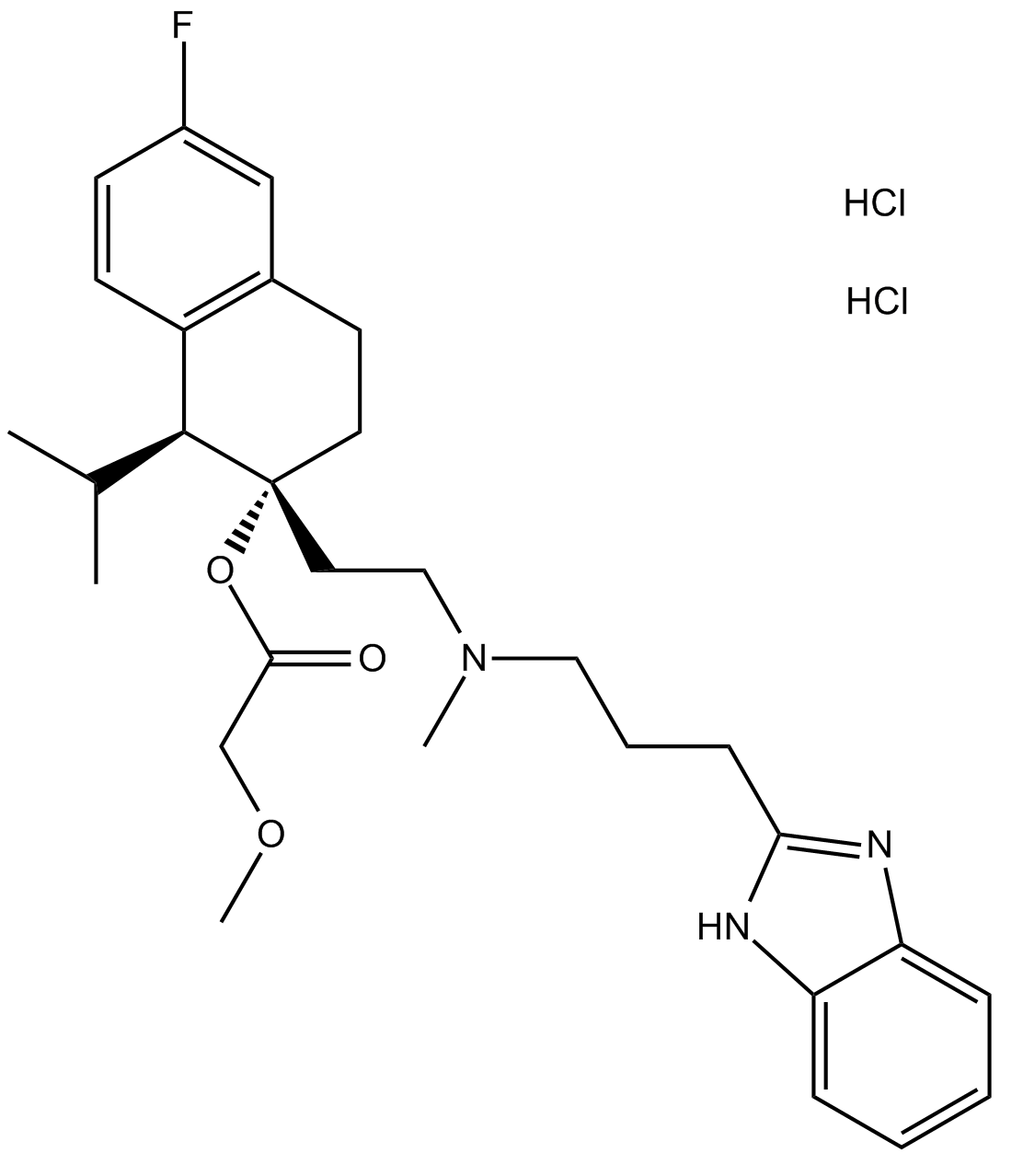
Cas No.: 116666-63-8
Sample solution is provided at 25 µL, 10mM.
_1-3.$$$39978408@51.jpg');)
_1-9.$$$38538795@65.jpg');)
_1-9.$$$39112701@51.jpg');)
_1-7.$$$37316672@70.jpg');)
_366-372.$$$36198801@70.jpg');)
.$$$38565142@65.jpg');)
_1867-1883.$$$33248023@67.jpg');)
_eads6055.$$$39977546@45.jpg');)
_eadm9805.$$$40080571@45.jpg');)
_eadj3020.$$$39666821@45.jpg');)
_1-20.$$$39757301@28.jpg');)
_1-24.$$$38898113@28.jpg');)
_273-287.$$$36806353@46.jpg');)
_1-16.$$$37156877@44.jpg');)
_1-19.$$$37460805@44.jpg');)
_1291-1307.$$$34518654@46.jpg');)
Mibefradil dihydrochloride is a calcium channel antagonist which can block both T-type and L-type calcium channels and the IC50 of Mibefradil dihydrochloride for T-type and L-type calcium current are 0.7μM and 2μM, respectively [1, 2]. Mibefradil dihydrochloride is clinically used to treat hypertension, chronic stable angina pectoris [1] and ovarian, pancreas, glioblastoma multiforme tumors [3].
Mibefradil dihydrochloride (100μM) significantly inhibited thapsigargin-induced endoplasmic reticulum Ca2+ release in EA.hy926 cells and HK-2 cells; Mibefradil dihydrochloride (100μM; 24h) significantly inhibited the proliferation of HK-2 and EA.hy926 cells [4]. Mibefradil dihydrochloride (5μM; 30h) decreased myoblast fusion [2]. Mibefradil dihydrochloride (0~10μM; 48h) suppressed the cell viability of both MOLT-4 and Jurkat in a dose-dependent manner; Mibefradil dihydrochloride (0, 5,10μM; 48h) enhanced the percentage of MOLT-4 cells in the G0/G1 and sub-G1 phase and reduced that in the S phase [3].
Mibefradil dihydrochloride (15mg/kg; 3d; b.i.d.; i.p.) caused a profound reduction of fasting blood glucose in male db/db mice[5]. Mibefradil dihydrochloride (20, 40mg/kg; i.p.) decreased the productions of TNF-α and IL-6 in bronchoalveolar lavage fluid (BALF) of male BALB/c mice stimulated by lipopolysaccharide (LPS) [6]. Mibefradil dihydrochloride (20mg/kg; 6months; p.o.) reduced the glomerulosclerosis and tubulointerstitial injury of Sprague-Dawley rats which were induced diabetes by strepozotocin [7].
References:
[1] Abernethy D R. Pharmacologic and pharmacokinetic profile of Mibefradil dihydrochloride, a T- and L-type calcium channel antagonist [J]. The American journal of cardiology, 1997, 80(4b): 4c-11c.
[2] Liu J H, Bijlenga P, Occhiodoro T, et al. Mibefradil dihydrochloride (Ro 40-5967) inhibits several Ca2+ and K+ currents in human fusion-competent myoblasts [J]. British journal of pharmacology, 1999, 126(1): 245-250.
[3] Huang W, Lu C, Wu Y, et al. T-type calcium channel antagonists, Mibefradil dihydrochloride and NNC-55-0396 inhibit cell proliferation and induce cell apoptosis in leukemia cell lines [J]. Journal of experimental & clinical cancer research, 2015, 34(1): 54.
[4] Li P, Rubaiy H N, Chen G L, et al. Mibefradil dihydrochloride, a T-type Ca2+ channel blocker also blocks Orai channels by action at the extracellular surface [J]. British journal of pharmacology, 2019, 176(19): 3845-3856.
[5] Lu Y, Long M, Zhou S, et al. Mibefradil dihydrochloride reduces blood glucose concentration in db/db mice [J]. Clinics (Sao Paulo, Brazil), 2014, 69(1): 61-67.
[6] Wan L, Wu W, Jiang S, et al. Mibefradil dihydrochloride and flunarizine, two T-type calcium channel inhibitors, protect mice against lipopolysaccharide-induced acute lung injury [J]. Mediators of inflammation, 2020, 2020: 3691701.
[7] Ma G, Allen T J, Cooper M E, et al. Calcium channel blockers, either amlodipine or Mibefradil dihydrochloride, ameliorate renal injury in experimental diabetes [J]. Kidney international, 2004, 66(3): 1090-1098.
| Cell experiment [1]: | |
Cell lines | MOLT-4 cells |
Preparation Method | MOLT-4 cells were treated with 10μΜ Mibefradil dihydrochloride for various time-points from 0 to 24h. Membranes were probed with a phosphospecific Ab to detect activated ERK1/2. |
Reaction Conditions | 10μM; 0, 0.5, 1, 2, 4, 8, 24h |
Applications | Mibefradil dihydrochloride decreased phosphorylated ERK1/2. |
| Animal experiment [2]: | |
Animal models | Male BALB/c mice |
Preparation Method | The mice were induced acute lung injury by exposure to lipopolysaccharide (LPS). Mibefradil dihydrochloride was injected 30min before LPS exposure, and the mice were sacrificed 6h after end of LPS exposure. The bronchoalveolar lavage fluid (BALF) of mice was collected to measure the levels of inflammatory cytokines. |
Dosage form | 20, 40mg/kg; i.g. |
Applications | Mibefradil dihydrochloride decreased the productions of TNF-α and IL-6 in BALF. |
References: | |
| Cas No. | 116666-63-8 | SDF | |
| Synonyms | Posicor, Ro 405967 | ||
| Chemical Name | [(1S,2S)-2-[2-[3-(1H-benzimidazol-2-yl)propyl-methylamino]ethyl]-6-fluoro-1-propan-2-yl-3,4-dihydro-1H-naphthalen-2-yl] 2-methoxyacetate;dihydrochloride | ||
| Canonical SMILES | CC(C)C1C2=C(CCC1(CCN(C)CCCC3=NC4=CC=CC=C4N3)OC(=O)COC)C=C(C=C2)F.Cl.Cl | ||
| Formula | C29H40Cl2FN3O3 | M.Wt | 568.55 |
| Solubility | DMF: 16mg/ml, DMSO: 14mg/ml, Ethanol: 16mg/ml, Water: 50mg/ml | Storage | Store at -20°C |
| General tips | Please select the appropriate solvent to prepare the stock solution according to the
solubility of the product in different solvents; once the solution is prepared, please store it in
separate packages to avoid product failure caused by repeated freezing and thawing.Storage method
and period of the stock solution: When stored at -80°C, please use it within 6 months; when stored
at -20°C, please use it within 1 month. To increase solubility, heat the tube to 37°C and then oscillate in an ultrasonic bath for some time. |
||
| Shipping Condition | Evaluation sample solution: shipped with blue ice. All other sizes available: with RT, or with Blue Ice upon request. | ||
| Prepare stock solution | |||

|
1 mg | 5 mg | 10 mg |
| 1 mM | 1.7589 mL | 8.7943 mL | 17.5886 mL |
| 5 mM | 351.8 μL | 1.7589 mL | 3.5177 mL |
| 10 mM | 175.9 μL | 879.4 μL | 1.7589 mL |
Step 1: Enter information below (Recommended: An additional animal making an allowance for loss during the experiment)
 g
μL
g
μL
Step 2: Enter the in vivo formulation (This is only the calculator, not formulation. Please contact us first if there is no in vivo formulation at the solubility Section.)
Calculation results:
Working concentration: mg/ml;
Method for preparing DMSO master liquid: mg drug pre-dissolved in μL DMSO ( Master liquid concentration mg/mL, Please contact us first if the concentration exceeds the DMSO solubility of the batch of drug. )
Method for preparing in vivo formulation: Take μL DMSO master liquid, next addμL PEG300, mix and clarify, next addμL Tween 80, mix and clarify, next add μL saline, mix and clarify.
Method for preparing in vivo formulation: Take μL DMSO master liquid, next add μL Corn oil, mix and clarify.
Note: 1. Please make sure the liquid is clear before adding the next solvent.
2. Be sure to add the solvent(s) in order. You must ensure that the solution obtained, in the previous addition, is a clear solution before proceeding to add the next solvent. Physical methods such as vortex, ultrasound or hot water bath can be used to aid dissolving.
3. All of the above co-solvents are available for purchase on the GlpBio website.
Quality Control & SDS
- View current batch:
- Purity: >99.00% Appearance: A solid
- COA (Certificate of Analysis)
- SDS (Safety Data Sheet)
- Datasheet
Average Rating: 5 (Based on Reviews and 30 reference(s) in Google Scholar.)