

Milrinone (Synonyms: WIN 47,203) |
Catalog No.GC14868
 One-Click Copy Product Info
|

PDE-3 inhibitor
Products are for research use only. Not for human use. We do not sell to patients.
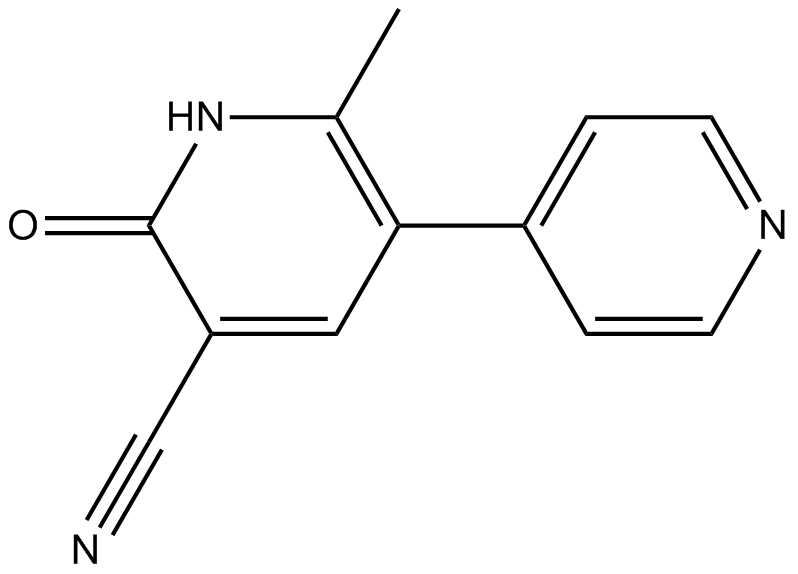
Cas No.: 78415-72-2
Sample solution is provided at 25 µL, 10mM.
Milrinone is a selective inhibitor of phosphodiesterase 3 (PDE-3) with a IC50 value of 56±12nM [1]
Milrinone has been noted to inhibit both members of the PDE3 family, PDE3A, which is prominent in heart, vascular smooth muscle, and platelets, as well as PDE3B, which is prominent in fat, liver, and pancreatic islets. Milrinone has shown the effect of concentration-dependent inhibition of PDE3 on the photolabelling with a IC50 value of 56±12nM. In addition, Milrinone has been reported to increase the accumulation of [3H]cAMP with a EC50 value of 5329±970nM in platelets. Apart from these, Milrinone has been revealed to have positive inotropic and vasodilatiry activities and thus used in clinical practice for short-trem treatment of patients who have the acute decompensated heart failure [1, 2].
References:
[1] Tang KM1, Jang EK, Haslam RJ. Photoaffinity labelling of cyclic GMP-inhibited phosphodiesterase (PDE III) in human and rat platelets and rat tissues: effects of phosphodiesterase inhibitors. Eur J Pharmacol. 1994 Jun 15;268(1):105-14.
[2] Cheung P1, Yang G, Boden G. Milrinone, a selective phosphodiesterase 3 inhibitor, stimulates lipolysis, endogenous glucose production, and insulin secretion. Metabolism. 2003 Nov;52(11):1496-500.
Animal experiment: | In juvenile rats of 100 ± 8 g body weight (bw), CHF is induced by supracoronary aortic banding. In brief, rats are anesthetized by intraperitoneal injection of ketamine (87 mg/kg bw) and xylazine (13 mg/kg bw). Rats are placed in the supine position, the chest wall is shaved, and a left thoracotomy is performed in the third intercostal space during ventilation with 100% O2. The ascending aorta is freed from connective tissue and partially occluded by implantation of a titanium clip with a defined internal diameter of 0.8 mm. After surgical closure of the thorax, the rats are allowed to recover from anesthesia. For postoperative analgesia, rats receive 250 mg/kg bw of metamizole intramuscularly immediately after the operation and on the first postoperative day. Sham-operated rats serve as controls. After recovery from anesthesia, the animals are placed in cages with free access to water and standard laboratory diet. For inhalation, milrinone (0.2-5 mg/mL) or NaCl (0.9%) are nebulized using an ultrasonic nebulizer and inhaled for 3 min at identical peak inspiratory pressures as used throughout the experiment. A 3-min nebulization of 1 mg/mL milrinone results in vaporization of 14 μg of the phosphodiesterase-3 inhibitor as determined by microgravimetry. Therefore, the respective dose of 39 μg/kg is analog to inhaled doses in human studies. For intravenous delivery, milrinone (initial bolus of 2-10 μg/kg, followed by 0.2-1 μg/kg/min) or equivalent volumes of NaCl (0.9%; initial bolus of 1.6 mL/kg, followed by 10 μL/kg/h) are administered by an infusion pump for 10 min. |
References: [1]. Santhosh KT, et al. Milrinone attenuates thromboxane receptor-mediated hyperresponsiveness in hypoxic pulmonary arterial myocytes. Br J Pharmacol. 2011 Jul;163(6):1223-36. | |
| Cas No. | 78415-72-2 | SDF | |
| Synonyms | WIN 47,203 | ||
| Chemical Name | 6-methyl-2-oxo-5-pyridin-4-yl-1H-pyridine-3-carbonitrile | ||
| Canonical SMILES | CC1=C(C=C(C(=O)N1)C#N)C2=CC=NC=C2 | ||
| Formula | C12H9N3O | M.Wt | 211.22 |
| Solubility | ≥ 8.2mg/mL in DMSO | Storage | Store at -20°C |
| General tips | Please select the appropriate solvent to prepare the stock solution according to the
solubility of the product in different solvents; once the solution is prepared, please store it in
separate packages to avoid product failure caused by repeated freezing and thawing.Storage method
and period of the stock solution: When stored at -80°C, please use it within 6 months; when stored
at -20°C, please use it within 1 month. To increase solubility, heat the tube to 37°C and then oscillate in an ultrasonic bath for some time. |
||
| Shipping Condition | Evaluation sample solution: shipped with blue ice. All other sizes available: with RT, or with Blue Ice upon request. | ||
| Prepare stock solution | |||

|
1 mg | 5 mg | 10 mg |
| 1 mM | 4.7344 mL | 23.672 mL | 47.344 mL |
| 5 mM | 946.9 μL | 4.7344 mL | 9.4688 mL |
| 10 mM | 473.4 μL | 2.3672 mL | 4.7344 mL |
Step 1: Enter information below (Recommended: An additional animal making an allowance for loss during the experiment)
 g
μL
g
μL
Step 2: Enter the in vivo formulation (This is only the calculator, not formulation. Please contact us first if there is no in vivo formulation at the solubility Section.)
Calculation results:
Working concentration: mg/ml;
Method for preparing DMSO master liquid: mg drug pre-dissolved in μL DMSO ( Master liquid concentration mg/mL, Please contact us first if the concentration exceeds the DMSO solubility of the batch of drug. )
Method for preparing in vivo formulation: Take μL DMSO master liquid, next addμL PEG300, mix and clarify, next addμL Tween 80, mix and clarify, next add μL saline, mix and clarify.
Method for preparing in vivo formulation: Take μL DMSO master liquid, next add μL Corn oil, mix and clarify.
Note: 1. Please make sure the liquid is clear before adding the next solvent.
2. Be sure to add the solvent(s) in order. You must ensure that the solution obtained, in the previous addition, is a clear solution before proceeding to add the next solvent. Physical methods such as vortex, ultrasound or hot water bath can be used to aid dissolving.
3. All of the above co-solvents are available for purchase on the GlpBio website.
Quality Control & SDS
- View current batch:
- Purity: >99.50% Appearance: A solid
- COA (Certificate of Analysis)
- SDS (Safety Data Sheet)
- Datasheet
Average Rating: 5 (Based on Reviews and 38 reference(s) in Google Scholar.)