

MK-2048 |
Catalog No.GC15561
 One-Click Copy Product Info
|

Products are for research use only. Not for human use. We do not sell to patients.
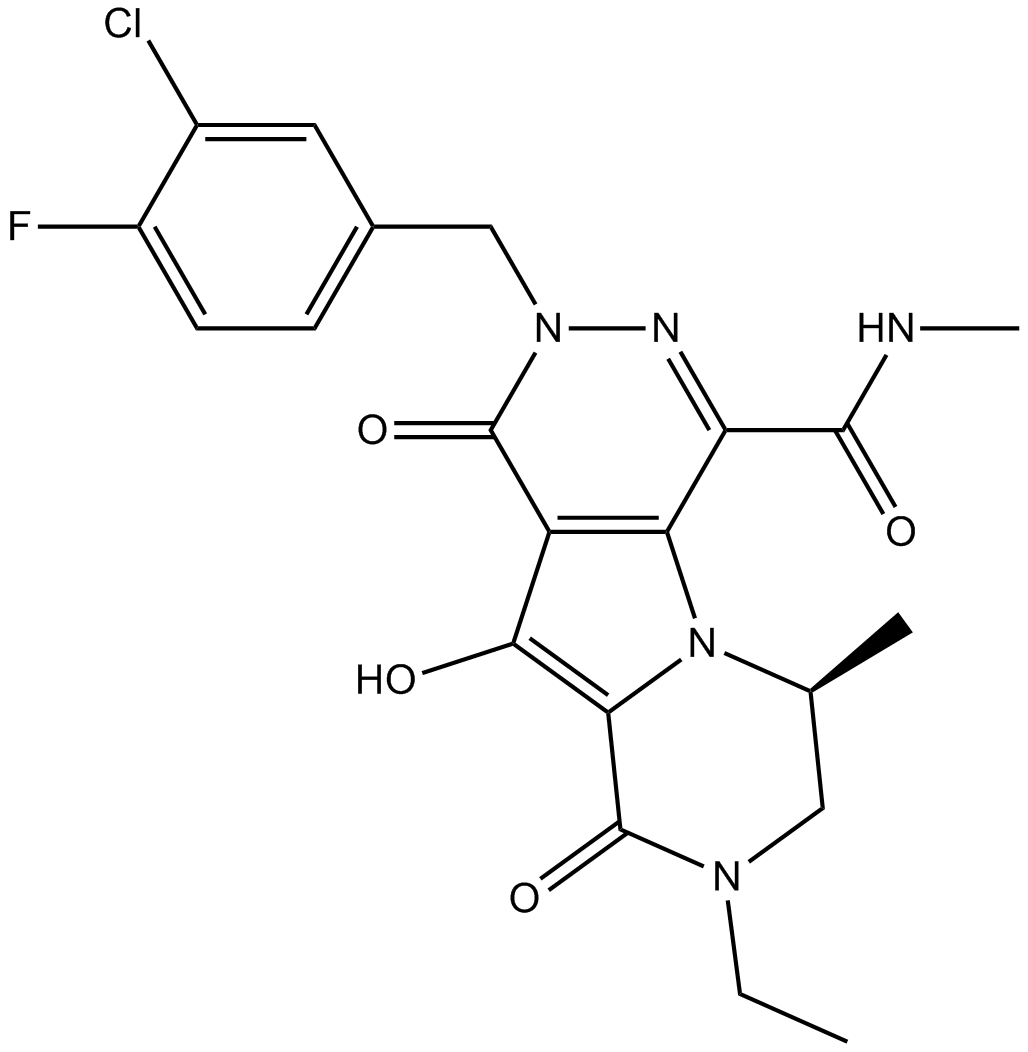
Cas No.: 869901-69-9
Sample solution is provided at 25 µL, 10mM.
_1-3.$$$39978408@51.jpg');)
_1-9.$$$38538795@65.jpg');)
_1-9.$$$39112701@51.jpg');)
_1-7.$$$37316672@70.jpg');)
_366-372.$$$36198801@70.jpg');)
.$$$38565142@65.jpg');)
_1867-1883.$$$33248023@67.jpg');)
_eads6055.$$$39977546@45.jpg');)
_eadm9805.$$$40080571@45.jpg');)
_eadj3020.$$$39666821@45.jpg');)
_1-20.$$$39757301@28.jpg');)
_1-24.$$$38898113@28.jpg');)
_273-287.$$$36806353@46.jpg');)
_1-16.$$$37156877@44.jpg');)
_1-19.$$$37460805@44.jpg');)
_1291-1307.$$$34518654@46.jpg');)
MK-2048 is a second generation inhibitor of HIV-1 integrase with IC50 values of 0.075 μM and 0.08 μM for subtype B and subtype C integrase, respectively.
Integration of viral cDNA into the host genome is one of the definitive features of retrovirus replication. Integrase inhibitors are active against both B and non-B subtypes in therapy. Subtype C variants are responsible for approximately 50% of infections worldwide, mostly in Sub-Saharan Africa and India. After viral entry and reverse transcription, reverse-transcribed double-stranded blunt-ended DNA is incorporated into the host cell genome through two catalytic activities mediated by integrase. MK-2048 could inhibit the strand transfer process catalyzed by integrase.
The inhibition activity of MK-2048 against integrase was evaluated by means of purified recombinant subtype B and C integrase enzymes, which were obtained and amplified from viruses in long-term infected patients. Purified recombinant subtype B and C integrase enzymes were incubated with increasing concentrations of MK-2048 and corresponding templates. MK-2048 possesses inhibition activities for strand transfer against subtype B and C enzymes, whose IC50 values were 0.075 μM and 0.08 μM, respectively. Disintegration was inhibited by high concentrations of MK-2048 to a comparable extent with both subtype B and C enzymes.
Inhibition of replication by MK-2048 was also evaluated in cell culture based assays using cord blood mononuclear cells. EC50 for subtype B viruses varies from 0.0003 μM to 0.0148 μM and 0.0007 μM to 0.0033 μM for subtype C viruses.
References:
1.Bar-Magen T, Sloan R D, Faltenbacher V H, et al. Comparative biochemical analysis of HIV-1 subtype B and C integrase enzymes[J]. Retrovirology, 2009, 6(1): 103.
| Cas No. | 869901-69-9 | SDF | |
| Chemical Name | (6S)-2-[(3-chloro-4-fluorophenyl)methyl]-8-ethyl-10-hydroxy-N,6-dimethyl-1,9-dioxo-6,7-dihydropyrazino[5,6]pyrrolo[1,3-b]pyridazine-4-carboxamide | ||
| Canonical SMILES | CCN1CC(N2C3=C(C(=C2C1=O)O)C(=O)N(N=C3C(=O)NC)CC4=CC(=C(C=C4)F)Cl)C | ||
| Formula | C21H21ClFN5O4 | M.Wt | 461.9 |
| Solubility | ≥ 10.55 mg/mL in DMSO, ≥ 3.68 mg/mL in EtOH with ultrasonic and warming | Storage | Store at -20°C |
| General tips | Please select the appropriate solvent to prepare the stock solution according to the
solubility of the product in different solvents; once the solution is prepared, please store it in
separate packages to avoid product failure caused by repeated freezing and thawing.Storage method
and period of the stock solution: When stored at -80°C, please use it within 6 months; when stored
at -20°C, please use it within 1 month. To increase solubility, heat the tube to 37°C and then oscillate in an ultrasonic bath for some time. |
||
| Shipping Condition | Evaluation sample solution: shipped with blue ice. All other sizes available: with RT, or with Blue Ice upon request. | ||
| Prepare stock solution | |||

|
1 mg | 5 mg | 10 mg |
| 1 mM | 2.165 mL | 10.8249 mL | 21.6497 mL |
| 5 mM | 433 μL | 2.165 mL | 4.3299 mL |
| 10 mM | 216.5 μL | 1.0825 mL | 2.165 mL |
Step 1: Enter information below (Recommended: An additional animal making an allowance for loss during the experiment)
 g
μL
g
μL
Step 2: Enter the in vivo formulation (This is only the calculator, not formulation. Please contact us first if there is no in vivo formulation at the solubility Section.)
Calculation results:
Working concentration: mg/ml;
Method for preparing DMSO master liquid: mg drug pre-dissolved in μL DMSO ( Master liquid concentration mg/mL, Please contact us first if the concentration exceeds the DMSO solubility of the batch of drug. )
Method for preparing in vivo formulation: Take μL DMSO master liquid, next addμL PEG300, mix and clarify, next addμL Tween 80, mix and clarify, next add μL saline, mix and clarify.
Method for preparing in vivo formulation: Take μL DMSO master liquid, next add μL Corn oil, mix and clarify.
Note: 1. Please make sure the liquid is clear before adding the next solvent.
2. Be sure to add the solvent(s) in order. You must ensure that the solution obtained, in the previous addition, is a clear solution before proceeding to add the next solvent. Physical methods such as vortex, ultrasound or hot water bath can be used to aid dissolving.
3. All of the above co-solvents are available for purchase on the GlpBio website.
Quality Control & SDS
- View current batch:
- Purity: >98.00% Appearance: A solid
- COA (Certificate of Analysis)
- SDS (Safety Data Sheet)
- Datasheet
Average Rating: 5 (Based on Reviews and 30 reference(s) in Google Scholar.)