

MRTX1133 |
Catalog No.GC62699
 One-Click Copy Product Info
|

MRTX1133 is a noncovalent, potent, and selective KRASG12D inhibitor, with a KD value of 0.0002nM and an IC50 value of 2nM.
Products are for research use only. Not for human use. We do not sell to patients.
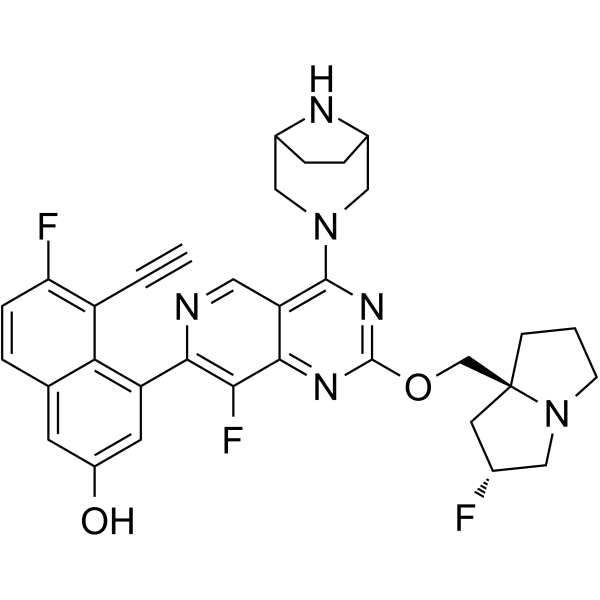
Cas No.: 2621928-55-8
Sample solution is provided at 25 µL, 10mM.
_1-3.$$$39978408@51.jpg');)
_1-9.$$$38538795@65.jpg');)
_1-9.$$$39112701@51.jpg');)
_1-7.$$$37316672@70.jpg');)
_366-372.$$$36198801@70.jpg');)
.$$$38565142@65.jpg');)
_1867-1883.$$$33248023@67.jpg');)
_eads6055.$$$39977546@45.jpg');)
_eadm9805.$$$40080571@45.jpg');)
_eadj3020.$$$39666821@45.jpg');)
_1-20.$$$39757301@28.jpg');)
_1-24.$$$38898113@28.jpg');)
_273-287.$$$36806353@46.jpg');)
_1-16.$$$37156877@44.jpg');)
_1-19.$$$37460805@44.jpg');)
_1291-1307.$$$34518654@46.jpg');)
MRTX1133 is a noncovalent, potent, and selective KRASG12D inhibitor, with a KD value of 0.0002nM and an IC50 value of 2nM[1]. MRTX1133 reversibly and non-covalently binds to the allosteric pocket of KRASG12D, inhibiting the activity of the pentose phosphate pathway (PPP), reprogramming the microenvironment and promoting the killing effect mediated by immune cells[2]. MRTX1133 has been widely used in tumor research to inhibit KRASG12D mutant cancer cells[3].
In vitro, MRTX1133 treatment for 5 days significantly inhibited the viability of KRASG12D mutant LS180, LS174T, and LS513 cells, with IC50 values of 31.7nM, 17.8nM and 8.4nM, respectively[4]. Treatment with 25nM MRTX1133 for 4 days upregulated the expression of LINC02159 in KRAS G12D mutant colorectal cancer cells (CRCs), inhibited cell migration and invasion, and induced ferroptosis[5]. 0.5μM MRTX1133 combined with 2μM Buparlisib treatment for 48 hours suppressed ERK-CyclinD1/CDK4 pathway activity in KRAS G12D mutant SW1990 cells, downregulated the expression of BCL-2 and MCL-1 proteins, and led to apoptosis[6].
In vivo, MRTX1133 administration via intraperitoneal injection at a dose of 30mg/kg, twice daily for 7 days, markedly restrained tumor growth in the 6419c5 xenograft mouse model and caused changes in the tumor stroma[7]. Intraperitoneal injection of MRTX1133 at a dose of 30mg/kg twice daily for 30 days significantly induced tumor regression and decreased pERK expression in tumor tissues in the HPAC xenograft mouse model [8].
References:
[1] Wang X, Allen S, Blake J F, et al. Identification of MRTX1133, a noncovalent, potent, and selective KRASG12D inhibitor[J]. J Med Chem, 2022, 65(4): 3123-3133.
[2] Jiang X, Wang T, Zhao B, et al. KRASG12D-driven pentose phosphate pathway remodeling imparts a targetable vulnerability synergizing with MRTX1133 for durable remissions in PDAC[J]. Cell Reports Medicine, 2025, 6(2).
[3] Wei D, Wang L, Zuo X, et al. A small molecule with big impact: MRTX1133 targets the KRASG12D mutation in pancreatic cancer[J]. Clinical Cancer Research, 2024, 30(4): 655-662.
[4] Feng J, Hu Z, Xia X, et al. Feedback activation of EGFR/wild-type RAS signaling axis limits KRASG12D inhibitor efficacy in KRAS G12D-mutated colorectal cancer[J]. Oncogene, 2023, 42(20): 1620-1633.
[5] Zou J, Shi X, Wu Z, et al. MRTX1133 attenuates KRASG12D mutated-colorectal cancer progression through activating ferroptosis activity via METTL14/LINC02159/FOXC2 axis[J]. Translational Oncology, 2025, 52: 102235.
[6] Hao M W, Zhang T X, Dong D, et al. Enhancing KRAS G12D inhibitor sensitivity in pancreatic cancer through SHP2/PI3K pathway[J]. Medical Oncology, 2025, 42(5): 139.
[7] Kemp S B, Cheng N, Markosyan N, et al. Efficacy of a small-molecule inhibitor of KrasG12D in immunocompetent models of pancreatic cancer[J]. Cancer discovery, 2023, 13(2): 298-311.
[8] Hallin J, Bowcut V, Calinisan A, et al. Anti-tumor efficacy of a potent and selective non-covalent KRASG12D inhibitor[J]. Nature medicine, 2022, 28(10): 2171-2182.
| Cell experiment [1]: | |
|
Cell lines |
KRAS G12D mutant LS513 cells |
|
Preparation Method |
KRAS G12D mutant LS513 cells were cultured in RPMI-1640 medium, supplemented with 10% fetal bovine serum (FBS), 1% penicillin-streptomycin at 37°C in an incubator with 5% CO2. Cells were seeded in a 96-well plate at a density of 2×10⁴ cells/well for 24h. Cells were treated with different concentrations of MRTX1133 (0, 0.1, 1, 5, 10, and 100nM) for 5 days, and the cell viability was determined. |
|
Reaction Conditions |
0, 0.1, 1, 5, 10, and 100nM; 5 days |
|
Applications |
MRTX1133 treatment inhibited the cell viability of LS513 cells in a dose-dependent manner. |
| Animal experiment [2]: | |
|
Animal models |
Female wild-type C57BL/6 mice |
|
Preparation Method |
Female wild-type C57BL/6 mice (6 weeks old; 18-22g) were maintained in a controlled environment at 21±1°C and 60% relative humidity under a 12h light/dark cycle, and were given free access to food and water. A single-cell suspension of murine 6419c5 cells was prepared in DMEM and kept on ice until injection. 6419c5 cells (1×10⁵) were injected subcutaneously into 6-week-old C57BL/6 mice. MRTX1133 was formulated in 50mM citrate buffer pH 5.0. Once formulated, MRTX1133 was protected from light and stored at 4°C for 1 week. MRTX1133 was administered at 30mg/kg (twice a day) via i.p. injection for 7 days. Subcutaneous tumor measurements began when tumors became palpable. Subcutaneous tumors were measured daily with digital calipers for short-term experiments (every 2-3 days for longer experiments). |
|
Dosage form |
30mg/kg; twice a day; 7 days; i.p. |
|
Applications |
MRTX1133 treatment significantly inhibited tumor growth in the mice with 6419c5 xenografts. |
References: [1] Feng J, Hu Z, Xia X, et al. Feedback activation of EGFR/wild-type RAS signaling axis limits KRASG12D inhibitor efficacy in KRAS G12D-mutated colorectal cancer[J]. Oncogene, 2023, 42(20): 1620-1633. [2] Kemp S B, Cheng N, Markosyan N, et al. Efficacy of a small-molecule inhibitor of KrasG12D in immunocompetent models of pancreatic cancer[J]. Cancer discovery, 2023, 13(2): 298-311. | |
| Cas No. | 2621928-55-8 | SDF | |
| Formula | C33H31F3N6O2 | M.Wt | 600.63 |
| Solubility | DMSO : 50 mg/mL | Storage | Store at -20°C |
| General tips | Please select the appropriate solvent to prepare the stock solution according to the
solubility of the product in different solvents; once the solution is prepared, please store it in
separate packages to avoid product failure caused by repeated freezing and thawing.Storage method
and period of the stock solution: When stored at -80°C, please use it within 6 months; when stored
at -20°C, please use it within 1 month. To increase solubility, heat the tube to 37°C and then oscillate in an ultrasonic bath for some time. |
||
| Shipping Condition | Evaluation sample solution: shipped with blue ice. All other sizes available: with RT, or with Blue Ice upon request. | ||
| Prepare stock solution | |||

|
1 mg | 5 mg | 10 mg |
| 1 mM | 1.6649 mL | 8.3246 mL | 16.6492 mL |
| 5 mM | 333 μL | 1.6649 mL | 3.3298 mL |
| 10 mM | 166.5 μL | 832.5 μL | 1.6649 mL |
Step 1: Enter information below (Recommended: An additional animal making an allowance for loss during the experiment)
 g
μL
g
μL
Step 2: Enter the in vivo formulation (This is only the calculator, not formulation. Please contact us first if there is no in vivo formulation at the solubility Section.)
Calculation results:
Working concentration: mg/ml;
Method for preparing DMSO master liquid: mg drug pre-dissolved in μL DMSO ( Master liquid concentration mg/mL, Please contact us first if the concentration exceeds the DMSO solubility of the batch of drug. )
Method for preparing in vivo formulation: Take μL DMSO master liquid, next addμL PEG300, mix and clarify, next addμL Tween 80, mix and clarify, next add μL saline, mix and clarify.
Method for preparing in vivo formulation: Take μL DMSO master liquid, next add μL Corn oil, mix and clarify.
Note: 1. Please make sure the liquid is clear before adding the next solvent.
2. Be sure to add the solvent(s) in order. You must ensure that the solution obtained, in the previous addition, is a clear solution before proceeding to add the next solvent. Physical methods such as vortex, ultrasound or hot water bath can be used to aid dissolving.
3. All of the above co-solvents are available for purchase on the GlpBio website.
Quality Control & SDS
- View current batch:
- Purity: >98.00% Appearance: A solid
- COA (Certificate of Analysis)
- SDS (Safety Data Sheet)
- Datasheet
Average Rating: 5 (Based on Reviews and 16 reference(s) in Google Scholar.)