

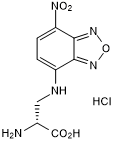
NADA-green (Synonyms: NADA hydrochloride) |
Catalog No.GC50534
 One-Click Copy Product Info
|

NADA-green is a fluorescent D-amino acid probe suitable for labeling peptidoglycan in living bacteria, with maximum excitation/emission wavelengths of ~450/555nm.
Products are for research use only. Not for human use. We do not sell to patients.
Cas No.: 2253733-11-6
Sample solution is provided at 25 µL, 10mM.
_1-3.$$$39978408@51.jpg');)
_1-9.$$$38538795@65.jpg');)
_1-9.$$$39112701@51.jpg');)
_1-7.$$$37316672@70.jpg');)
_366-372.$$$36198801@70.jpg');)
.$$$38565142@65.jpg');)
_1867-1883.$$$33248023@67.jpg');)
_eads6055.$$$39977546@45.jpg');)
_eadm9805.$$$40080571@45.jpg');)
_eadj3020.$$$39666821@45.jpg');)
_1-20.$$$39757301@28.jpg');)
_1-24.$$$38898113@28.jpg');)
_273-287.$$$36806353@46.jpg');)
_1-16.$$$37156877@44.jpg');)
_1-19.$$$37460805@44.jpg');)
_1291-1307.$$$34518654@46.jpg');)
NADA-green is a fluorescent D-amino acid probe suitable for labeling peptidoglycan in living bacteria, with maximum excitation/emission wavelengths of ~450/555nm[1]. NADA-green can be efficiently incorporated into the peptidoglycan layer of different bacteria, strongly leading to peripheral and intermediate labeling of bacterial cell populations without affecting growth rate[2]. NADA-green can be used to detect modified cell wall peptides in E. coli[3]. NADA-green can be used to label living spirochetes[4]. NADA-green can activate the GPCR cannabinoid 1 (CB1) and transient receptor potential vanilloid 1 (TRPV1) receptor[5]. NADA probes mainly report L,D-transpeptidase activity, tetrapeptide substrates, or both[6].
References:
[1] Kuru E, Tekkam S, Hall E, et al. Synthesis of fluorescent D-amino acids and their use for probing peptidoglycan synthesis and bacterial growth in situ[J]. Nature protocols, 2015, 10(1): 33-52.
[2] Arend K I, Schmidt J J, Bentler T, et al. Myxococcus xanthus predation of Gram-positive or Gram-negative bacteria is mediated by different bacteriolytic mechanisms[J]. Applied and Environmental Microbiology, 2021, 87(5): e02382-20.
[3] Kuru E, Hughes H V, Brown P J, et al. In situ probing of newly synthesized peptidoglycan in live bacteria with fluorescent D‐amino acids[J]. Angewandte Chemie, 2012, 124(50): 12687-12691.
[4] Jutras B L, Scott M, Parry B, et al. Lyme disease and relapsing fever Borrelia elongate through zones of peptidoglycan synthesis that mark division sites of daughter cells[J]. Proceedings of the National Academy of Sciences, 2016, 113(33): 9162-9170.
[5] Fawley J A, Hofmann M E, Andresen M C. Cannabinoid 1 and transient receptor potential vanilloid 1 receptors discretely modulate evoked glutamate separately from spontaneous glutamate transmission[J]. Journal of Neuroscience, 2014, 34(24): 8324-8332.
[6] García-Heredia A, Pohane A A, Melzer E S, et al. Peptidoglycan precursor synthesis along the sidewall of pole-growing mycobacteria. eLife, 7[J]. e, 2018, 37243.
This protocol only provides a guide, please modify it to meet your specific needs.
1. Solution preparation
(1) Stock solution: Dissolve NADA-green in DMSO to prepare a 10mM stock solution.
Note: Unused stock solution should be stored in aliquots at -20°C or -80°C in the dark to avoid repeated freezing and thawing.
(2) Working solution: Dilute the stock solution with experimental buffer to the required working concentration, for example: 25μM[1].
Note: The optimal working concentration should be adjusted according to actual conditions or refer to the literature to set the gradient concentration by yourself. The working solution must be prepared and used immediately.
2. Labeling the cell wall with NADA-green[1](from the literature, for reference only)
(1) When the OD600 of the culture reaches 0.8, take 500µL of sample, collect the cells by centrifugation, and discard the supernatant.
(2) Resuspend the cell pellet in 150µL fresh culture medium, add 25µM NADA-green dye, and incubate at 37°C in a shaker in the dark for 10 min. Collect the cells by centrifugation and discard the supernatant.
(3) Gently wash once with 200µL PBS to remove unbound dye and resuspend in 150µL fresh culture medium for later use.
(4) Take the labeled cell suspension, centrifuge and wash again with 200µL PBS to completely remove the culture medium components. Resuspend the cells in 50µL PBS, take 1µL and drop it on a slide covered with a thin layer of 1.2% agarose (pre-soaked in PBS), and gently press the coverslip to fix.
(5) Use structured illumination microscopy (SIM) to image NADA-green at 488nm with an exposure time of 30ms.
References:
[1] Pereira A R, Hsin J, Król E, et al. FtsZ-dependent elongation of a coccoid bacterium[J]. MBio, 2016, 7(5): 10.1128/mbio. 00908-16.
| Cas No. | 2253733-11-6 | SDF | |
| Synonyms | NADA hydrochloride | ||
| Canonical SMILES | N[C@@H](C(O)=O)CNC1=CC=C([N+]([O-])=O)C2=NON=C12.Cl | ||
| Formula | C9H9N5O5.HCl | M.Wt | 303.66 |
| Solubility | DMSO : 30 mg/mL (98.79 mM; Need ultrasonic and warming) | Storage | Store at -20°C |
| General tips | Please select the appropriate solvent to prepare the stock solution according to the
solubility of the product in different solvents; once the solution is prepared, please store it in
separate packages to avoid product failure caused by repeated freezing and thawing.Storage method
and period of the stock solution: When stored at -80°C, please use it within 6 months; when stored
at -20°C, please use it within 1 month. To increase solubility, heat the tube to 37°C and then oscillate in an ultrasonic bath for some time. |
||
| Shipping Condition | Evaluation sample solution: shipped with blue ice. All other sizes available: with RT, or with Blue Ice upon request. | ||
| Prepare stock solution | |||

|
1 mg | 5 mg | 10 mg |
| 1 mM | 3.2932 mL | 16.4658 mL | 32.9316 mL |
| 5 mM | 658.6 μL | 3.2932 mL | 6.5863 mL |
| 10 mM | 329.3 μL | 1.6466 mL | 3.2932 mL |
Step 1: Enter information below (Recommended: An additional animal making an allowance for loss during the experiment)
 g
μL
g
μL
Step 2: Enter the in vivo formulation (This is only the calculator, not formulation. Please contact us first if there is no in vivo formulation at the solubility Section.)
Calculation results:
Working concentration: mg/ml;
Method for preparing DMSO master liquid: mg drug pre-dissolved in μL DMSO ( Master liquid concentration mg/mL, Please contact us first if the concentration exceeds the DMSO solubility of the batch of drug. )
Method for preparing in vivo formulation: Take μL DMSO master liquid, next addμL PEG300, mix and clarify, next addμL Tween 80, mix and clarify, next add μL saline, mix and clarify.
Method for preparing in vivo formulation: Take μL DMSO master liquid, next add μL Corn oil, mix and clarify.
Note: 1. Please make sure the liquid is clear before adding the next solvent.
2. Be sure to add the solvent(s) in order. You must ensure that the solution obtained, in the previous addition, is a clear solution before proceeding to add the next solvent. Physical methods such as vortex, ultrasound or hot water bath can be used to aid dissolving.
3. All of the above co-solvents are available for purchase on the GlpBio website.
Quality Control & SDS
- View current batch:
- Purity: >98.00% Appearance: A solid
- COA (Certificate of Analysis)
- SDS (Safety Data Sheet)
- Datasheet
Average Rating: 5 (Based on Reviews and 29 reference(s) in Google Scholar.)