

Nelonicline (ABT-126) (Synonyms: ABT-126) |
Catalog No.GC33741
 One-Click Copy Product Info
|

Nelonicline (ABT-126) (ABT-126) is an orally active and selective α7 nicotinic receptor agonist with high affinity to α7 nAChRs in human brain (Ki=12.3 nM).
Products are for research use only. Not for human use. We do not sell to patients.
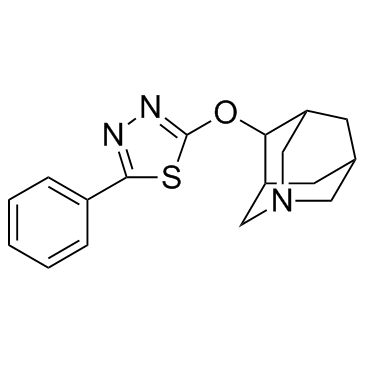
Cas No.: 1026134-63-3
Sample solution is provided at 25 µL, 10mM.
_1-3.$$$39978408@51.jpg');)
_1-9.$$$38538795@65.jpg');)
_1-9.$$$39112701@51.jpg');)
_1-7.$$$37316672@70.jpg');)
_366-372.$$$36198801@70.jpg');)
.$$$38565142@65.jpg');)
_1867-1883.$$$33248023@67.jpg');)
_eads6055.$$$39977546@45.jpg');)
_eadm9805.$$$40080571@45.jpg');)
_eadj3020.$$$39666821@45.jpg');)
_1-20.$$$39757301@28.jpg');)
_1-24.$$$38898113@28.jpg');)
_273-287.$$$36806353@46.jpg');)
_1-16.$$$37156877@44.jpg');)
_1-19.$$$37460805@44.jpg');)
_1291-1307.$$$34518654@46.jpg');)
Nelonicline (ABT-126) is a selective neuronal nicotinic receptor agonist.
The 0.03 mg/kg dose Nelonicline (ABT-126) has no significant effect on LIDs. Nelonicline at 0.10 mg/kg reduces LIDs by ~40%, while the 0.30 and 1.0 mg/kg Nelonicline doses decrease LIDs up to ~60%. The effect of Nelonicline (1.0 mg/kg) is also tested for its ability to reduce LIDs at a higher dose of L-dopa (15 mg/kg)/carbidopa (3.75 mg/kg). The higher dose of L-dopa leads to greater LID scores in vehicle treated monkeys. Nelonicline treatment reduces LIDs by 70%, after the morning dose of L-dopa and 60% after the aftemoon dose. The effect of Nelonicline is most pronounced during the latter weeks, possibly because of a greater decline with continued drug treatment. A washout is in progress to determine if LIDs return to vehicle-treated levels after Nelonicline discontinuation. There is no effect of the drug on Parkinsonism or cognitive ability. Overall, these data indicate that Nelonicline would be useful as an antidyskinetic drug in Parkinson's disease[1].
[1]. ARYL SULFONOHYDRAZIDES. WO2015168616A1.
Animal experiment: | Monkeys[1]MPTP-lesioned monkeys are used. All monkeys have been administered MPTP and exhibited mild to moderate parkinsonism. All monkeys are orally gavaged with L-dopa/carbidopa twice daily, which lead to the development of stable abnormal involuntary movements or dyskinesias. The treatment groups are as follows: vehicle-treated (n=6), nicotine-treated (n=5), Nelonicline treated (set 1, n=5) and Nelonicline-treated (set 2, n=5). These latter two sets of monkeys have previously been given ABT-894 and ABT-107 but using somewhat different treatment regimens. The present study is done after a 7 wk washout period, when LIDs are similar in all groups. Nelonicline is administered orally in a small cracker 30 min before L-dopa (10 mg/kg) and carbidopa (2.5 mg/kg). Nicotine, a positive control, is provided in the drinking water. Nelonicline is tested at 0.03, 0.10, 0.30 and 1.0 mg/kg, with each dose of Nelonicline tested for 1 or 2 wk[1]. |
References: [1]. ARYL SULFONOHYDRAZIDES. WO2015168616A1. | |
| Cas No. | 1026134-63-3 | SDF | |
| Synonyms | ABT-126 | ||
| Canonical SMILES | [C@H]1([C@H]2C[C@H](C3)C[C@@H]1C[N@]3C2)OC4=NN=C(C5=CC=CC=C5)S4 | ||
| Formula | C17H19N3OS | M.Wt | 313.42 |
| Solubility | DMSO : 12.5 mg/mL (39.88 mM; ultrasonic and warming and heat to 60°C) | Storage | Store at -20°C |
| General tips | Please select the appropriate solvent to prepare the stock solution according to the
solubility of the product in different solvents; once the solution is prepared, please store it in
separate packages to avoid product failure caused by repeated freezing and thawing.Storage method
and period of the stock solution: When stored at -80°C, please use it within 6 months; when stored
at -20°C, please use it within 1 month. To increase solubility, heat the tube to 37°C and then oscillate in an ultrasonic bath for some time. |
||
| Shipping Condition | Evaluation sample solution: shipped with blue ice. All other sizes available: with RT, or with Blue Ice upon request. | ||
| Prepare stock solution | |||

|
1 mg | 5 mg | 10 mg |
| 1 mM | 3.1906 mL | 15.953 mL | 31.9061 mL |
| 5 mM | 638.1 μL | 3.1906 mL | 6.3812 mL |
| 10 mM | 319.1 μL | 1.5953 mL | 3.1906 mL |
Step 1: Enter information below (Recommended: An additional animal making an allowance for loss during the experiment)
 g
μL
g
μL
Step 2: Enter the in vivo formulation (This is only the calculator, not formulation. Please contact us first if there is no in vivo formulation at the solubility Section.)
Calculation results:
Working concentration: mg/ml;
Method for preparing DMSO master liquid: mg drug pre-dissolved in μL DMSO ( Master liquid concentration mg/mL, Please contact us first if the concentration exceeds the DMSO solubility of the batch of drug. )
Method for preparing in vivo formulation: Take μL DMSO master liquid, next addμL PEG300, mix and clarify, next addμL Tween 80, mix and clarify, next add μL saline, mix and clarify.
Method for preparing in vivo formulation: Take μL DMSO master liquid, next add μL Corn oil, mix and clarify.
Note: 1. Please make sure the liquid is clear before adding the next solvent.
2. Be sure to add the solvent(s) in order. You must ensure that the solution obtained, in the previous addition, is a clear solution before proceeding to add the next solvent. Physical methods such as vortex, ultrasound or hot water bath can be used to aid dissolving.
3. All of the above co-solvents are available for purchase on the GlpBio website.
Quality Control & SDS
- View current batch:
- Purity: >99.00% Appearance: A solid
- COA (Certificate of Analysis)
- SDS (Safety Data Sheet)
- Datasheet
Average Rating: 5 (Based on Reviews and 24 reference(s) in Google Scholar.)