

Oryzalin |
Catalog No.GC64626
 One-Click Copy Product Info
|

Oryzalin is a dinitroaniline herbicide.
Products are for research use only. Not for human use. We do not sell to patients.
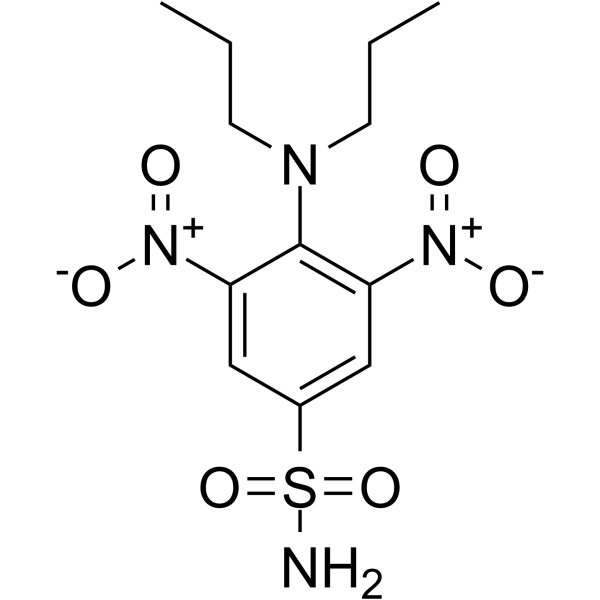
Cas No.: 19044-88-3
Sample solution is provided at 25 µL, 10mM.
_1-3.$$$39978408@51.jpg');)
_1-9.$$$38538795@65.jpg');)
_1-9.$$$39112701@51.jpg');)
_1-7.$$$37316672@70.jpg');)
_366-372.$$$36198801@70.jpg');)
.$$$38565142@65.jpg');)
_1867-1883.$$$33248023@67.jpg');)
_eads6055.$$$39977546@45.jpg');)
_eadm9805.$$$40080571@45.jpg');)
_eadj3020.$$$39666821@45.jpg');)
_1-20.$$$39757301@28.jpg');)
_1-24.$$$38898113@28.jpg');)
_273-287.$$$36806353@46.jpg');)
_1-16.$$$37156877@44.jpg');)
_1-19.$$$37460805@44.jpg');)
_1291-1307.$$$34518654@46.jpg');)
Oryzalin is a dinitroaniline herbicide. Oryzalin binds to plant tubulin and inhibits microtubule polymerization, thereby blocking mitosis and suppressing weed seedling growth. Oryzalin can be used in studies related to weed control and plant chromosome engineering[1-4].
In vitro, Oryzalin (0.1, 1, 10, 50μM) was applied to rice Nihon-Masari wild-type and ER31d suspension cells for 1–8 days. Oryzalin dose-dependently reduced cell viability, caused cell swelling and loss of anisotropy, and eliminated cortical microtubule arrays[5]. Oryzalin (0.41–31μM) was applied to Trypanosoma brucei variant 221 bloodstream forms, Leishmania donovani axenic amastigotes, J774 mouse macrophages, and PC3 human prostate cancer cells for 72h. Oryzalin inhibited the proliferation of T. brucei variant, L. donovani axenic amastigotes, J774 cells, and PC3 cells[6].
In vivo, Oryzalin (100mg/kg; every 12h) was administered by gastric intubation to neonatal Swiss ARC mice and Wistar neonatal rats inoculated with C. parvum oocysts for 3 days with a total of 6 doses. Oryzalin reduced the number of oocysts recovered from the guts of mice and rats[7]. Oryzalin (300–2000mg/kg; once daily) was administered by oral gavage or subcutaneous injection to C57Bl/6 mice bearing B16 melanoma tumors, starting 1 day after tumor inoculation for 3–10 days; Oryzalin (150–600mg/kg; once daily) was administered by subcutaneous or intraperitoneal injection to CD1 Nu/Nu mice bearing VRC5, CX-1, or HT-29 colon cancer xenografts, starting 7–14 days after tumor inoculation for 10 days. Oryzalin significantly inhibited the growth of B16 melanoma, while Oryzalin showed no obvious inhibitory effect on colon cancer xenografts[8].
References:
[1] Chen J, Yu Q, Patterson E, et al. Dinitroaniline Herbicide Resistance and Mechanisms in Weeds. Front Plant Sci. 2021 Mar 25;12:634018.
[2] Singh B, Yun S, Gil Y, et al. The Role of Colchicine in Plant Breeding. Int J Mol Sci. 2025 Jul 14;26(14):6743.
[3] Basit A, Lim KB. Systematic approach of polyploidy as an evolutionary genetic and genomic phenomenon in horticultural crops. Plant Sci. 2024 Nov;348:112236.
[4] Gantait S, Mukherjee E. Induced autopolyploidy-a promising approach for enhanced biosynthesis of plant secondary metabolites: an insight. J Genet Eng Biotechnol. 2021 Jan 8;19(1):4.
[5] Morettini S, Gianì S, Nick P, et al. Two anti-microtubular drugs for two differential responses: a rice cell line resistant to EPC remains susceptible to oryzalin. Plant Physiol Biochem. 2013 Feb;63:107-14.
[6] Bhattacharya G, Herman J, Delfín D, et al. Synthesis and antitubulin activity of N1- and N4-substituted 3,5-dinitro sulfanilamides against African trypanosomes and Leishmania. J Med Chem. 2004 Mar 25;47(7):1823-32.
[7] Armson A, Sargent K, MacDonald LM, et al. A comparison of the effects of two dinitroanilines against Cryptosporidium parvum in vitro and in vivo in neonatal mice and rats. FEMS Immunol Med Microbiol. 1999 Nov;26(2):109-13.
[8] Mara C, Dempsey E, Bell A, et al. Synthesis and evaluation of phosphoramidate and phosphorothioamidate analogues of amiprophos methyl as potential antimalarial agents. Bioorg Med Chem Lett. 2011 Oct 15;21(20):6180-3.
| Cell experiment [1]: | |
Cell lines | J774 mouse macrophages, PC3 human prostate cancer cells |
Preparation Method | J774 macrophages were maintained in DMEM supplemented with 10% heat-inactivated fetal calf serum, 2.0mM L-glutamine, 50units/mL penicillin and 50μg/mL streptomycin. PC3 cells were maintained in RPMI 1640 with the same supplements. Both cell types were incubated at 37°C, 5% CO₂. Cells were seeded at 10⁴ cells/mL (100μL per well) in 96-well plates. Cells were treated with Oryzalin. |
Reaction Conditions | 0.41–31μM; 72h |
Applications | Oryzalin inhibited the proliferation of J774 mouse macrophages and PC3 human prostate cancer cells with IC₅₀ values of 28±4μM and 31±8μM. |
| Animal experiment [2]: | |
Animal models | Neonatal Swiss ARC mice, Wistar neonatal rats, each inoculated with 105 viable Cryptosporidium parvum oocysts |
Preparation Method | Animals received Oryzalin via gastric intubation at 12-h intervals for 3 days starting from day 4 post-infection, with 6 doses in total. All animals were sacrificed on day 7 post-infection, and gut contents were collected to determine oocyst load. |
Dosage form | 100mg/kg; gastric intubation; twice daily for 3 days (6 total doses) |
Applications | Oryzalin at 100mg/kg caused 90% inhibition of oocysts recovered from the gut of infected neonatal Swiss ARC mice and 79% inhibition in infected Wistar neonatal rats. |
References: | |
| Cas No. | 19044-88-3 | SDF | |
| Formula | C12H18N4O6S | M.Wt | 346.36 |
| Solubility | DMSO : 250 mg/mL (721.79 mM; Need ultrasonic) | Storage | Store at -20°C |
| General tips | Please select the appropriate solvent to prepare the stock solution according to the
solubility of the product in different solvents; once the solution is prepared, please store it in
separate packages to avoid product failure caused by repeated freezing and thawing.Storage method
and period of the stock solution: When stored at -80°C, please use it within 6 months; when stored
at -20°C, please use it within 1 month. To increase solubility, heat the tube to 37°C and then oscillate in an ultrasonic bath for some time. |
||
| Shipping Condition | Evaluation sample solution: shipped with blue ice. All other sizes available: with RT, or with Blue Ice upon request. | ||
| Prepare stock solution | |||

|
1 mg | 5 mg | 10 mg |
| 1 mM | 2.8872 mL | 14.4358 mL | 28.8717 mL |
| 5 mM | 577.4 μL | 2.8872 mL | 5.7743 mL |
| 10 mM | 288.7 μL | 1.4436 mL | 2.8872 mL |
Step 1: Enter information below (Recommended: An additional animal making an allowance for loss during the experiment)
 g
μL
g
μL
Step 2: Enter the in vivo formulation (This is only the calculator, not formulation. Please contact us first if there is no in vivo formulation at the solubility Section.)
Calculation results:
Working concentration: mg/ml;
Method for preparing DMSO master liquid: mg drug pre-dissolved in μL DMSO ( Master liquid concentration mg/mL, Please contact us first if the concentration exceeds the DMSO solubility of the batch of drug. )
Method for preparing in vivo formulation: Take μL DMSO master liquid, next addμL PEG300, mix and clarify, next addμL Tween 80, mix and clarify, next add μL saline, mix and clarify.
Method for preparing in vivo formulation: Take μL DMSO master liquid, next add μL Corn oil, mix and clarify.
Note: 1. Please make sure the liquid is clear before adding the next solvent.
2. Be sure to add the solvent(s) in order. You must ensure that the solution obtained, in the previous addition, is a clear solution before proceeding to add the next solvent. Physical methods such as vortex, ultrasound or hot water bath can be used to aid dissolving.
3. All of the above co-solvents are available for purchase on the GlpBio website.
Quality Control & SDS
- View current batch:
- Purity: >98.00% Appearance: A solid
- COA (Certificate of Analysis)
- SDS (Safety Data Sheet)
- Datasheet
Average Rating: 5 (Based on Reviews and 30 reference(s) in Google Scholar.)