

PF 04418948 |
Catalog No.GC11067
 One-Click Copy Product Info
|

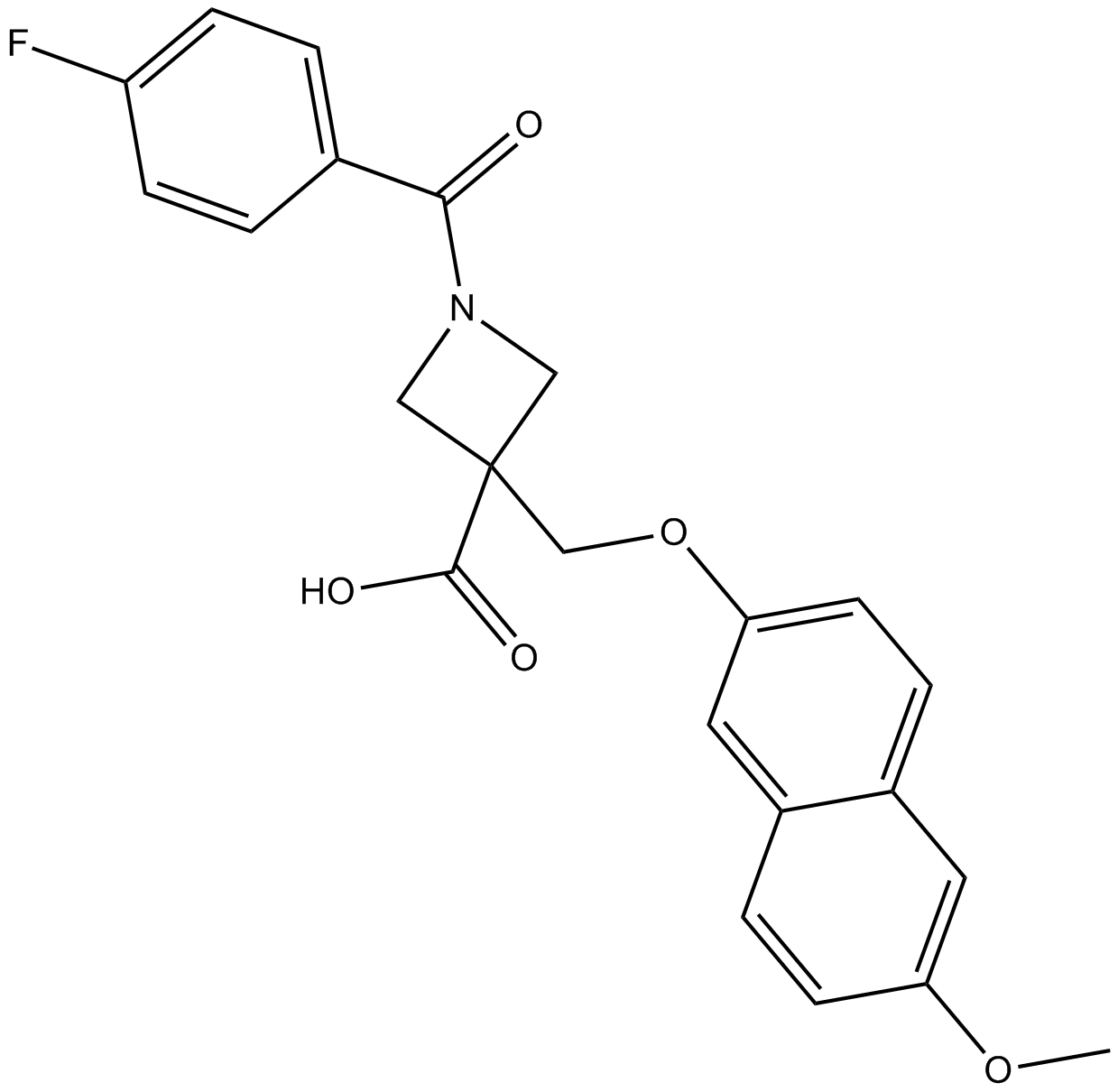
PF 04418948 is an orally active, potent, and selective prostaglandin EP2 receptor antagonist with an IC50 value of 16nM.
Products are for research use only. Not for human use. We do not sell to patients.
Cas No.: 1078166-57-0
Sample solution is provided at 25 µL, 10mM.
_1-3.$$$39978408@51.jpg');)
_1-9.$$$38538795@65.jpg');)
_1-9.$$$39112701@51.jpg');)
_1-7.$$$37316672@70.jpg');)
_366-372.$$$36198801@70.jpg');)
.$$$38565142@65.jpg');)
_1867-1883.$$$33248023@67.jpg');)
_eads6055.$$$39977546@45.jpg');)
_eadm9805.$$$40080571@45.jpg');)
_eadj3020.$$$39666821@45.jpg');)
_1-20.$$$39757301@28.jpg');)
_1-24.$$$38898113@28.jpg');)
_273-287.$$$36806353@46.jpg');)
_1-16.$$$37156877@44.jpg');)
_1-19.$$$37460805@44.jpg');)
_1291-1307.$$$34518654@46.jpg');)
PF 04418948 is an orally active, potent, and selective prostaglandin EP2 receptor antagonist with an IC50 value of 16nM [1]. PF 04418948 can inhibit the production of nitrite in microglia and reduce the accumulation of cyclic adenosine monophosphate (cAMP) by inhibiting the EP2 receptor[2]. PF 04418948 is widely used to inhibit the activation of satellite glial cells (SGCs) and alleviate the progression of temporomandibular joint osteoarthritis[3].
In vitro, PF 04418948 treatment (10nM) for 30 minutes significantly inhibited the excitatory effects of butaprost and treprostinil, and reduced the firing frequency of isolated rat locus coeruleus neurons[4]. Four days of treatment with 1µM PF 04418948 significantly inhibited the anti-proliferative effect of treprostinil on human pulmonary artery smooth muscle cells (hPASMCs) and prevented the activation of EP2 receptors[5]. 1µM of PF 04418948 pretreatment for 30 minutes significantly reduced the secretion of IL-6 by the growth-arrested human airway smooth muscle (ASM) cells, and inhibited the expression of IL-6 and COX-2 mRNA[6].
In vivo, PF 04418948 treatment via intraperitoneal injection at a dose of 10mg/kg/day for 10 days significantly alleviated the colitis induced by dextran sodium sulfate (DSS) in mice, and improved the weight loss and shortening of the colon in the mice[7]. Intracerebroventricular injection of PF 04418948 (5µl; 100nmol/rat) for 30 minutes significantly attenuated the changes in threshold pressure required to induce micturition (TP) induced by PGE2 (1nmol/rat)[8].
References:
[1] Af Forselles K J, Root J, Clarke T, et al. In vitro and in vivo characterization of PF‐04418948, a novel, potent and selective prostaglandin EP2 receptor antagonist[J]. British journal of pharmacology, 2011, 164(7): 1847-1856.
[2] Nagano T, Nishiyama R, Sanada A, et al. Prostaglandin E2 potentiates interferon‐γ‐induced nitric oxide production in cultured rat microglia[J]. Journal of neurochemistry, 2017, 140(4): 605-612.
[3] Ma X, Yuan Y, Zhu T, et al. EP2 Modulates Satellite Glial Cell Activation in Temporomandibular Joint Osteoarthritis Chronic Pain via p-ERK1/2 Signaling[J]. Journal of dental research, 2025, 104(10): 1127-1137.
[4] Nazabal A, Mendiguren A, Pineda J. Pharmacological characterization of prostaglandin E2 EP2 and EP4 receptors in male rat locus coeruleus neurons ex vivo[J]. Biochemical Pharmacology, 2024, 230: 116602.
[5] Patel J A, Shen L, Hall S M, et al. Prostanoid EP2 receptors are up-regulated in human pulmonary arterial hypertension: a key anti-proliferative target for treprostinil in smooth muscle cells[J]. International journal of molecular sciences, 2018, 19(8): 2372.
[6] Bradbury P, Rumzhum N N, Ammit A J. EP2 and EP4 receptor antagonists: Impact on cytokine production and β2‐adrenergic receptor desensitization in human airway smooth muscle[J]. Journal of Cellular Physiology, 2019, 234(7): 11070-11077.
[7] Wang C, Yu T, Wang Y, et al. Targeting the EP2 receptor ameliorates inflammatory bowel disease in mice by enhancing the immunosuppressive activity of Treg cells[J]. Mucosal Immunology, 2025, 18(2): 418-430.
[8] Shimizu T, Shimizu N, Tsubouchi S, et al. Centrally administered prostaglandin E2 suppresses the micturition reflex in rats[J]. Journal of Pharmacological Sciences, 2025, 158(3): 231-237.
| Cell experiment [1]: | |
Cell lines | Human airway smooth muscle (ASM) cells |
Preparation Method | Human ASM cells were cultured in DMEM medium supplemented with 10% fetal bovine serum (FBS), 5mg/ml of penicillin, and 5mg/ml of streptomycin at 37℃ in the presence of 5% CO2. Growth-arrested ASM cells were pretreated for 30min with a range of concentrations (0, 0.25, 0.5, 1, 2.5, 5, and 10µM) of PF 04418948 (EP2 receptor antagonist) or vehicle controls, before 24h treatment with PGE2 (100nM). IL-6 protein secretion was measured by ELISA. |
Reaction Conditions | 0, 0.25, 0.5, 1, 2.5, 5, and 10µM; 30min |
Applications | PF 04418948 treatment reduced the PGE2-induced IL-6 protein secretion in ASM cells in a dose-dependent manner. |
| Animal experiment [2]: | |
Animal models | C57BL/6J mice |
Preparation Method | Male C57BL/6J mice (6-weeks-old) were maintained in the specific pathogen-free animal laboratory in an environment with a controlled temperature (22±1°C) and relative humidity (50±5%) on a 12:12-h light/dark cycle, with free access to sterile food and water. For DSS-induced colitis, mice were subjected to DSS treatment (2% in drinking water) for 6-9 days. After 5 days of DSS treatment, mice were given daily doses of 10mg/kg PF 04418948 by intraperitoneal (i.p.) injections for an additional 10 days. Then, colon samples from the mice were collected for analysis. |
Dosage form | 10mg/kg/day for 10 days; i.p. |
Applications | PF 04418948 administration significantly improved DSS-induced weight loss and colon shortening in mice. |
References: | |
| Cas No. | 1078166-57-0 | SDF | |
| Chemical Name | 1-(4-fluorobenzoyl)-3-(((6-methoxynaphthalen-2-yl)oxy)methyl)azetidine-3-carboxylic acid | ||
| Canonical SMILES | FC1=CC=C(C=C1)C(N2CC(COC3=CC=C4C(C=CC(OC)=C4)=C3)(C(O)=O)C2)=O | ||
| Formula | C23H20FNO5 | M.Wt | 409.41 |
| Solubility | <0.834mg/mL in EtOH, Limited solubility in DMSO | Storage | Store at -20°C |
| General tips | Please select the appropriate solvent to prepare the stock solution according to the
solubility of the product in different solvents; once the solution is prepared, please store it in
separate packages to avoid product failure caused by repeated freezing and thawing.Storage method
and period of the stock solution: When stored at -80°C, please use it within 6 months; when stored
at -20°C, please use it within 1 month. To increase solubility, heat the tube to 37°C and then oscillate in an ultrasonic bath for some time. |
||
| Shipping Condition | Evaluation sample solution: shipped with blue ice. All other sizes available: with RT, or with Blue Ice upon request. | ||
| Prepare stock solution | |||

|
1 mg | 5 mg | 10 mg |
| 1 mM | 2.4425 mL | 12.2127 mL | 24.4254 mL |
| 5 mM | 488.5 μL | 2.4425 mL | 4.8851 mL |
| 10 mM | 244.3 μL | 1.2213 mL | 2.4425 mL |
Step 1: Enter information below (Recommended: An additional animal making an allowance for loss during the experiment)
 g
μL
g
μL
Step 2: Enter the in vivo formulation (This is only the calculator, not formulation. Please contact us first if there is no in vivo formulation at the solubility Section.)
Calculation results:
Working concentration: mg/ml;
Method for preparing DMSO master liquid: mg drug pre-dissolved in μL DMSO ( Master liquid concentration mg/mL, Please contact us first if the concentration exceeds the DMSO solubility of the batch of drug. )
Method for preparing in vivo formulation: Take μL DMSO master liquid, next addμL PEG300, mix and clarify, next addμL Tween 80, mix and clarify, next add μL saline, mix and clarify.
Method for preparing in vivo formulation: Take μL DMSO master liquid, next add μL Corn oil, mix and clarify.
Note: 1. Please make sure the liquid is clear before adding the next solvent.
2. Be sure to add the solvent(s) in order. You must ensure that the solution obtained, in the previous addition, is a clear solution before proceeding to add the next solvent. Physical methods such as vortex, ultrasound or hot water bath can be used to aid dissolving.
3. All of the above co-solvents are available for purchase on the GlpBio website.
Quality Control & SDS
- View current batch:
- Purity: >98.50% Appearance: A solid
- COA (Certificate of Analysis)
- SDS (Safety Data Sheet)
- Datasheet
Average Rating: 5 (Based on Reviews and 4 reference(s) in Google Scholar.)