

PIK-90 (Synonyms: PIK85) |
Catalog No.GC17199
 One-Click Copy Product Info
|

PI3K inhibitor,potent selective
Products are for research use only. Not for human use. We do not sell to patients.
Cas No.: 677338-12-4
Sample solution is provided at 25 µL, 10mM.
_1-3.$$$39978408@51.jpg');)
_1-9.$$$38538795@65.jpg');)
_1-9.$$$39112701@51.jpg');)
_1-7.$$$37316672@70.jpg');)
_366-372.$$$36198801@70.jpg');)
.$$$38565142@65.jpg');)
_1867-1883.$$$33248023@67.jpg');)
_eads6055.$$$39977546@45.jpg');)
_eadm9805.$$$40080571@45.jpg');)
_eadj3020.$$$39666821@45.jpg');)
_1-20.$$$39757301@28.jpg');)
_1-24.$$$38898113@28.jpg');)
_273-287.$$$36806353@46.jpg');)
_1-16.$$$37156877@44.jpg');)
_1-19.$$$37460805@44.jpg');)
_1291-1307.$$$34518654@46.jpg');)
PIK-90 is a broad-spectrum PI3K inhibitors that inhibits PI3Kα, PI3Kγ and PI3Kδ with IC50 values of 11, 18 and 58nM, respectively [1].
Studies showed that PIK-90 induced increased levels of secreted IgE at 1 μmol/L, while it inhibited IgE production at doses of greater than 2 μmol/L [2]. PIk-90 has been reported to block Akt phosphorylation. PIK-90 combined with the CDK2 inhibitor has been demonstrated to induce apoptosis in LN229 PTENWT cells. In addition, PIK-90 combined with siRNA against both CDK1 and CDK2 has shown to induce cell death, whereas PIK-90 combined with siRNA against CDK1 or CDK2 had no apoptotic effect [3].
In vivo, PIK-90 combined with roscovitine revealed a significant reduction of tumor size in nude mice implanted with GBM43 cells [3].
References:
[1] Van Keymeulen A1, Wong K, Knight ZA, Govaerts C, Hahn KM, Shokat KM, Bourne HR. To stabilize neutrophil polarity, PIP3 and Cdc42 augment RhoA activity at the back as well as signals at the front. J Cell Biol. 2006 Jul 31;174(3):437-45. Epub 2006 Jul 24.
[2] Zhang TT1, Okkenhaug K, Nashed BF, Puri KD, Knight ZA, Shokat KM, Vanhaesebroeck B, Marshall AJ. Genetic or pharmaceutical blockade of p110delta phosphoinositide 3-kinase enhances IgE production. J Allergy Clin Immunol. 2008 Oct;122(4):811-819.e2.
[3] Cheng CK1, Gustafson WC, Charron E, Houseman BT, Zunder E, Goga A, Gray NS, Pollok B, Oakes SA, James CD, Shokat KM, Weiss WA, Fan QW. Dual blockade of lipid and cyclin-dependent kinases induces synthetic lethality in malignant glioma. Proc Natl Acad Sci U S A. 2012 Jul 31;109(31):12722-7.
Cell experiment: | To determine the viability of CLL B cells, 200 μL cells are removed from the wells of a 24-well plate at the indicated time points and incubated for 15 minutes in fluorescence-activated cell sorter buffer (RPMI+0.5% BSA) containing 40 nM 3,3′-dihexyloxacarbocyanine iodide (DiOC6) and 10 μg/mL Propidium iodide (PI). Within 30 minutes, the cells are then analyzed by flow cytometry. Viable cells show high DiOC6 and low PI fluorescence, whereas apoptotic cells have low DiOC6 and PI fluorescence; necrotic cells are characterized by low DiOC6 and high PI fluorescence. The normal PBMCs are also cultured under the same conditions, with or without the various PI3K inhibitors (e.g., PIK-90, 1 μM and 10 μM), Fludarabine, and with or without stromal cell support, and their viability is also determined by staining with DiOC6 and PI[2]. |
Animal experiment: | Mice[3]Human primary GBM43 cells (106) are injected s.c. just caudal to the left forelimb in 4- to 6-wk-old female BALB/c nu/nu mice. After tumors are established (50-100 mm3), mice are randomly allocated to daily i.p. treatment with 40 mg/kg PIK-90 (DMSO:H2O), 50 mg/kg Roscovitine (DMSO:PBS), 40 mg/kg PIK-90 plus 50 mg/kg Roscovitine, and DMSO:H2O:PBS (control). Tumor diameters are measured with calipers at 3-d intervals, and volumes are calculated. |
References: [1]. Knight ZA, et al. A pharmacological map of the PI3-K family defines a role for p110alpha in insulin signaling. Cell. 2006 May 19;125(4):733-47. | |
| Cas No. | 677338-12-4 | SDF | |
| Synonyms | PIK85 | ||
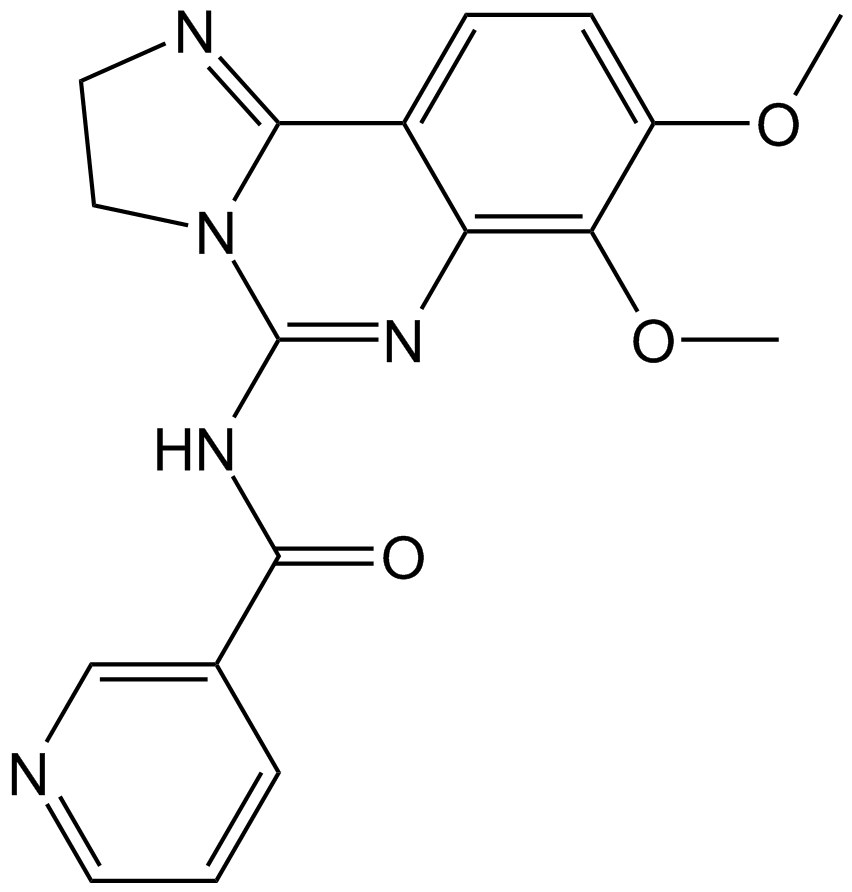
| Chemical Name | N-(7,8-dimethoxy-2,3-dihydroimidazo[1,2-c]quinazolin-5-yl)pyridine-3-carboxamide | ||
| Canonical SMILES | COC1=C(C2=C(C=C1)C3=NCCN3C(=N2)NC(=O)C4=CN=CC=C4)OC | ||
| Formula | C18H17N5O3 | M.Wt | 351.36 |
| Solubility | <3.51mg/mL in DMSO | Storage | Store at -20°C |
| General tips | Please select the appropriate solvent to prepare the stock solution according to the
solubility of the product in different solvents; once the solution is prepared, please store it in
separate packages to avoid product failure caused by repeated freezing and thawing.Storage method
and period of the stock solution: When stored at -80°C, please use it within 6 months; when stored
at -20°C, please use it within 1 month. To increase solubility, heat the tube to 37°C and then oscillate in an ultrasonic bath for some time. |
||
| Shipping Condition | Evaluation sample solution: shipped with blue ice. All other sizes available: with RT, or with Blue Ice upon request. | ||
| Prepare stock solution | |||

|
1 mg | 5 mg | 10 mg |
| 1 mM | 2.8461 mL | 14.2304 mL | 28.4608 mL |
| 5 mM | 569.2 μL | 2.8461 mL | 5.6922 mL |
| 10 mM | 284.6 μL | 1.423 mL | 2.8461 mL |
Step 1: Enter information below (Recommended: An additional animal making an allowance for loss during the experiment)
 g
μL
g
μL
Step 2: Enter the in vivo formulation (This is only the calculator, not formulation. Please contact us first if there is no in vivo formulation at the solubility Section.)
Calculation results:
Working concentration: mg/ml;
Method for preparing DMSO master liquid: mg drug pre-dissolved in μL DMSO ( Master liquid concentration mg/mL, Please contact us first if the concentration exceeds the DMSO solubility of the batch of drug. )
Method for preparing in vivo formulation: Take μL DMSO master liquid, next addμL PEG300, mix and clarify, next addμL Tween 80, mix and clarify, next add μL saline, mix and clarify.
Method for preparing in vivo formulation: Take μL DMSO master liquid, next add μL Corn oil, mix and clarify.
Note: 1. Please make sure the liquid is clear before adding the next solvent.
2. Be sure to add the solvent(s) in order. You must ensure that the solution obtained, in the previous addition, is a clear solution before proceeding to add the next solvent. Physical methods such as vortex, ultrasound or hot water bath can be used to aid dissolving.
3. All of the above co-solvents are available for purchase on the GlpBio website.
Quality Control & SDS
- View current batch:
- Purity: >99.00% Appearance: A solid
- COA (Certificate of Analysis)
- SDS (Safety Data Sheet)
- Datasheet
Average Rating: 5 (Based on Reviews and 12 reference(s) in Google Scholar.)