

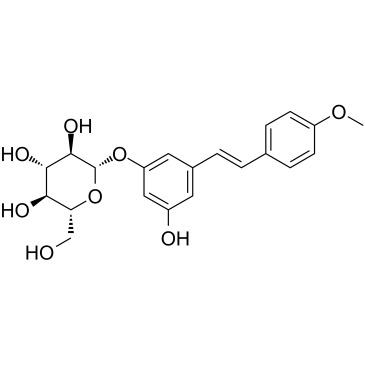
Desoxyrhaponticin |
Catalog No.GC38221
 One-Click Copy Product Info
|

Desoxyrhaponticin, a stilbene glycoside from rhubarb, is a potent BACE1 inhibitor with an IC50 value of 1.213µM.
Products are for research use only. Not for human use. We do not sell to patients.
Cas No.: 30197-14-9
Sample solution is provided at 25 µL, 10mM.
_1-3.$$$39978408@51.jpg');)
_1-9.$$$38538795@65.jpg');)
_1-9.$$$39112701@51.jpg');)
_1-7.$$$37316672@70.jpg');)
_366-372.$$$36198801@70.jpg');)
.$$$38565142@65.jpg');)
_1867-1883.$$$33248023@67.jpg');)
_eads6055.$$$39977546@45.jpg');)
_eadm9805.$$$40080571@45.jpg');)
_eadj3020.$$$39666821@45.jpg');)
_1-20.$$$39757301@28.jpg');)
_1-24.$$$38898113@28.jpg');)
_273-287.$$$36806353@46.jpg');)
_1-16.$$$37156877@44.jpg');)
_1-19.$$$37460805@44.jpg');)
_1291-1307.$$$34518654@46.jpg');)
Desoxyrhaponticin, a stilbene glycoside from rhubarb, is a potent BACE1 inhibitor with an IC50 value of 1.213µM [1]. Desoxyrhaponticin improves insulin resistance (IR) and reduces lipid accumulation through the PI3K/AKT/mTOR signaling pathway[2]. Desoxyrhaponticin is widely used as an internal standard to develop high-speed counter-current chromatography (HSCCC) methods for the large-scale separation and identification of related compounds[3].
In vitro, Desoxyrhaponticin treatment for 4 days significantly inhibited the proliferation of H1299 cells and HBE cells, with IC50 values of 86.68µM and 58.83µM, respectively[4]. Treatment with 400µM Desoxyrhaponticin for 24 hours strongly inhibited the expression of Fatty acid synthase (FAS) in MCF-7 cells and the activity of FAS within the cells, and promoted cell apoptosis[5]. Treatment with 10µM Desoxyrhaponticin for 48 hours significantly inhibited the accumulation of triglycerides (TG) in 3T3-L1 preadipocytes and increased the level of PPARγ[6].
In vivo, Desoxyrhaponticin treatment via a single oral administration at a dose of 300mg/kg for 2 hours significantly reduced postprandial hyperglycemia in diabetic rats[7].
References:
[1] Oh J M, Kim S H, Pandey B P, et al. A stilbenoid, rhapontigenin, isolated from the root of Rheum palmatum L. acts as a potent BACE1 inhibitor[J]. Fitoterapia, 2025, 182: 106484.
[2] Gao Y, Wu Y, Tie F, et al. Stilbenoids from fenugreek seeds alleviate insulin resistance by regulating the PI3K/AKT/mTOR signaling pathway in a type 2 diabetes zebrafish model[J]. Heliyon, 2024, 10(13).
[3] Wang X, Wang H, Ding C, et al. One‐step preparative separation of two polyhydroxystilbenes from Rheum likiangense sam. by high‐speed counter‐current chromatography[J]. Phytochemical Analysis, 2012, 23(6): 684-688.
[4] Fan M, Liu Q, Ma X, et al. ZNF131-BACH1 transcriptionally accelerates RAD51-dependent homologous recombination repair and therapy-resistance of non-small-lung cancer cells by preventing their degradation from CUL3[J]. Theranostics, 2024, 14(18): 7241.
[5] Li P, Tian W, Wang X, et al. Inhibitory effect of desoxyrhaponticin and rhaponticin, two natural stilbene glycosides from the Tibetan nutritional food Rheum tanguticum Maxim. ex Balf., on fatty acid synthase and human breast cancer cells[J]. Food & function, 2014, 5(2): 251-256.
[6] Li G, Luan G, He Y, et al. Polyphenol Stilbenes from Fenugreek (Trigonella foenum-graecum L.) Seeds Improve Insulin Sensitivity and Mitochondrial Function in 3T3‐L1 Adipocytes[J]. Oxidative Medicine and Cellular Longevity, 2018, 2018(1): 7634362.
[7] Li J M, Che C T, Lau C B S, et al. Desoxyrhaponticin (3, 5-dihydroxy-4′-methoxystilbene 3-O-β-d-glucoside) inhibits glucose uptake in the intestine and kidney: In vitro and in vivo studies[J]. The Journal of pharmacology and experimental therapeutics, 2007, 320(1): 38-46.
| Cell experiment [1]: | |
|
Cell lines |
H1299 cells |
|
Preparation Method |
H1299 cells were grown in RPMI-1640 medium with 10% (v/v) fetal bovine serum (FBS), 100U/ml penicillin and 100μg/ml streptomycin at 37°C in 5% CO2/atmosphere. H1299 cells (3×10³ cells) were seeded on 96-well plates, incubated for 24h, and then treated with different concentrations of Desoxyrhaponticin (0, 10, 20, 40, 80, 160, 320 and 640µM) at 37°C. After 4 days, cell viability was measured. |
|
Reaction Conditions |
0, 10, 20, 40, 80, 160, 320 and 640µM; 4 days |
|
Applications |
Desoxyrhaponticin treatment significantly reduced the cell viability of H1299 cells in a concentration-dependent manner. |
| Animal experiment [2]: | |
|
Animal models |
Wistar rats |
|
Preparation Method |
Neonatal Wistar rats were injected with streptozotocin (STZ) i.p. (100mg/kg in 50mM citrate buffer, pH 4.5) on the first day of birth. Mice were weaned 21 days after birth, housed in stainless steel wire cages, and given standard laboratory chow and tap water ad libitum. After 2h of fasting of the 12-week-old diabetic rats, an oral glucose tolerance test (OGTT) was performed. Glucose (2g/kg) was orally administered to the diabetic rats as a 0.4g/ml glucose solution. Desoxyrhaponticin was administered to the mice (300mg/kg; p.o.) in a 50% PEG 400 solution just before the glucose loading. Mice in the untreated diabetic group were given the 50% PEG 400 solution as the solvent control. Blood samples were collected from the tip of the rats’ tails before the glucose administration and at different times afterwards up to 120min. The plasma glucose level was measured. |
|
Dosage form |
300mg/kg for once; p.o. |
|
Applications |
Desoxyrhaponticin treatment significantly reduced postprandial hyperglycemia in diabetic rats. |
|
References: |
|
| Cas No. | 30197-14-9 | SDF | |
| Canonical SMILES | COC(C=C1)=CC=C1/C=C/C2=CC(O)=CC(O[C@@H]3O[C@@H]([C@@H](O)[C@H](O)[C@H]3O)CO)=C2 | ||
| Formula | C21H24O8 | M.Wt | 404.41 |
| Solubility | Soluble in DMSO | Storage | 4°C, protect from light |
| General tips | Please select the appropriate solvent to prepare the stock solution according to the
solubility of the product in different solvents; once the solution is prepared, please store it in
separate packages to avoid product failure caused by repeated freezing and thawing.Storage method
and period of the stock solution: When stored at -80°C, please use it within 6 months; when stored
at -20°C, please use it within 1 month. To increase solubility, heat the tube to 37°C and then oscillate in an ultrasonic bath for some time. |
||
| Shipping Condition | Evaluation sample solution: shipped with blue ice. All other sizes available: with RT, or with Blue Ice upon request. | ||
| Prepare stock solution | |||

|
1 mg | 5 mg | 10 mg |
| 1 mM | 2.4727 mL | 12.3637 mL | 24.7274 mL |
| 5 mM | 494.5 μL | 2.4727 mL | 4.9455 mL |
| 10 mM | 247.3 μL | 1.2364 mL | 2.4727 mL |
Step 1: Enter information below (Recommended: An additional animal making an allowance for loss during the experiment)
 g
μL
g
μL
Step 2: Enter the in vivo formulation (This is only the calculator, not formulation. Please contact us first if there is no in vivo formulation at the solubility Section.)
Calculation results:
Working concentration: mg/ml;
Method for preparing DMSO master liquid: mg drug pre-dissolved in μL DMSO ( Master liquid concentration mg/mL, Please contact us first if the concentration exceeds the DMSO solubility of the batch of drug. )
Method for preparing in vivo formulation: Take μL DMSO master liquid, next addμL PEG300, mix and clarify, next addμL Tween 80, mix and clarify, next add μL saline, mix and clarify.
Method for preparing in vivo formulation: Take μL DMSO master liquid, next add μL Corn oil, mix and clarify.
Note: 1. Please make sure the liquid is clear before adding the next solvent.
2. Be sure to add the solvent(s) in order. You must ensure that the solution obtained, in the previous addition, is a clear solution before proceeding to add the next solvent. Physical methods such as vortex, ultrasound or hot water bath can be used to aid dissolving.
3. All of the above co-solvents are available for purchase on the GlpBio website.
Quality Control & SDS
- View current batch:
- Purity: >98.00% Appearance: A solid
- COA (Certificate of Analysis)
- SDS (Safety Data Sheet)
- Datasheet
Average Rating: 5 (Based on Reviews and 27 reference(s) in Google Scholar.)