

Pyrimethamine (Synonyms: Darapram, Daraprim, Khloridin, NSC 3061) |
Catalog No.GC17867
 One-Click Copy Product Info
|

A dihydrofolate reductase inhibitor
Products are for research use only. Not for human use. We do not sell to patients.
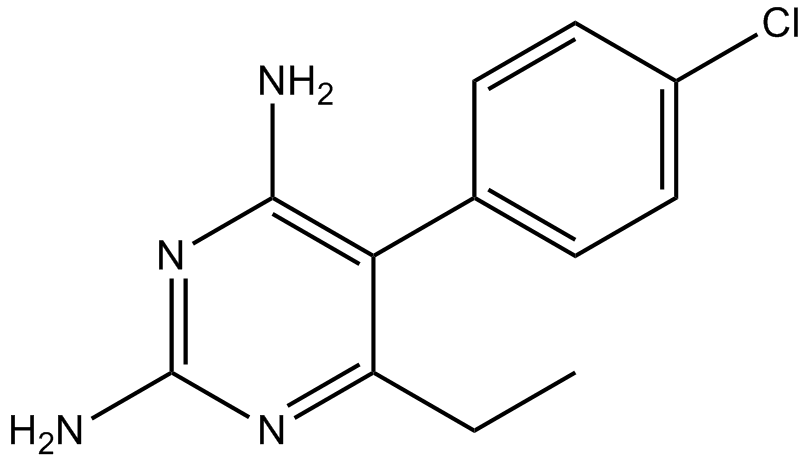
Cas No.: 58-14-0
Sample solution is provided at 25 µL, 10mM.
_1-3.$$$39978408@51.jpg');)
_1-9.$$$38538795@65.jpg');)
_1-9.$$$39112701@51.jpg');)
_1-7.$$$37316672@70.jpg');)
_366-372.$$$36198801@70.jpg');)
.$$$38565142@65.jpg');)
_1867-1883.$$$33248023@67.jpg');)
_eads6055.$$$39977546@45.jpg');)
_eadm9805.$$$40080571@45.jpg');)
_eadj3020.$$$39666821@45.jpg');)
_1-20.$$$39757301@28.jpg');)
_1-24.$$$38898113@28.jpg');)
_273-287.$$$36806353@46.jpg');)
_1-16.$$$37156877@44.jpg');)
_1-19.$$$37460805@44.jpg');)
_1291-1307.$$$34518654@46.jpg');)
Pyrimethamine(RP4753) is a medication used for protozoal infections; interferes with tetrahydrofolic acid synthesis from folic acid by inhibiting the enzyme dihydrofolate reductase (DHFR).IC50 Value: 15.4 nM (Plasmodium falciparum) [1]Target: DHFR; antifolatein vitro: Three susceptibility levels (susceptible, intermediate, and resistant) were observed in the response of culture-adapted clones and strains to pyrimethamine (50% inhibitory concentration [IC50]) 2,000 nM) and cycloguanil (IC50 500 nM). Based on these susceptibility levels, 73 and 68 of 96 fresh clinical isolates were susceptible to pyrimethamine (mean IC50 15.4 nM) and cycloguanil (mean IC50 11.1 nM), respectively [1]. We tested pyrimethamine(previously reported to suppress SOD1 expression), several compounds currently in trials in human and murine ALS, and a set of 1040 FDA-approved compounds. In a PC12 cell-based assay, no compounds reduced SOD1 promoter activity without concomitant cytotoxicity. Additionally,pyrimethamine failed to repress levels of SOD1 protein in HeLa cells or homogenates of liver, spinal cord and brain of wild-type mice [3].in vivo: (131)I-Pyrimethamine (specific activity: 7.08 MBq/ mol) was injected intravenously into the tail vein of the control and infected rats. Static whole body images of the rats were acquired under the gamma camera at 5 min, 45 min, 2 h, 6 h, and 24 h following the intravenous administration of the radioactivity (3.7 MBq/rat) [2]. The 10-day treatment with 10mg/kg/day of fluconazole combined with 40/1mg/kg/day sulfadiazine and pyrimethamine resulted in 93% survival of CF1 mice acutely infected with the highly virulent T. gondii RH strain, versus 36% of mice treated with just sulfadiazine and pyrimethamine [4].Toxicity: Sulfadoxine/pyrimethamine is well tolerated as treatment and when used as intermittent preventive treatment in pregnant African women. Sulfadoxine/pyrimethamine is no longer used as prophylaxis because it may cause toxic epidermal necrolysis and Stevens Johnson syndrome [5].
References:
[1]. Basco LK, et al. In vitro activity of pyrimethamine, cycloguanil, and other antimalarial drugs against African isolates and clones of Plasmodium falciparum. Am J Trop Med Hyg. 1994 Feb; 50(2):193-9.
[2]. Inceboz T, et al. Preparation of (131)I-Pyrimethamine and evaluation for scintigraphy of experimentally Toxoplasma gondii-infectedrats. J Drug Target. 2013 Feb;21(2):175-9.
[3]. Wright PD, et al. Screening for inhibitors of the SOD1 gene promoter: pyrimethamine does not reduce SOD1 levels in cell and animal models. Neurosci Lett. 2010 Oct 4;482(3):188-92.
[4]. Martins-Duarte ES, et al. Toxoplasma gondii: the effect of fluconazole combined with sulfadiazine and pyrimethamine against acute toxoplasmosis in murine model. Exp Parasitol. 2013 Mar;133(3):294-9.
[5]. Taylor WR, et al. Antimalarial drug toxicity: a review. Drug Saf. 2004;27(1):25-61.
| Cas No. | 58-14-0 | SDF | |
| Synonyms | Darapram, Daraprim, Khloridin, NSC 3061 | ||
| Chemical Name | 5-(4-chlorophenyl)-6-ethylpyrimidine-2,4-diamine | ||
| Canonical SMILES | CCC1=C(C(=NC(=N1)N)N)C2=CC=C(C=C2)Cl | ||
| Formula | C12H13ClN4 | M.Wt | 248.71 |
| Solubility | ≥ 10 mg/mL in DMSO with gentle warming, ≥ 5.23 mg/mL in EtOH with ultrasonic | Storage | Store at -20°C |
| General tips | Please select the appropriate solvent to prepare the stock solution according to the
solubility of the product in different solvents; once the solution is prepared, please store it in
separate packages to avoid product failure caused by repeated freezing and thawing.Storage method
and period of the stock solution: When stored at -80°C, please use it within 6 months; when stored
at -20°C, please use it within 1 month. To increase solubility, heat the tube to 37°C and then oscillate in an ultrasonic bath for some time. |
||
| Shipping Condition | Evaluation sample solution: shipped with blue ice. All other sizes available: with RT, or with Blue Ice upon request. | ||
| Prepare stock solution | |||

|
1 mg | 5 mg | 10 mg |
| 1 mM | 4.0207 mL | 20.1037 mL | 40.2075 mL |
| 5 mM | 804.1 μL | 4.0207 mL | 8.0415 mL |
| 10 mM | 402.1 μL | 2.0104 mL | 4.0207 mL |
Step 1: Enter information below (Recommended: An additional animal making an allowance for loss during the experiment)
 g
μL
g
μL
Step 2: Enter the in vivo formulation (This is only the calculator, not formulation. Please contact us first if there is no in vivo formulation at the solubility Section.)
Calculation results:
Working concentration: mg/ml;
Method for preparing DMSO master liquid: mg drug pre-dissolved in μL DMSO ( Master liquid concentration mg/mL, Please contact us first if the concentration exceeds the DMSO solubility of the batch of drug. )
Method for preparing in vivo formulation: Take μL DMSO master liquid, next addμL PEG300, mix and clarify, next addμL Tween 80, mix and clarify, next add μL saline, mix and clarify.
Method for preparing in vivo formulation: Take μL DMSO master liquid, next add μL Corn oil, mix and clarify.
Note: 1. Please make sure the liquid is clear before adding the next solvent.
2. Be sure to add the solvent(s) in order. You must ensure that the solution obtained, in the previous addition, is a clear solution before proceeding to add the next solvent. Physical methods such as vortex, ultrasound or hot water bath can be used to aid dissolving.
3. All of the above co-solvents are available for purchase on the GlpBio website.
Quality Control & SDS
- View current batch:
- Purity: >99.50% Appearance: A solid
- COA (Certificate of Analysis)
- SDS (Safety Data Sheet)
- Datasheet
Average Rating: 5 (Based on Reviews and 30 reference(s) in Google Scholar.)