

Dihydrorotenone |
Catalog No.GC38620
 One-Click Copy Product Info
|

Dihydrorotenone is an insecticide and irreversible inhibitor of mitochondrial complex I and can cross the blood-brain barrier.
Products are for research use only. Not for human use. We do not sell to patients.
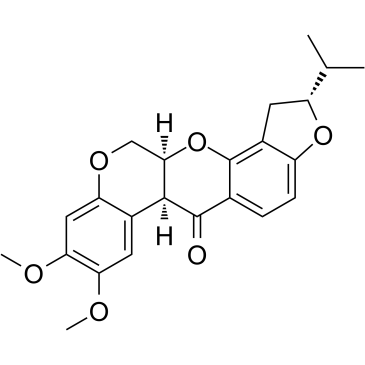
Cas No.: 6659-45-6
Sample solution is provided at 25 µL, 10mM.
_1-3.$$$39978408@51.jpg');)
_1-9.$$$38538795@65.jpg');)
_1-9.$$$39112701@51.jpg');)
_1-7.$$$37316672@70.jpg');)
_366-372.$$$36198801@70.jpg');)
.$$$38565142@65.jpg');)
_1867-1883.$$$33248023@67.jpg');)
_eads6055.$$$39977546@45.jpg');)
_eadm9805.$$$40080571@45.jpg');)
_eadj3020.$$$39666821@45.jpg');)
_1-20.$$$39757301@28.jpg');)
_1-24.$$$38898113@28.jpg');)
_273-287.$$$36806353@46.jpg');)
_1-16.$$$37156877@44.jpg');)
_1-19.$$$37460805@44.jpg');)
_1291-1307.$$$34518654@46.jpg');)
Dihydrorotenone is an insecticide and irreversible inhibitor of mitochondrial complex I and can cross the blood-brain barrier [1]. Dihydrorotenone binds to and inhibits the complex I in the electron transport chain, thus inhibiting mitochondrial function and decreasing ATP production[2]. Dihydrorotenone can be labeled for use in radioautography to investigate the unique distribution of complex I in the brain[3].
In vitro, Dihydrorotenone treatment at 20µM for 24 hours triggered endoplasmic reticulum stress and activated the p38 signaling pathway, leading to apoptosis of KMS11 cells[4]. Treatment with 15µM Dihydrorotenone for 24 hours inhibited the expression of cell cycle proteins, causing LP1 cells to be arrested in the G0/G1 phase and reducing the phosphorylation levels of AKT and ERK[5]. After 2 weeks of treatment with 1µM Dihydrorotenone, the expressions of FSP1, PDGFRα and PDGFRβ in SCAF#36 cells significantly decreased, the expression of pro-inflammatory cytokine genes was significantly downregulated, and the cell viability significantly declined[6].
References:
[1] Ambrose A M, Christensen H E, Rather L J. Toxicological and pharmacological studies on dihydrorotenone[J]. Journal of the American Pharmaceutical Association (Scientific ed.), 1953, 42(6): 364-366.
[2] Talpade D J, Greene J G, Higgins Jr D S, et al. In vivo labeling of mitochondrial complex I (NADH: ubiquinoneoxidoreductase) in rat brain using [3H] dihydrorotenone[J]. Journal of neurochemistry, 2000, 75(6): 2611-2621.
[3] Greenamyre J T, Higgins D S, Eller R V. Quantitative autoradiography of dihydrorotenone binding to complex I of the electron transport chain[J]. Journal of neurochemistry, 1992, 59(2): 746-749.
[4] Zhang J, Tang J, Cao B, et al. The natural pesticide dihydrorotenone induces human plasma cell apoptosis by triggering endoplasmic reticulum stress and activating p38 signaling pathway[J]. PloS one, 2013, 8(7): e69911.
[5] Xu X, Zhang J, Han K, et al. Natural pesticide dihydrorotenone arrests human plasma cancer cells at the G0/G1 phase of the cell cycle[J]. Journal of Biochemical and Molecular Toxicology, 2014, 28(5): 232-238.
[6] Lee E, Yeo S Y, Lee K W, et al. New screening system using Twist1 promoter activity identifies dihydrorotenone as a potent drug targeting cancer-associated fibroblasts[J]. Scientific Reports, 2020, 10(1): 7058.
| Cell experiment [1]: | |
Cell lines | KMS11 cells |
Preparation Method | KMS11 cells were cultured in DMEM medium supplemented with 10% fetal bovine serum (FBS) and antibiotics (penicillin 100U/ml, streptomycin 0.1mg/ml) in an incubator humidified with 95% air and 5% CO2 at 37°C. KMS11 cells were cultured in 96-well plates at a density of 1.5×10⁴ cells per well and treated with 0, 0.39, 0.78, 1.56, 3.12, 6.25, 12.5, and 25µM of Dihydrorotenone. After incubation for 72 hours, the cell viability was detected. |
Reaction Conditions | 0, 0.39, 0.78, 1.56, 3.12, 6.25, 12.5, and 25µM; 72h |
Applications | Dihydrorotenone treatment decreased the cell viability of KMS11 cells in a dose-dependent manner. |
References: | |
| Cas No. | 6659-45-6 | SDF | |
| Canonical SMILES | O=C1[C@]2([H])[C@](COC3=CC(OC)=C(OC)C=C32)([H])OC4=C5C(O[C@@H](C(C)C)C5)=CC=C14 | ||
| Formula | C23H24O6 | M.Wt | 396.43 |
| Solubility | DMSO : 25 mg/mL (63.06 mM; Need ultrasonic) | Storage | Store at -20°C |
| General tips | Please select the appropriate solvent to prepare the stock solution according to the
solubility of the product in different solvents; once the solution is prepared, please store it in
separate packages to avoid product failure caused by repeated freezing and thawing.Storage method
and period of the stock solution: When stored at -80°C, please use it within 6 months; when stored
at -20°C, please use it within 1 month. To increase solubility, heat the tube to 37°C and then oscillate in an ultrasonic bath for some time. |
||
| Shipping Condition | Evaluation sample solution: shipped with blue ice. All other sizes available: with RT, or with Blue Ice upon request. | ||
| Prepare stock solution | |||

|
1 mg | 5 mg | 10 mg |
| 1 mM | 2.5225 mL | 12.6126 mL | 25.2251 mL |
| 5 mM | 504.5 μL | 2.5225 mL | 5.045 mL |
| 10 mM | 252.3 μL | 1.2613 mL | 2.5225 mL |
Step 1: Enter information below (Recommended: An additional animal making an allowance for loss during the experiment)
 g
μL
g
μL
Step 2: Enter the in vivo formulation (This is only the calculator, not formulation. Please contact us first if there is no in vivo formulation at the solubility Section.)
Calculation results:
Working concentration: mg/ml;
Method for preparing DMSO master liquid: mg drug pre-dissolved in μL DMSO ( Master liquid concentration mg/mL, Please contact us first if the concentration exceeds the DMSO solubility of the batch of drug. )
Method for preparing in vivo formulation: Take μL DMSO master liquid, next addμL PEG300, mix and clarify, next addμL Tween 80, mix and clarify, next add μL saline, mix and clarify.
Method for preparing in vivo formulation: Take μL DMSO master liquid, next add μL Corn oil, mix and clarify.
Note: 1. Please make sure the liquid is clear before adding the next solvent.
2. Be sure to add the solvent(s) in order. You must ensure that the solution obtained, in the previous addition, is a clear solution before proceeding to add the next solvent. Physical methods such as vortex, ultrasound or hot water bath can be used to aid dissolving.
3. All of the above co-solvents are available for purchase on the GlpBio website.
Quality Control & SDS
- View current batch:
- Purity: >98.00% Appearance: A solid
- COA (Certificate of Analysis)
- SDS (Safety Data Sheet)
- Datasheet
Average Rating: 5 (Based on Reviews and 20 reference(s) in Google Scholar.)