

Pyruvic acid (2-Oxopropanoic acid) |
Catalog No.GC30192
 One-Click Copy Product Info
|

Pyruvic acid (2-Oxopropanoic acid) is an intermediate metabolite in the metabolism of carbohydrates, proteins, and fats.
Products are for research use only. Not for human use. We do not sell to patients.
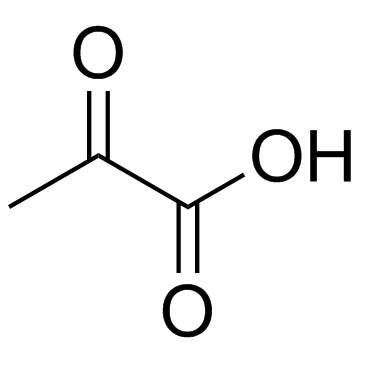
Cas No.: 127-17-3
Sample solution is provided at 25 µL, 10mM.
_1-3.$$$39978408@51.jpg');)
_1-9.$$$38538795@65.jpg');)
_1-9.$$$39112701@51.jpg');)
_1-7.$$$37316672@70.jpg');)
_366-372.$$$36198801@70.jpg');)
.$$$38565142@65.jpg');)
_1867-1883.$$$33248023@67.jpg');)
_eads6055.$$$39977546@45.jpg');)
_eadm9805.$$$40080571@45.jpg');)
_eadj3020.$$$39666821@45.jpg');)
_1-20.$$$39757301@28.jpg');)
_1-24.$$$38898113@28.jpg');)
_273-287.$$$36806353@46.jpg');)
_1-16.$$$37156877@44.jpg');)
_1-19.$$$37460805@44.jpg');)
_1291-1307.$$$34518654@46.jpg');)
Pyruvic acid (2-Oxopropanoic acid), an important organic chemical intermediate, is a potential precursor for polymers [1]. Pyruvic acid is converted into carbohydrates through gluconeogenesis, which are further transformed into fatty acids/energy, and ultimately into amino acids, such as alanine and ethanol[2]. Pyruvic acid combines the keratolytic effect of α-keto acids and the humectant effects of lactic acid, and has been widely used as a topical peeling agent to mitigate acne [3].
In vitro, Pyruvic acid treatment (1mM) for 8 hours significantly inhibited Cu2+/Zn2+-induced cell death in GT1-7 cells, alleviated mitochondrial damage, and reduced the release of cytochrome c into the cytoplasm[4]. Treatment with 10mM Pyruvic acid for 24 hours significantly increased the survival of N-2A cells under 500µM H₂O₂ conditions[5]. Pyruvic acid treatment at 5mM for 48 hours significantly reduced the tyrosinase activity in B16F10 cells, induced GSK3β phosphorylation, and activated the PI3K/AKT signaling pathway, thereby leading to a decrease in melanin synthesis[6].
In vivo, Pyruvic acid treatment via intraperitoneal injection at a single dose of 1g/kg 15 minutes before administering sodium sulfide (100mg/kg; i.p.) significantly reduced the mortality rate of mice[7].
References:
[1] Maleki N, Eiteman M A. Recent progress in the microbial production of pyruvic acid[J]. Fermentation, 2017, 3(1): 8.
[2] Pal D, Keshav A, Mazumdar B, et al. Production and recovery of pyruvic acid: recent advances[J]. Journal of The Institution of Engineers (India): Series E, 2017, 98(2): 165-175.
[3] Cotellessa C, Manunta T, Ghersetich I, et al. The use of pyruvic acid in the treatment of acne[J]. Journal of the European Academy of Dermatology and Venereology, 2004, 18(3): 275-278.
[4] Tanaka K, Shimoda M, Kawahara M. Pyruvic acid prevents Cu2+/Zn2+-induced neurotoxicity by suppressing mitochondrial injury[J]. Biochemical and biophysical research communications, 2018, 495(1): 1335-1341.
[5] Mazzio E, Soliman K F A. Pyruvic acid cytoprotection against 1-methyl-4-phenylpyridinium, 6-hydroxydopamine and hydrogen peroxide toxicities in vitro[J]. Neuroscience Letters, 2003, 337(2): 77-80.
[6] Zhou S, Sakamoto K. Pyruvic acid/ethyl pyruvate inhibits melanogenesis in B16F10 melanoma cells through PI3K/AKT, GSK3β, and ROS‐ERK signaling pathways[J]. Genes to Cells, 2019, 24(1): 60-69.
[7] Dulaney Jr M, Hume A S. Pyruvic acid protects against the lethality of sulfide[J]. Research communications in chemical pathology and pharmacology, 1988, 59(1): 133-136.
| Cell experiment [1]: | |
Cell lines | N-2A cells |
Preparation Method | N-2A cells were grown in Dulbecco's Modified Eagle Medium (DMEM) with 10% (v/v) fetal bovine serum (FBS), 4mM l-glutamine, and penicillin/streptomycin (100Units/0.1mg per ml) at 37°C in 5% CO2/atmosphere. The N-2A cells were treated with different concentrations of Pyruvic acid (0, 0.1, 1, 5, and 10mM) and H2O2 (500μM) at 37°C for 24 hours, and then the cell viability was analyzed. |
Reaction Conditions | 0, 0.1, 1, 5, and 10mM; 24h |
Applications | Pyruvic acid treatment significantly enhanced the cell viability of N-2A cells in the presence of H2O2 in a dose-dependent manner. |
References: | |
| Cas No. | 127-17-3 | SDF | |
| Canonical SMILES | CC(C(O)=O)=O | ||
| Formula | C3H4O3 | M.Wt | 88.06 |
| Solubility | ≥43 mg/mL in EtOH; ≥55.2 mg/mL in DMSO; ≥8.8 mg/mL in Water | Storage | Store at 2-8°C,stored under nitrogen |
| General tips | Please select the appropriate solvent to prepare the stock solution according to the
solubility of the product in different solvents; once the solution is prepared, please store it in
separate packages to avoid product failure caused by repeated freezing and thawing.Storage method
and period of the stock solution: When stored at -80°C, please use it within 6 months; when stored
at -20°C, please use it within 1 month. To increase solubility, heat the tube to 37°C and then oscillate in an ultrasonic bath for some time. |
||
| Shipping Condition | Evaluation sample solution: shipped with blue ice. All other sizes available: with RT, or with Blue Ice upon request. | ||
| Prepare stock solution | |||

|
1 mg | 5 mg | 10 mg |
| 1 mM | 11.3559 mL | 56.7795 mL | 113.5589 mL |
| 5 mM | 2.2712 mL | 11.3559 mL | 22.7118 mL |
| 10 mM | 1.1356 mL | 5.6779 mL | 11.3559 mL |
Step 1: Enter information below (Recommended: An additional animal making an allowance for loss during the experiment)
 g
μL
g
μL
Step 2: Enter the in vivo formulation (This is only the calculator, not formulation. Please contact us first if there is no in vivo formulation at the solubility Section.)
Calculation results:
Working concentration: mg/ml;
Method for preparing DMSO master liquid: mg drug pre-dissolved in μL DMSO ( Master liquid concentration mg/mL, Please contact us first if the concentration exceeds the DMSO solubility of the batch of drug. )
Method for preparing in vivo formulation: Take μL DMSO master liquid, next addμL PEG300, mix and clarify, next addμL Tween 80, mix and clarify, next add μL saline, mix and clarify.
Method for preparing in vivo formulation: Take μL DMSO master liquid, next add μL Corn oil, mix and clarify.
Note: 1. Please make sure the liquid is clear before adding the next solvent.
2. Be sure to add the solvent(s) in order. You must ensure that the solution obtained, in the previous addition, is a clear solution before proceeding to add the next solvent. Physical methods such as vortex, ultrasound or hot water bath can be used to aid dissolving.
3. All of the above co-solvents are available for purchase on the GlpBio website.
Quality Control & SDS
- View current batch:
- Purity: >98.00% Appearance: A liquid
- COA (Certificate of Analysis)
- SDS (Safety Data Sheet)
- Datasheet
Average Rating: 5 (Based on Reviews and 10 reference(s) in Google Scholar.)