

R 568 hydrochloride (Synonyms: KRN 568, NPS R-568, Tecalcet) |
Catalog No.GC17700
 One-Click Copy Product Info
|

R 568 hydrochloride is a kind of calcimimetic agent which can changed the structural conformation of the calcium-sensing receptor (CaSR) and stereo-selectively increased its sensitivity to extracellular Ca2+.
Products are for research use only. Not for human use. We do not sell to patients.
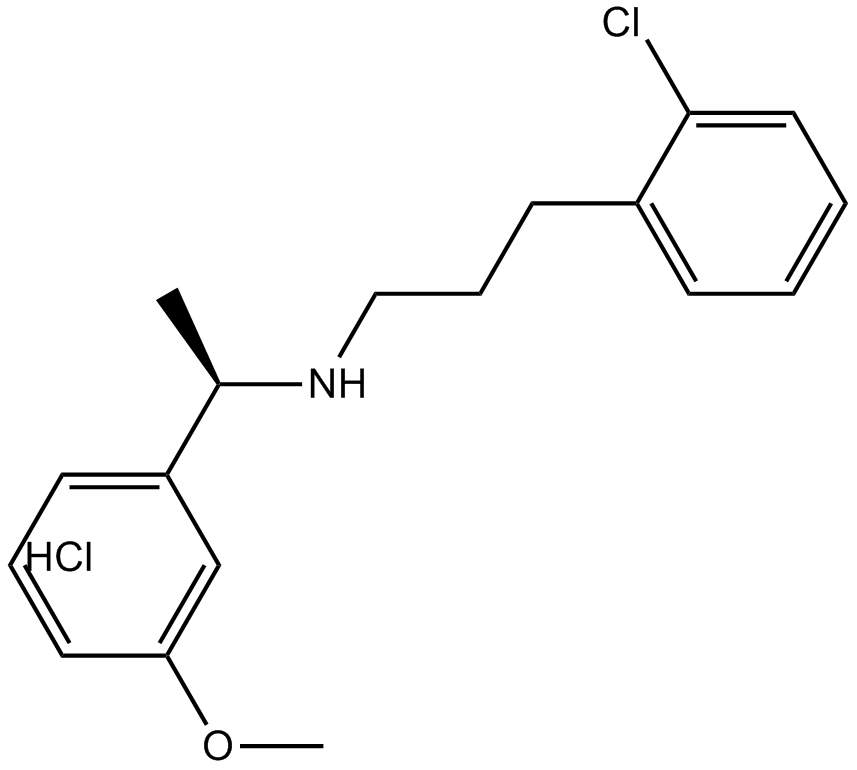
Cas No.: 177172-49-5
Sample solution is provided at 25 µL, 10mM.
R 568 hydrochloride is a kind of calcimimetic agent which can changed the structural conformation of the calcium-sensing receptor (CaSR) and stereo-selectively increased its sensitivity to extracellular Ca2+ [1]. R 568 hydrochloride, as a phenylalkylamine derivative of calcimimetics, has been subjected to clinical trials and shown a dose-dependent decrease in the levels of parathyroid hormone (PTH) [2].
R 568 hydrochloride (1μM; 4h) significantly upregulated IL-8 expression in HT29CaSR-GFP cells; R 568 hydrochloride (1μM; 4h) significantly upregulated the expression of COX-2 and PGES-1 [3].
R 568 hydrochloride (20μmol/kg; 8weeks; s.c.) decreased the blood urea nitrogen (BUN) levels of Sprague-Dawley (SD) rats with uremic; R 568 hydrochloride (20μmol/kg; 8weeks; s.c.) suppressed the increase in parathyroid gland volume of SD rats with uremic [4]. R 568 hydrochloride (3, 30mg/kg; 16d; p.o.) reduced serum PTH levels of SD rats which subjected to a partial nephrectomy [5]. R 568 hydrochloride (0.5, 1.0, 2.5 and 5.0mg/kg; 30min; i.v.) decreased plasma Ca2+ concentration in Wistar rats [6].
References:
[1] Ureña P, Frazão J M. Calcimimetic agents: review and perspectives [J]. Kidney international Supplement, 2003, (85): S91-S96.
[2] Wada M, Furuya Y, Sakiyama J, et al. The calcimimetic compound NPS R-568 suppresses parathyroid cell proliferation in rats with renal insufficiency. Control of parathyroid cell growth via a calcium receptor [J]. The Journal of clinical investigation, 1997, 100(12): 2977-2983.
[3] Gushchina V, Kupper N, Schwarzkopf M, et al. The calcium-sensing receptor modulates the prostaglandin E2 pathway in intestinal inflammation [J]. Frontiers in pharmacology, 2023, 14: 1151144.
[4] Wada M, Nagano N, Furuya Y, et al. Calcimimetic NPS R-568 prevents parathyroid hyperplasia in rats with severe secondary hyperparathyroidism [J]. Kidney international, 2000, 57(1): 50-58.
[5] Wada M, Ishii H, Furuya Y, et al. NPS R-568 halts or reverses osteitis fibrosa in uremic rats [J]. Kidney international, 1998, 53(2): 448-453.
[6] Rybczyńska A, Boblewski K, Lehmann A, et al. Pharmacological activity of calcimimetic NPS R-568 administered intravenously in rats: dose dependency [J]. Pharmacological reports, 2006, 58(4): 533-539.
| Cell experiment [1]: | |
Cell lines | HT29 cells |
Preparation Method | HT29 cells were lentivirally transduced to stably express the CaSR fused to GFP (HT29CaSR-GFP), and when the cells reached 80% confluency, they were treated with vehicle (H2O) or 1µM R 568 hydrochloride for 4h. |
Reaction Conditions | 1μM; 4h |
Applications | R 568 hydrochloride significantly upregulated IL-8 expression in HT29CaSR-GFP cells. |
| Animal experiment [2]: | |
Animal models | Male Sprague-Dawley rats |
Preparation Method | Rats were rendered uremic using a two-step partial ligation procedure and then received continuous subcutaneous infusion (20μmol/kg) of R 568 hydrochloride for 8weeks. |
Dosage form | 20μmol/kg; 8weeks; s.c. |
Applications | R 568 hydrochloride suppressed the increase in parathyroid gland volume of uremic rats by decreased the cell volume and cell number of gland. |
References: | |
| Cas No. | 177172-49-5 | SDF | |
| Synonyms | KRN 568, NPS R-568, Tecalcet | ||
| Chemical Name | (R)-3-(2-chlorophenyl)-N-(1-(3-methoxyphenyl)ethyl)propan-1-amine hydrochloride | ||
| Canonical SMILES | ClC1=CC=CC=C1CCCN[C@H](C)C2=CC=CC(OC)=C2.Cl | ||
| Formula | C18H22ClNO.HCl | M.Wt | 340.29 |
| Solubility | DMF: 5 mg/ml,DMSO: 10 mg/ml,Ethanol: 10 mg/ml,PBS (pH 7.2): 5 mg/ml | Storage | Store at -20°C |
| General tips | Please select the appropriate solvent to prepare the stock solution according to the
solubility of the product in different solvents; once the solution is prepared, please store it in
separate packages to avoid product failure caused by repeated freezing and thawing.Storage method
and period of the stock solution: When stored at -80°C, please use it within 6 months; when stored
at -20°C, please use it within 1 month. To increase solubility, heat the tube to 37°C and then oscillate in an ultrasonic bath for some time. |
||
| Shipping Condition | Evaluation sample solution: shipped with blue ice. All other sizes available: with RT, or with Blue Ice upon request. | ||
| Prepare stock solution | |||

|
1 mg | 5 mg | 10 mg |
| 1 mM | 2.9387 mL | 14.6933 mL | 29.3867 mL |
| 5 mM | 587.7 μL | 2.9387 mL | 5.8773 mL |
| 10 mM | 293.9 μL | 1.4693 mL | 2.9387 mL |
Step 1: Enter information below (Recommended: An additional animal making an allowance for loss during the experiment)
 g
μL
g
μL
Step 2: Enter the in vivo formulation (This is only the calculator, not formulation. Please contact us first if there is no in vivo formulation at the solubility Section.)
Calculation results:
Working concentration: mg/ml;
Method for preparing DMSO master liquid: mg drug pre-dissolved in μL DMSO ( Master liquid concentration mg/mL, Please contact us first if the concentration exceeds the DMSO solubility of the batch of drug. )
Method for preparing in vivo formulation: Take μL DMSO master liquid, next addμL PEG300, mix and clarify, next addμL Tween 80, mix and clarify, next add μL saline, mix and clarify.
Method for preparing in vivo formulation: Take μL DMSO master liquid, next add μL Corn oil, mix and clarify.
Note: 1. Please make sure the liquid is clear before adding the next solvent.
2. Be sure to add the solvent(s) in order. You must ensure that the solution obtained, in the previous addition, is a clear solution before proceeding to add the next solvent. Physical methods such as vortex, ultrasound or hot water bath can be used to aid dissolving.
3. All of the above co-solvents are available for purchase on the GlpBio website.
Quality Control & SDS
- View current batch:
- Purity: >98.00% Appearance: A solid
- COA (Certificate of Analysis)
- SDS (Safety Data Sheet)
- Datasheet
Average Rating: 5 (Based on Reviews and 18 reference(s) in Google Scholar.)