

RA190 |
Catalog No.GC32765
 One-Click Copy Product Info
|

RA190, a bis-benzylidine piperidon, inhibits proteasome function by covalently binding to cysteine 88 of ubiquitin receptor RPN13.
Products are for research use only. Not for human use. We do not sell to patients.
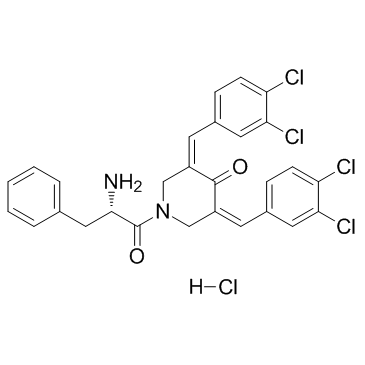
Cas No.: 1617495-03-0
Sample solution is provided at 25 µL, 10mM.
_1-3.$$$39978408@51.jpg');)
_1-9.$$$38538795@65.jpg');)
_1-9.$$$39112701@51.jpg');)
_1-7.$$$37316672@70.jpg');)
_366-372.$$$36198801@70.jpg');)
.$$$38565142@65.jpg');)
_1867-1883.$$$33248023@67.jpg');)
_eads6055.$$$39977546@45.jpg');)
_eadm9805.$$$40080571@45.jpg');)
_eadj3020.$$$39666821@45.jpg');)
_1-20.$$$39757301@28.jpg');)
_1-24.$$$38898113@28.jpg');)
_273-287.$$$36806353@46.jpg');)
_1-16.$$$37156877@44.jpg');)
_1-19.$$$37460805@44.jpg');)
_1291-1307.$$$34518654@46.jpg');)
RA190, a bis-benzylidine piperidon, inhibits proteasome function by covalently binding to cysteine 88 of ubiquitin receptor RPN13.
RA190 covalently binds to cysteine 88 of ubiquitin receptor RPN13 in the 19S regulatory particle and inhibits proteasome function, triggering rapid accumulation of polyubiquitinated proteins. Multiple myeloma (MM) lines, even those resistant to bortezomib, are sensitive to RA190 via endoplasmic reticulum stress-related apoptosis. RA190 stabilizes targets of human papillomavirus (HPV) E6 oncoprotein, and preferentially kills HPV-transformed cells[1].
RA190 distributes to plasma and major organs excepting brain, and inhibits proteasome function in skin and muscle. RA190 administration profoundly reduces growth of multiple myeloma and ovarian cancer xenografts, and oral RA190 treatment retards HPV16+ syngeneic mouse tumor growth, without impacting spontaneous HPV-specific CD8+ T cell responses[1].
[1]. Anchoori RK, et al. A bis-benzylidine piperidone targeting proteasome ubiquitin receptor RPN13/ADRM1 as a therapy for cancer. Cancer Cell. 2013 Dec 9;24(6):791-805.
Cell experiment: | RA190 is dissolved in DMSO and diluted with cell culture medium. HeLa cells are treated with RA190 (0.2, 0.4, 0.6, 0.8, 1, 2, 3, 4, 5 μM) for 48 hr. Cell viability is assayed using commerical kit[1]. |
Animal experiment: | Mice: Mice are divided into two groups and treated daily i.p. with RA190 (10 mg/kg) or vehicle, and imaged again on day 7 and day 14. NOG mice (5 per group) are inoculated with 1X10⁶ NCI-H929-GFP-Luc cells i.v., and after 4 weeks, mice are imaged for their luciferase activity and divided into two groups. Mice are treated i.p. with RA190 (20 mg/kg) or vehicle, and imaged again at the end of the treatment for their luciferase activity[1]. |
References: [1]. Anchoori RK, et al. A bis-benzylidine piperidone targeting proteasome ubiquitin receptor RPN13/ADRM1 as a therapy for cancer. Cancer Cell. 2013 Dec 9;24(6):791-805. | |
| Cas No. | 1617495-03-0 | SDF | |
| Canonical SMILES | O=C1/C(CN(C([C@@H](N)CC2=CC=CC=C2)=O)C/C1=C/C3=CC=C(Cl)C(Cl)=C3)=C\C4=CC=C(Cl)C(Cl)=C4.[H]Cl | ||
| Formula | C28H23Cl5N2O2 | M.Wt | 596.76 |
| Solubility | DMSO : ≥ 100 mg/mL (167.57 mM);Water : < 0.1 mg/mL (insoluble) | Storage | Store at -20°C |
| General tips | Please select the appropriate solvent to prepare the stock solution according to the
solubility of the product in different solvents; once the solution is prepared, please store it in
separate packages to avoid product failure caused by repeated freezing and thawing.Storage method
and period of the stock solution: When stored at -80°C, please use it within 6 months; when stored
at -20°C, please use it within 1 month. To increase solubility, heat the tube to 37°C and then oscillate in an ultrasonic bath for some time. |
||
| Shipping Condition | Evaluation sample solution: shipped with blue ice. All other sizes available: with RT, or with Blue Ice upon request. | ||
| Prepare stock solution | |||

|
1 mg | 5 mg | 10 mg |
| 1 mM | 1.6757 mL | 8.3786 mL | 16.7572 mL |
| 5 mM | 335.1 μL | 1.6757 mL | 3.3514 mL |
| 10 mM | 167.6 μL | 837.9 μL | 1.6757 mL |
Step 1: Enter information below (Recommended: An additional animal making an allowance for loss during the experiment)
 g
μL
g
μL
Step 2: Enter the in vivo formulation (This is only the calculator, not formulation. Please contact us first if there is no in vivo formulation at the solubility Section.)
Calculation results:
Working concentration: mg/ml;
Method for preparing DMSO master liquid: mg drug pre-dissolved in μL DMSO ( Master liquid concentration mg/mL, Please contact us first if the concentration exceeds the DMSO solubility of the batch of drug. )
Method for preparing in vivo formulation: Take μL DMSO master liquid, next addμL PEG300, mix and clarify, next addμL Tween 80, mix and clarify, next add μL saline, mix and clarify.
Method for preparing in vivo formulation: Take μL DMSO master liquid, next add μL Corn oil, mix and clarify.
Note: 1. Please make sure the liquid is clear before adding the next solvent.
2. Be sure to add the solvent(s) in order. You must ensure that the solution obtained, in the previous addition, is a clear solution before proceeding to add the next solvent. Physical methods such as vortex, ultrasound or hot water bath can be used to aid dissolving.
3. All of the above co-solvents are available for purchase on the GlpBio website.
Quality Control & SDS
- View current batch:
- Purity: >99.00% Appearance: A solid
- COA (Certificate of Analysis)
- SDS (Safety Data Sheet)
- Datasheet
Average Rating: 5 (Based on Reviews and 31 reference(s) in Google Scholar.)