

Risarestat (CT 112) (Synonyms: CT 112) |
Catalog No.GC31474
 One-Click Copy Product Info
|

Risarestat (CT 112) (CT-112), an aldose reductase inhibitor, is developed for the treatment of diabetic complications.
Products are for research use only. Not for human use. We do not sell to patients.
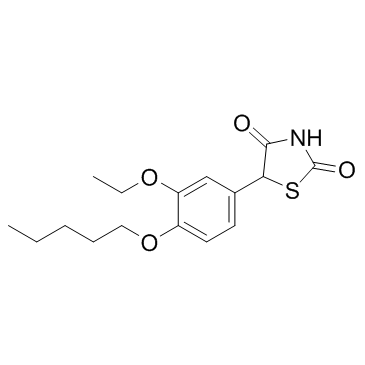
Cas No.: 79714-31-1
Sample solution is provided at 25 µL, 10mM.
_1-3.$$$39978408@51.jpg');)
_1-9.$$$38538795@65.jpg');)
_1-9.$$$39112701@51.jpg');)
_1-7.$$$37316672@70.jpg');)
_366-372.$$$36198801@70.jpg');)
.$$$38565142@65.jpg');)
_1867-1883.$$$33248023@67.jpg');)
_eads6055.$$$39977546@45.jpg');)
_eadm9805.$$$40080571@45.jpg');)
_eadj3020.$$$39666821@45.jpg');)
_1-20.$$$39757301@28.jpg');)
_1-24.$$$38898113@28.jpg');)
_273-287.$$$36806353@46.jpg');)
_1-16.$$$37156877@44.jpg');)
_1-19.$$$37460805@44.jpg');)
_1291-1307.$$$34518654@46.jpg');)
Risarestat (CT-112), an aldose reductase inhibitor, is developed for the treatment of diabetic complications.
Risarestat inhibits the accumulation of dulcitol in a dose-dependent manner, except for the 1.0% solution which has an activity comparable to the 0.25% solution[1]. Risarestat peaks in the corneal epithelium, stroma, endothelium and aqueous humor in 30 minutes following instillation, then gradually diminishes time-dependently over a period of 24 hours. Risarestat remains detectable in the lens up to 24 hours, with a peak concentration at 2 hours after instillation[2]. The anterior surface area of superficial cells in the group treated with Risarestat is significantly decreases from a mean value of 881 to 728 microns2. Corneal sensitivity significantly improves from 5.36 to 1.37 g/mm2[3]. Animals treated with Risarestat shows a significant increase in the mean blinkresponse compared to untreated galactose-fed rats and does not differ significantly from controls towards the completion of the 7 month study. Animals treated topically with Risarestat and untreated galactose-fed rats develop bilateral nuclear cataracts within 3 weeks[4].
[1]. Awata T, et al. Effect of an aldose reductase inhibitor, CT-112, on healing of the corneal epithelium in galactose-fed rats. J Ocul Pharmacol. 1988 Fall;4(3):195-201. [2]. Ohashi Y, et al. Intraocular penetration of CT-112, an aldose reductase inhibitor, following topical instillation. J Ocul Pharmacol. 1989 Winter;5(4):325-8. [3]. Hosotani H, et al. Reversal of abnormal corneal epithelial cell morphologic characteristics and reduced corneal sensitivity in diabetic patients by aldose reductase inhibitor, CT-112. Am J Ophthalmol. 1995 Mar;119(3):288-94. [4]. Jacot JL, et al. Diabetic-like corneal sensitivity loss in galactose-fed rats ameliorated with aldose reductase inhibitors. J Ocul Pharmacol Ther. 1998 Apr;14(2):169-80.
Animal experiment: | Rats: The other 5 groups are fed on a 50% galactose diet, and 0.1, 0.25, 0.5 or 1.0% Risarestat ophthalmic solution or its vehicle is instilled in both eyes 4 times a day in each of the 5 treated groups. After 2 weeks, the corneal epithelium is scraped off in all rats and its dulcitol content is determined by gas chromatography[1]. Rabbits: Risarestat is prepared in acetate-buffered saline. 50 μL of 0.5% Risarestat in 7mM acetate-buffered saline (pH 5.2, 290 mOsm) containing 0.15% chlorbutanol as a preservative is instilled to both conjunctival sac of rabbits. This ophthalmic solution is proven to be untoxic to the external eye after 90 days' instillation to the rabbits 9 times a day. The rabbits are then sacrificed at, 15 and 30 minutes, 1, 2, 4, 8, and 24 hours after instillation[2]. |
References: [1]. Awata T, et al. Effect of an aldose reductase inhibitor, CT-112, on healing of the corneal epithelium in galactose-fed rats. J Ocul Pharmacol. 1988 Fall;4(3):195-201. | |
| Cas No. | 79714-31-1 | SDF | |
| Synonyms | CT 112 | ||
| Canonical SMILES | O=C(N1)SC(C2=CC=C(OCCCCC)C(OCC)=C2)C1=O | ||
| Formula | C16H21NO4S | M.Wt | 323.41 |
| Solubility | DMSO : 105 mg/mL (324.67 mM; Need ultrasonic) | Storage | Store at -20°C |
| General tips | Please select the appropriate solvent to prepare the stock solution according to the
solubility of the product in different solvents; once the solution is prepared, please store it in
separate packages to avoid product failure caused by repeated freezing and thawing.Storage method
and period of the stock solution: When stored at -80°C, please use it within 6 months; when stored
at -20°C, please use it within 1 month. To increase solubility, heat the tube to 37°C and then oscillate in an ultrasonic bath for some time. |
||
| Shipping Condition | Evaluation sample solution: shipped with blue ice. All other sizes available: with RT, or with Blue Ice upon request. | ||
| Prepare stock solution | |||

|
1 mg | 5 mg | 10 mg |
| 1 mM | 3.0921 mL | 15.4603 mL | 30.9205 mL |
| 5 mM | 618.4 μL | 3.0921 mL | 6.1841 mL |
| 10 mM | 309.2 μL | 1.546 mL | 3.0921 mL |
Step 1: Enter information below (Recommended: An additional animal making an allowance for loss during the experiment)
 g
μL
g
μL
Step 2: Enter the in vivo formulation (This is only the calculator, not formulation. Please contact us first if there is no in vivo formulation at the solubility Section.)
Calculation results:
Working concentration: mg/ml;
Method for preparing DMSO master liquid: mg drug pre-dissolved in μL DMSO ( Master liquid concentration mg/mL, Please contact us first if the concentration exceeds the DMSO solubility of the batch of drug. )
Method for preparing in vivo formulation: Take μL DMSO master liquid, next addμL PEG300, mix and clarify, next addμL Tween 80, mix and clarify, next add μL saline, mix and clarify.
Method for preparing in vivo formulation: Take μL DMSO master liquid, next add μL Corn oil, mix and clarify.
Note: 1. Please make sure the liquid is clear before adding the next solvent.
2. Be sure to add the solvent(s) in order. You must ensure that the solution obtained, in the previous addition, is a clear solution before proceeding to add the next solvent. Physical methods such as vortex, ultrasound or hot water bath can be used to aid dissolving.
3. All of the above co-solvents are available for purchase on the GlpBio website.
Quality Control & SDS
- View current batch:
- Purity: >98.00% Appearance: A solid
- COA (Certificate of Analysis)
- SDS (Safety Data Sheet)
- Datasheet
Average Rating: 5 (Based on Reviews and 37 reference(s) in Google Scholar.)