

Rolipram (Synonyms: SB 95952, ZK 62711) |
Catalog No.GC16629
 One-Click Copy Product Info
|

Rolipram is a selective inhibitor of phosphodiesterases (PDE) IV.
Products are for research use only. Not for human use. We do not sell to patients.
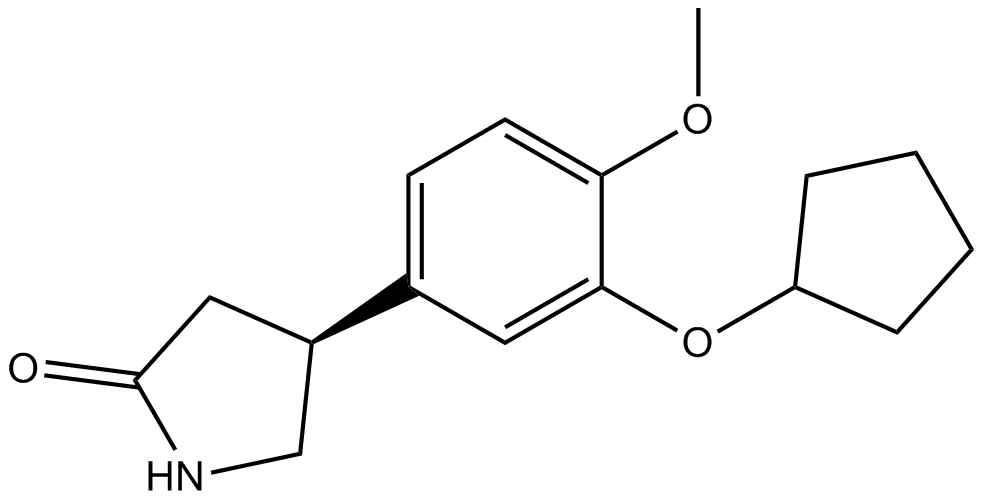
Cas No.: 61413-54-5
Sample solution is provided at 25 µL, 10mM.
Rolipram is a selective inhibitor of phosphodiesterases (PDE) IV[1]. Rolipram increases intracellular cAMP and cGMP by inhibiting PDE, leading to an increase of norepinephrine, which suppresses expression of proinflammatory cytokines and other mediators of inflammation[1]. Rolipram has potential clinical significance in alleviating endogenous depression and inflammation in the central nervous system[1].
In vitro, Rolipram (10μM; 24h) significantly inhibited the basal adhesion of T lymphoblasts to ICAM-1 (intercellular adhesion molecule-1) and VCAM-1 (vascular cell adhesion molecule-1)[2]. Rolipram (10μM; 1h) significantly inhibited lipopolysaccharide (LPS)-induced upregulation and secretion of TNF-α and IL-6 in cardiac fibroblasts[3]. Rolipram (50nM; 24h) inhibited the expression of TGF‑β1 in hypertrophic fibroblasts[4].
In vivo, Rolipram (10mg/kg; i.p.) with a single dose reduced the production of IL-1β, IL-5, IL-6 and TNF-α, while increasing the levels of IL-10 in C57BL/6 mice induced by lipopolysaccharide[5]. Rolipram (1mg/kg; i.p.) acutely restored capillary perfusion in 18h in murine cecal ligation and puncture (CLP) C57BL/6 mice model[6]. Rolipram (1.25mg/kg; 10d; i.p.) attenuated cognitive decline as well as anxiety- and depression-like behaviors in the triple-transgenic mice (3×Tg-AD) harboring 3 mutant genes APPswe, Ps1M146V and tauP301L[7].
References:
[1] hu J, Mix E, Winblad B. The antidepressant and antiinflammatory effects of rolipram in the central nervous system [J]. CNS drug reviews, 2001, 7(4): 387-398.
[2] Layseca-Espinosa E, Baranda L, Alvarado-Sánchez B, et al. Rolipram inhibits polarization and migration of human T lymphocytes [J]. The Journal of investigative dermatology, 2003, 121(1): 81-87.
[3] Ji J, Liu Z, Hong X, et al. Protective effects of rolipram on endotoxic cardiac dysfunction via inhibition of the inflammatory response in cardiac fibroblasts [J]. BMC cardiovascular disorders, 2020, 20(1): 242.
[4] Wu L, Xu L, Chen Y, et al. Rolipram plays an anti-fibrotic effect in ligamentum flavum fibroblasts by inhibiting the activation of ERK1/2 [J]. BMC musculoskeletal disorders, 2021, 22(1): 818.
[5] Lu X, Wang J, Chen X, et al. Rolipram protects mice from gram-negative bacterium Escherichia coli-induced inflammation and septic shock [J]. Scientific reports, 2020, 10(1): 175.
[6] Holthoff J H, Wang Z, Patil N K, et al. Rolipram improves renal perfusion and function during sepsis in the mouse [J]. The Journal of pharmacology and experimental therapeutics, 2013, 347(2): 357-364.
[7] Cong Y F, Liu F W, Xu L, et al. Rolipram ameliorates memory deficits and depression-like behavior in APP/PS1/tau triple transgenic mice: involvement of neuroinflammation and apoptosis via cAMP signaling [J]. The international journal of neuropsychopharmacology, 2023, 26(9): 585-598.
| Cell experiment [1]: | |
|
Cell lines |
Cardiac fibroblasts |
|
Preparation Method |
Cardiac fibroblasts were treated with 1μg/ml lipopolysaccharide (LPS) for 6h or 10μM Rolipram for 1h before LPS stimulation. LPS was dissolved in normal saline, and Rolipram was dissolved in dimethylsulfoxide (DMSO). The TNF-ɑ, IL-6 concentrations in the supernatant of cardiac fibroblasts were measured by enzyme immunoassays. |
|
Reaction Conditions |
10μM; 1h |
|
Applications |
Rolipram significantly inhibited LPS-induced upregulation and secretion of TNF-α and IL-6. |
| Animal experiment [2]: | |
|
Animal models |
Male C57BL/6 mice |
|
Preparation Method |
Mice received vehicle or Rolipram (10mg/kg) 1h before LPS (15mg/kg; i.p.) injection. LPS was dissolved in PBS and Rolipram was dissolved in DMSO and further diluted in PBS. Blood samples were collected at 0, 3, 12, 24, and 48h after LPS injection for cytokine/chemokine assays. |
|
Dosage form |
10mg/kg; i.p. |
|
Applications |
Rolipram reduced the production of IL-1β, IL-5, IL-6 and TNF-α, while increased the levels of IL-10. |
References: [1] Ji J, Liu Z, Hong X, et al. Protective effects of rolipram on endotoxic cardiac dysfunction via inhibition of the inflammatory response in cardiac fibroblasts [J]. BMC cardiovascular disorders, 2020, 20(1): 242. [2] Lu X, Wang J, Chen X, et al. Rolipram protects mice from gram-negative bacterium Escherichia coli-induced inflammation and septic shock [J]. Scientific reports, 2020, 10(1): 175. | |
| Cas No. | 61413-54-5 | SDF | |
| Synonyms | SB 95952, ZK 62711 | ||
| Chemical Name | 4-(3-cyclopentyloxy-4-methoxyphenyl)pyrrolidin-2-one | ||
| Canonical SMILES | COC1=C(C=C(C=C1)C2CC(=O)NC2)OC3CCCC3 | ||
| Formula | C16H21NO3 | M.Wt | 275.34 |
| Solubility | ≥ 13 mg/mL in DMSO, ≥ 24.65 mg/mL in EtOH with ultrasonic | Storage | Store at -20°C |
| General tips | Please select the appropriate solvent to prepare the stock solution according to the
solubility of the product in different solvents; once the solution is prepared, please store it in
separate packages to avoid product failure caused by repeated freezing and thawing.Storage method
and period of the stock solution: When stored at -80°C, please use it within 6 months; when stored
at -20°C, please use it within 1 month. To increase solubility, heat the tube to 37°C and then oscillate in an ultrasonic bath for some time. |
||
| Shipping Condition | Evaluation sample solution: shipped with blue ice. All other sizes available: with RT, or with Blue Ice upon request. | ||
| Prepare stock solution | |||

|
1 mg | 5 mg | 10 mg |
| 1 mM | 3.6319 mL | 18.1594 mL | 36.3187 mL |
| 5 mM | 726.4 μL | 3.6319 mL | 7.2637 mL |
| 10 mM | 363.2 μL | 1.8159 mL | 3.6319 mL |
Step 1: Enter information below (Recommended: An additional animal making an allowance for loss during the experiment)
 g
μL
g
μL
Step 2: Enter the in vivo formulation (This is only the calculator, not formulation. Please contact us first if there is no in vivo formulation at the solubility Section.)
Calculation results:
Working concentration: mg/ml;
Method for preparing DMSO master liquid: mg drug pre-dissolved in μL DMSO ( Master liquid concentration mg/mL, Please contact us first if the concentration exceeds the DMSO solubility of the batch of drug. )
Method for preparing in vivo formulation: Take μL DMSO master liquid, next addμL PEG300, mix and clarify, next addμL Tween 80, mix and clarify, next add μL saline, mix and clarify.
Method for preparing in vivo formulation: Take μL DMSO master liquid, next add μL Corn oil, mix and clarify.
Note: 1. Please make sure the liquid is clear before adding the next solvent.
2. Be sure to add the solvent(s) in order. You must ensure that the solution obtained, in the previous addition, is a clear solution before proceeding to add the next solvent. Physical methods such as vortex, ultrasound or hot water bath can be used to aid dissolving.
3. All of the above co-solvents are available for purchase on the GlpBio website.
Quality Control & SDS
- View current batch:
- Purity: >99.50% Appearance: A solid
- COA (Certificate of Analysis)
- SDS (Safety Data Sheet)
- Datasheet
Average Rating: 5 (Based on Reviews and 30 reference(s) in Google Scholar.)