

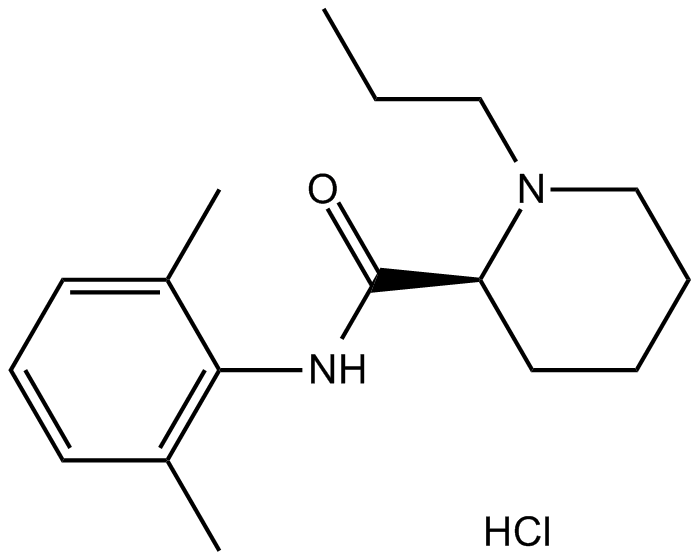
Ropivacaine HCl |
Catalog No.GC14932
 One-Click Copy Product Info
|

Ropivacaine HCl is a potentsodium channelblocker and blocks impulse conduction via reversible inhibition ofsodium ion influxin nerve fibrese.
Products are for research use only. Not for human use. We do not sell to patients.
Cas No.: 98717-15-8
Sample solution is provided at 25 µL, 10mM.
_1-3.$$$39978408@51.jpg');)
_1-9.$$$38538795@65.jpg');)
_1-9.$$$39112701@51.jpg');)
_1-7.$$$37316672@70.jpg');)
_366-372.$$$36198801@70.jpg');)
.$$$38565142@65.jpg');)
_1867-1883.$$$33248023@67.jpg');)
_eads6055.$$$39977546@45.jpg');)
_eadm9805.$$$40080571@45.jpg');)
_eadj3020.$$$39666821@45.jpg');)
_1-20.$$$39757301@28.jpg');)
_1-24.$$$38898113@28.jpg');)
_273-287.$$$36806353@46.jpg');)
_1-16.$$$37156877@44.jpg');)
_1-19.$$$37460805@44.jpg');)
_1291-1307.$$$34518654@46.jpg');)
Ropivacaine hydrochloride is an inhibitor of K2P (two-pore domain potassium channel) TREK-1 with an IC50 of 402.7 μM.
Ropivacaine hydrochloride shows reversible inhibition of TREK-1 channels in a concentration-dependent manner. The half-maximal inhibitory concentrations (IC50) of Ropivacaine hydrochloride is 402.7±31.8 μM.. Hill coefficient is 0.89 for Ropivacaine hydrochloride[1].
Epidural injections of Ropivacaine hydrochloride (60, 180 and 600 μg) produce immediate and reversible motor paralysis. The motor blockade effect is dose-dependent, with paralysis duration of 4.6, 14.6 and 29.5 mins, respectively. Epidural Ropivacaine hydrochloride sustained release suspension also produces significant blockade of mechanical allodynia and thermal hyperalgesia by 59.5% and 70.9%, respectively (P<0.05). Ropivacaine hydrochloride sustained release suspension also produces a mild antinociception (response to heat stimulus) but longer anti-allodynic and anti-hyperalgesic effects, with biological half-lives of 6.4±2.5 hrs and 6.8±2.9 hrs, respectively (P<0.05). Multiple daily epidural administration of Ropivacaine hydrochloride sustained release suspension prolongs the preemptive effects (P<0.05)[2].
References:
[1]. Shin HW, et al. The inhibitory effects of bupivacaine, levobupivacaine, and ropivacaine on K2P (two-pore domain potassium) channel TREK-1. J Anesth. 2014 Feb;28(1):81-6.
[2]. Li TF, et al. Epidural sustained release ropivacaine prolongs anti-allodynia and anti-hyperalgesia in developing and established neuropathic pain. PLoS One. 2015 Jan 24;10(1):e0117321.
| Cell experiment [1]: | |
|
Cell lines |
SW620 cells |
|
Preparation method |
This compound is soluble in DMSO. General tips for obtaining a higher concentration: Please warm the tube at 37℃ for 10 minutes and/or shake it in the ultrasonic bath for a while. Stock solution can be stored below -20℃ for several months. |
|
Reacting condition |
0-1000 μM |
|
Applications |
In SW620 cells, Ropivacaine concentration-dependently inhibited SW620 invasion through Matrigel with IC50 value of 3.8 μM. |
| Animal experiment [2]: | |
|
Animal models |
male NMRI mice |
|
Dosage form |
65 and 650 μM; intrascrotal injection |
|
Application |
In male NMRI mice, Ropivacaine (650 μM) dose-dependently reduced TNF-a-induced leukocyte adhesion by 63%. Ropivacaine (650 μM) also abolished tissue accumulation of leukocytes in response to TNF-a activation by 79%. |
|
Other notes |
Please test the solubility of all compounds indoor, and the actual solubility may slightly differ with the theoretical value. This is caused by an experimental system error and it is normal. |
|
References: [1]. Baptista-Hon DT1, Robertson FM1, Robertson GB1, et al. Potent inhibition by ropivacaine of metastatic colon cancer SW620 cell invasion and NaV1.5 channel function. Br J Anaesth. 2014 Jul;113 Suppl 1:i39-i48. [2]. Zhang XW1, Thorlacius H. Inhibitory actions of ropivacaine on tumor necrosis factor-alpha-induced leukocyte adhesion and tissue accumulation in vivo. Eur J Pharmacol. 2000 Mar 24;392(1-2):R1-3. | |
| Cas No. | 98717-15-8 | SDF | |
| Chemical Name | (2S)-N-(2,6-dimethylphenyl)-1-propylpiperidine-2-carboxamide;hydrochloride | ||
| Canonical SMILES | CCCN1CCCCC1C(=O)NC2=C(C=CC=C2C)C.Cl | ||
| Formula | C17H26N2O.HCl | M.Wt | 310.86 |
| Solubility | ≥ 10.1mg/mL in Water | Storage | Store at -20°C |
| General tips | Please select the appropriate solvent to prepare the stock solution according to the
solubility of the product in different solvents; once the solution is prepared, please store it in
separate packages to avoid product failure caused by repeated freezing and thawing.Storage method
and period of the stock solution: When stored at -80°C, please use it within 6 months; when stored
at -20°C, please use it within 1 month. To increase solubility, heat the tube to 37°C and then oscillate in an ultrasonic bath for some time. |
||
| Shipping Condition | Evaluation sample solution: shipped with blue ice. All other sizes available: with RT, or with Blue Ice upon request. | ||
| Prepare stock solution | |||

|
1 mg | 5 mg | 10 mg |
| 1 mM | 3.2169 mL | 16.0844 mL | 32.1688 mL |
| 5 mM | 643.4 μL | 3.2169 mL | 6.4338 mL |
| 10 mM | 321.7 μL | 1.6084 mL | 3.2169 mL |
Step 1: Enter information below (Recommended: An additional animal making an allowance for loss during the experiment)
 g
μL
g
μL
Step 2: Enter the in vivo formulation (This is only the calculator, not formulation. Please contact us first if there is no in vivo formulation at the solubility Section.)
Calculation results:
Working concentration: mg/ml;
Method for preparing DMSO master liquid: mg drug pre-dissolved in μL DMSO ( Master liquid concentration mg/mL, Please contact us first if the concentration exceeds the DMSO solubility of the batch of drug. )
Method for preparing in vivo formulation: Take μL DMSO master liquid, next addμL PEG300, mix and clarify, next addμL Tween 80, mix and clarify, next add μL saline, mix and clarify.
Method for preparing in vivo formulation: Take μL DMSO master liquid, next add μL Corn oil, mix and clarify.
Note: 1. Please make sure the liquid is clear before adding the next solvent.
2. Be sure to add the solvent(s) in order. You must ensure that the solution obtained, in the previous addition, is a clear solution before proceeding to add the next solvent. Physical methods such as vortex, ultrasound or hot water bath can be used to aid dissolving.
3. All of the above co-solvents are available for purchase on the GlpBio website.
Quality Control & SDS
- View current batch:
- Purity: >98.50% Appearance: A solid
- COA (Certificate of Analysis)
- SDS (Safety Data Sheet)
- Datasheet
Average Rating: 5 (Based on Reviews and 28 reference(s) in Google Scholar.)