

SSR128129E (Synonyms: SSR) |
Catalog No.GC10491
 One-Click Copy Product Info
|

allosteric inhibitor of FGFR1, orally-active
Products are for research use only. Not for human use. We do not sell to patients.
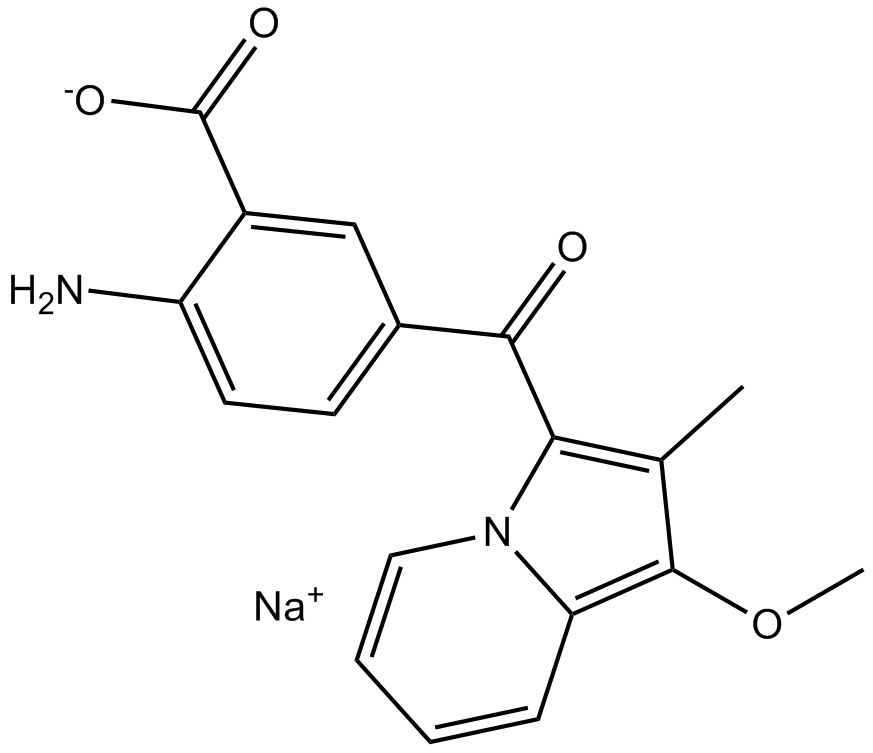
Cas No.: 848318-25-2
Sample solution is provided at 25 µL, 10mM.
_1-3.$$$39978408@51.jpg');)
_1-9.$$$38538795@65.jpg');)
_1-9.$$$39112701@51.jpg');)
_1-7.$$$37316672@70.jpg');)
_366-372.$$$36198801@70.jpg');)
.$$$38565142@65.jpg');)
_1867-1883.$$$33248023@67.jpg');)
_eads6055.$$$39977546@45.jpg');)
_eadm9805.$$$40080571@45.jpg');)
_eadj3020.$$$39666821@45.jpg');)
_1-20.$$$39757301@28.jpg');)
_1-24.$$$38898113@28.jpg');)
_273-287.$$$36806353@46.jpg');)
_1-16.$$$37156877@44.jpg');)
_1-19.$$$37460805@44.jpg');)
_1291-1307.$$$34518654@46.jpg');)
SSR128129E is an allosteric inhibitor of FGFR1 with IC50 value of 1.9 μM [1].
The fibroblast growth factor receptors (FGFRs) are receptor tyrosine kinases for fibroblast growth factors (FGFs) and play an important role in cancer and inflammation. FGF2 plays an important role in angiogenesis [1] [2].
SSR128129E is an orally-active and allosteric FGFR1 inhibitor. In human umbilical venous endothelial cells (HUVECs), SSR128129E inhibited FGF2-induced endothelial cells (ECs) proliferation and migration with IC50 values of 31 and 15.2 nM respectively and also inhibited lamellipodia formation. SSR128129E inhibited responses mediated by FGFR1-4. In FGFR2-expressing HEK293 cells, SSR128129E inhibited phosphorylation of FRS2 and ERK1/2 induced by FGF2 [1].
In arthritis mice, SSR128129E inhibited bone and joint damage and reduced angiogenesis in the inflamed joints. In orthotopic Panc02 tumor model, SSR128129E (30 mg/kg) inhibited tumor growth by 44%. In murine 4T1 breast tumors, SSR128129E (30 mg/kg) reduced tumor weight and size by 40% and 53%, respectively [1]. In atherosclerosis-prone apolipoprotein E (apoE)-deficient mice, SSR128129E (50 mg/kg) reduced neointimal proliferation and reduced FGFR2 mRNA levels and lesion size in the aortic sinus [2].
References:
[1]. Bono F, De Smet F, Herbert C, et al. Inhibition of tumor angiogenesis and growth by a small-molecule multi-FGF receptor blocker with allosteric properties. Cancer Cell, 2013, 23(4): 477-488.
[2]. Dol-Gleizes F, Delesque-Touchard N, Marès AM, et al. A new synthetic FGF receptor antagonist inhibits arteriosclerosis in a mouse vein graft model and atherosclerosis in apolipoprotein E-deficient mice. PLoS One, 2013, 8(11): e80027.
Cell experiment: | HUVECs, freshly isolated from different donors and used between passage two and five, are cultured in M199 medium supplemented with 20% fetal bovine serum (FBS), 2 mM L-glutamine, 30 mg/L endothelial cell growth factor supplements (EGCS), 10 units/mL heparin, and penicillin/streptomycin. For proliferation, ECs are starved overnight in growth factor-depleted M199 medium containing 2% FBS and stimulated for 24 hr with 10 ng/mL bFGF with SSR128129E or DMSO. Proliferation is assessed the last 2 hr by incubation with 1 μCi/mL [3H]thymidine[1]. |
Animal experiment: | Mice: Anesthetized BALB/c mice are inoculated with murine 4T1 mammary carcinoma cells. After randomization of tumor bearing mice for tumor size on day 5 after tumor cell inoculation, SSR128129E or vehicle (0.6 % methylcellulose) is administered daily via oral gavage at a dose of 30 mg/kg until the end of the experiment at day 21. Tumor volume is measured. At the end of the experiment, mice are sacrificed by pentobarbital injection, and lungs and tumors are dissected. Visible metastatic nodules on the lungs are counted by using a dissecting microscope[1]. |
References: [1]. Bono F, et al. Inhibition of tumor angiogenesis and growth by a small-molecule multi-FGF receptor blocker with allosteric properties. Cancer Cell. 2013 Apr 15;23(4):477-88. | |
| Cas No. | 848318-25-2 | SDF | |
| Synonyms | SSR | ||
| Chemical Name | sodium;2-amino-5-(1-methoxy-2-methylindolizine-3-carbonyl)benzoate | ||
| Canonical SMILES | CC1=C(N2C=CC=CC2=C1OC)C(=O)C3=CC(=C(C=C3)N)C(=O)[O-].[Na+] | ||
| Formula | C18H15N2O4.Na | M.Wt | 346.31 |
| Solubility | ≥ 17.3mg/mL in DMSO | Storage | Store at -20° C |
| General tips | Please select the appropriate solvent to prepare the stock solution according to the
solubility of the product in different solvents; once the solution is prepared, please store it in
separate packages to avoid product failure caused by repeated freezing and thawing.Storage method
and period of the stock solution: When stored at -80°C, please use it within 6 months; when stored
at -20°C, please use it within 1 month. To increase solubility, heat the tube to 37°C and then oscillate in an ultrasonic bath for some time. |
||
| Shipping Condition | Evaluation sample solution: shipped with blue ice. All other sizes available: with RT, or with Blue Ice upon request. | ||
| Prepare stock solution | |||

|
1 mg | 5 mg | 10 mg |
| 1 mM | 2.8876 mL | 14.4379 mL | 28.8759 mL |
| 5 mM | 577.5 μL | 2.8876 mL | 5.7752 mL |
| 10 mM | 288.8 μL | 1.4438 mL | 2.8876 mL |
Step 1: Enter information below (Recommended: An additional animal making an allowance for loss during the experiment)
 g
μL
g
μL
Step 2: Enter the in vivo formulation (This is only the calculator, not formulation. Please contact us first if there is no in vivo formulation at the solubility Section.)
Calculation results:
Working concentration: mg/ml;
Method for preparing DMSO master liquid: mg drug pre-dissolved in μL DMSO ( Master liquid concentration mg/mL, Please contact us first if the concentration exceeds the DMSO solubility of the batch of drug. )
Method for preparing in vivo formulation: Take μL DMSO master liquid, next addμL PEG300, mix and clarify, next addμL Tween 80, mix and clarify, next add μL saline, mix and clarify.
Method for preparing in vivo formulation: Take μL DMSO master liquid, next add μL Corn oil, mix and clarify.
Note: 1. Please make sure the liquid is clear before adding the next solvent.
2. Be sure to add the solvent(s) in order. You must ensure that the solution obtained, in the previous addition, is a clear solution before proceeding to add the next solvent. Physical methods such as vortex, ultrasound or hot water bath can be used to aid dissolving.
3. All of the above co-solvents are available for purchase on the GlpBio website.
Quality Control & SDS
- View current batch:
- Purity: >99.50% Appearance: A solid
- COA (Certificate of Analysis)
- SDS (Safety Data Sheet)
- Datasheet
Average Rating: 5 (Based on Reviews and 39 reference(s) in Google Scholar.)