

Suberohydroxamic Acid (Synonyms: SBHA, Suberic bisHydroxamic Acid) |
Catalog No.GC12976
 One-Click Copy Product Info
|

Suberohydroxamic Acid (Suberohydroxamic acid; SBHA) is a competitive and cell-permeable HDAC1 and HDAC3 inhibitor with ID50 values of 0.25 μM and 0.30 μM, respectively.Suberohydroxamic Acid renders MM cells susceptible to apoptosis and facilitates the mitochondrial apoptotic pathways.Suberohydroxamic Acid can be used for the study of medullary thyroid carcinoma (MTC).
Products are for research use only. Not for human use. We do not sell to patients.
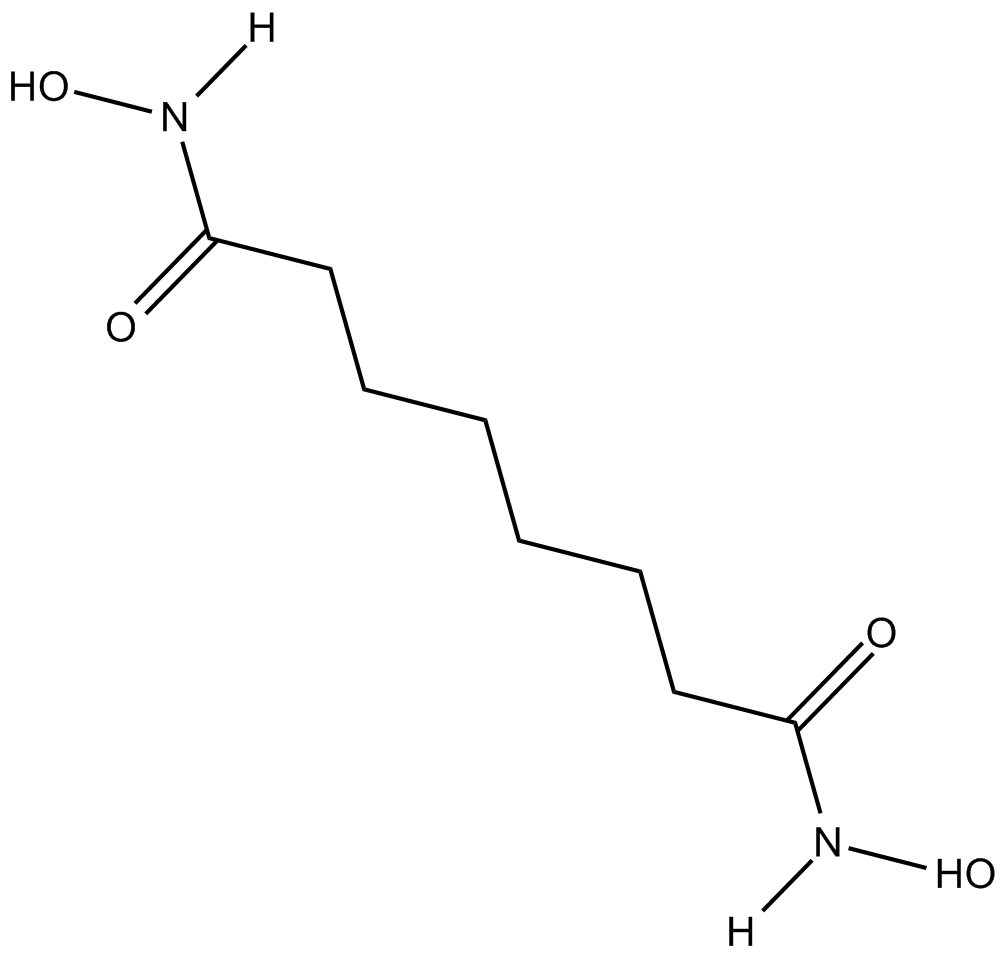
Cas No.: 38937-66-5
Sample solution is provided at 25 µL, 10mM.
_1-3.$$$39978408@51.jpg');)
_1-9.$$$38538795@65.jpg');)
_1-9.$$$39112701@51.jpg');)
_1-7.$$$37316672@70.jpg');)
_366-372.$$$36198801@70.jpg');)
.$$$38565142@65.jpg');)
_1867-1883.$$$33248023@67.jpg');)
_eads6055.$$$39977546@45.jpg');)
_eadm9805.$$$40080571@45.jpg');)
_eadj3020.$$$39666821@45.jpg');)
_1-20.$$$39757301@28.jpg');)
_1-24.$$$38898113@28.jpg');)
_273-287.$$$36806353@46.jpg');)
_1-16.$$$37156877@44.jpg');)
_1-19.$$$37460805@44.jpg');)
_1291-1307.$$$34518654@46.jpg');)
Suberohydroxamic Acid (Suberoyl bis-hydroxamic acid, SBHA) is an inhibitor of HDAC with ID50 values of 0.25 and 0.30 μM for HDAC1 and HDAC3, respectively [1].
Histone deacetylases (HDACs) are a class of enzymes that remove acetyl groups from ε-N-acetyl lysines on histones, allowing the histones to wrap the DNA more tightly. DNA expression is regulated by de-acetylation and acetylation.
Suberohydroxamic Acid (SBHA) is an HDAC inhibitor. In MEL cells, SBHA induced the accumulation of acetylated H4 [1]. In medullary thyroid carcinoma (MTC) cells, SBHA dose-dependently induced the Notch-1 intracellular domain (the active form of Notch-1), which then decreased NE tumor marker chromogranin A (CgA) and achaete-scute complex-like 1 (ASCL-1), a downstream target of Notch-1 signaling. Also, SBHA increased the levels of cleaved poly ADP-ribose polymerase (PARP) and caspase-3, induced apoptosis and reduced cell viability in a dose-dependent way [2]. In MCF-7 breast cancer cells, SBHA induced the expressions of p53, p21, Bax, and PUMA, and ΔΨm collapsed, which then induced apoptosis [3]. In acute T lymphoblastic leukemia (T-ALL) cells, SBHA enhanced WNT/β-catenin signaling, blocked G2/M cell cycle progression, increased p21(WAF1) expression and inhibited cell growth. SBHA also increased the levels of cleaved PARP, caspase-9 and caspase-3, and induced apoptosis [4].
References:
[1]. Richon VM, Emiliani S, Verdin E, et al. A class of hybrid polar inducers of transformed cell differentiation inhibits histone deacetylases. Proc Natl Acad Sci U S A, 1998, 95(6): 3003-3007.
[2]. Ning L, Greenblatt DY, Kunnimalaiyaan M, et al. Suberoyl bis-hydroxamic acid activates Notch-1 signaling and induces apoptosis in medullary thyroid carcinoma cells. Oncologist, 2008, 13(2): 98-104.
[3]. Zhuang ZG, Fei F, Chen Y, et al. Suberoyl bis-hydroxamic acid induces p53-dependent apoptosis of MCF-7 breast cancer cells. Acta Pharmacol Sin, 2008, 29(12): 1459-1466.
[4]. Shao N, Zou J, Li J, et al. Hyper-activation of WNT/β-catenin signaling pathway mediates anti-tumor effects of histone deacetylase inhibitors in acute T lymphoblastic leukemia. Leuk Lymphoma, 2012, 53(9): 1769-1778.
| Cas No. | 38937-66-5 | SDF | |
| Synonyms | SBHA, Suberic bisHydroxamic Acid | ||
| Chemical Name | N1,N8-dihydroxyoctanediamide | ||
| Canonical SMILES | ON([H])C(CCCCCCC(N(O)[H])=O)=O | ||
| Formula | C8H16N2O4 | M.Wt | 204.22 |
| Solubility | >9.2mg/mL in DMSO | Storage | Store at -20°C |
| General tips | Please select the appropriate solvent to prepare the stock solution according to the
solubility of the product in different solvents; once the solution is prepared, please store it in
separate packages to avoid product failure caused by repeated freezing and thawing.Storage method
and period of the stock solution: When stored at -80°C, please use it within 6 months; when stored
at -20°C, please use it within 1 month. To increase solubility, heat the tube to 37°C and then oscillate in an ultrasonic bath for some time. |
||
| Shipping Condition | Evaluation sample solution: shipped with blue ice. All other sizes available: with RT, or with Blue Ice upon request. | ||
| Prepare stock solution | |||

|
1 mg | 5 mg | 10 mg |
| 1 mM | 4.8967 mL | 24.4834 mL | 48.9668 mL |
| 5 mM | 979.3 μL | 4.8967 mL | 9.7934 mL |
| 10 mM | 489.7 μL | 2.4483 mL | 4.8967 mL |
Step 1: Enter information below (Recommended: An additional animal making an allowance for loss during the experiment)
 g
μL
g
μL
Step 2: Enter the in vivo formulation (This is only the calculator, not formulation. Please contact us first if there is no in vivo formulation at the solubility Section.)
Calculation results:
Working concentration: mg/ml;
Method for preparing DMSO master liquid: mg drug pre-dissolved in μL DMSO ( Master liquid concentration mg/mL, Please contact us first if the concentration exceeds the DMSO solubility of the batch of drug. )
Method for preparing in vivo formulation: Take μL DMSO master liquid, next addμL PEG300, mix and clarify, next addμL Tween 80, mix and clarify, next add μL saline, mix and clarify.
Method for preparing in vivo formulation: Take μL DMSO master liquid, next add μL Corn oil, mix and clarify.
Note: 1. Please make sure the liquid is clear before adding the next solvent.
2. Be sure to add the solvent(s) in order. You must ensure that the solution obtained, in the previous addition, is a clear solution before proceeding to add the next solvent. Physical methods such as vortex, ultrasound or hot water bath can be used to aid dissolving.
3. All of the above co-solvents are available for purchase on the GlpBio website.
Quality Control & SDS
- View current batch:
- Purity: >98.00% Appearance: A solid
- COA (Certificate of Analysis)
- SDS (Safety Data Sheet)
- Datasheet
Average Rating: 5 (Based on Reviews and 5 reference(s) in Google Scholar.)