

Takinib (Synonyms: EDHS-206) |
Catalog No.GC32687
 One-Click Copy Product Info
|

A TAK1 inhibitor
Products are for research use only. Not for human use. We do not sell to patients.
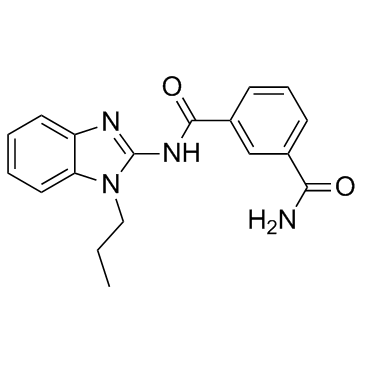
Cas No.: 1111556-37-6
Sample solution is provided at 25 µL, 10mM.
_1-3.$$$39978408@51.jpg');)
_1-9.$$$38538795@65.jpg');)
_1-9.$$$39112701@51.jpg');)
_1-7.$$$37316672@70.jpg');)
_366-372.$$$36198801@70.jpg');)
.$$$38565142@65.jpg');)
_1867-1883.$$$33248023@67.jpg');)
_eads6055.$$$39977546@45.jpg');)
_eadm9805.$$$40080571@45.jpg');)
_eadj3020.$$$39666821@45.jpg');)
_1-20.$$$39757301@28.jpg');)
_1-24.$$$38898113@28.jpg');)
_273-287.$$$36806353@46.jpg');)
_1-16.$$$37156877@44.jpg');)
_1-19.$$$37460805@44.jpg');)
_1291-1307.$$$34518654@46.jpg');)
Takinib is a potent and selective TAK1 inhibitor with an IC50 of 9.5 nM.
At 10 mM, Takinib shows significant inhibitory activity (<10% enzyme activity after exposure) on six serine/threonine kinases, including TAK1, IRAK4, IRAK1, GCK, CLK2, and MINK1. Analysis reveals that increasing concentrations of Takinib leads to a decrease in Vmax while maintaining KM. When the enzyme is activated with 5 mM ATP for 3 hr, the same Vmax is reached for 0, 10, 50, and 100 nM Takinib, and KM increases for these concentrations, which implies that Takinib is an ATP-competitive inhibitor if TAK1 is ATP activated. Importantly, results show that Takinib inhibits the function of both activated and un-activated TAK1 with identical potency. TNF-α stimulation in the presence of Takinib induces caspase activity in MDA-MB-231 cells in a dose-dependent manner, whereas unstimulated cells do not upregulate caspase activity. Takinib reduces phosphorylation significantly but does not influence total protein levels. Takinib inhibits phosphorylation of IKK, MAPK 8/9, and c-Jun in a dose-dependent manner. Takinib shows an almost complete inhibition of IL-6 secretion at micromolar concentrations following 24 hr of treatment in the presence of TNF-α[1].
[1]. Totzke J, et al. Takinib, a Selective TAK1 Inhibitor, Broadens the Therapeutic Efficacy of TNF-α Inhibition for Cancer and Autoimmune Disease. Cell Chem Biol. 2017 Aug 17;24(8):1029-1039.
|
Kinase experiment: |
Activity of purified TAK1-TAB1 protein is measured. In brief, TAK1-TAB1 (50 ng/well) is incubated with 5 μM ATP containing radiolabeled [32P]-ATP in the presence of 300 mM substrate peptide (RLGRDKYKTLRQIRQ) in a final volume of 40 μL in the presence of buffer (containing 50 mM Tris pH 7.5, 0.1 mM EGTA, 0.1% β-Mercaptoethanol, 10 mM magnesium acetate, 0.5 mM MnCl) and indicated compounds. The reaction is let go for 10 min and stopped with 10 μL concentrated H3PO4. The remaining activity is measured using a scintillation counter. Dose-response curves are repeated 3 times. For kinetic mechanistic studies, experiments are repeated two times and averaged[1]. |
|
Cell experiment: |
MDA-MB-231 cells (1,000 cells/well) are seeded in a 96-well plate with 10% FBS, 5% Pen/Strep, 4 g/L glucose DMEM medium. After 24h, cells are serum starved with 1% FBS, 5% Pen/Strep, 4 g/L glucose DMEM medium for 4h. Cells are treated with titrations of Takinib in the presence or absence of 30 ng/mL TNFα. Plates at 0 h and 24 h following treatment are frozen at -80°C after removal of media. After 24 h, 100 μL ddH2O is added to each well and plates are refrozen. 1 μL from Hoechst stock [1 mg/mL in 1:4 DMSO/H2O] is dissolved in 1 mL of TNE buffer (10 mM Tris, 2 M NaCl, 1 mM Na2EDTA) and 100 μL of this solution is added to each well. The fluorescence is determined at 355/460 nm[1]. |
|
References: [1]. Totzke J, et al. Takinib, a Selective TAK1 Inhibitor, Broadens the Therapeutic Efficacy of TNF-α Inhibition for Cancer and Autoimmune Disease. Cell Chem Biol. 2017 Aug 17;24(8):1029-1039. |
|
| Cas No. | 1111556-37-6 | SDF | |
| Synonyms | EDHS-206 | ||
| Canonical SMILES | CCCN1C2=CC=CC=C2N=C1NC(C3=CC(C(N)=O)=CC=C3)=O | ||
| Formula | C18H18N4O2 | M.Wt | 322.36 |
| Solubility | DMSO : 6.8 mg/mL (21.09 mM) | Storage | Store at -20°C |
| General tips | Please select the appropriate solvent to prepare the stock solution according to the
solubility of the product in different solvents; once the solution is prepared, please store it in
separate packages to avoid product failure caused by repeated freezing and thawing.Storage method
and period of the stock solution: When stored at -80°C, please use it within 6 months; when stored
at -20°C, please use it within 1 month. To increase solubility, heat the tube to 37°C and then oscillate in an ultrasonic bath for some time. |
||
| Shipping Condition | Evaluation sample solution: shipped with blue ice. All other sizes available: with RT, or with Blue Ice upon request. | ||
| Prepare stock solution | |||

|
1 mg | 5 mg | 10 mg |
| 1 mM | 3.1021 mL | 15.5106 mL | 31.0212 mL |
| 5 mM | 620.4 μL | 3.1021 mL | 6.2042 mL |
| 10 mM | 310.2 μL | 1.5511 mL | 3.1021 mL |
Step 1: Enter information below (Recommended: An additional animal making an allowance for loss during the experiment)
 g
μL
g
μL
Step 2: Enter the in vivo formulation (This is only the calculator, not formulation. Please contact us first if there is no in vivo formulation at the solubility Section.)
Calculation results:
Working concentration: mg/ml;
Method for preparing DMSO master liquid: mg drug pre-dissolved in μL DMSO ( Master liquid concentration mg/mL, Please contact us first if the concentration exceeds the DMSO solubility of the batch of drug. )
Method for preparing in vivo formulation: Take μL DMSO master liquid, next addμL PEG300, mix and clarify, next addμL Tween 80, mix and clarify, next add μL saline, mix and clarify.
Method for preparing in vivo formulation: Take μL DMSO master liquid, next add μL Corn oil, mix and clarify.
Note: 1. Please make sure the liquid is clear before adding the next solvent.
2. Be sure to add the solvent(s) in order. You must ensure that the solution obtained, in the previous addition, is a clear solution before proceeding to add the next solvent. Physical methods such as vortex, ultrasound or hot water bath can be used to aid dissolving.
3. All of the above co-solvents are available for purchase on the GlpBio website.
Quality Control & SDS
- View current batch:
- Purity: >98.00% Appearance: A solid
- COA (Certificate of Analysis)
- SDS (Safety Data Sheet)
- Datasheet
Average Rating: 5 (Based on Reviews and 7 reference(s) in Google Scholar.)