

Tenatoprazole (Synonyms: TU-199) |
Catalog No.GC18005
 One-Click Copy Product Info
|

proton pump inhibitor
Products are for research use only. Not for human use. We do not sell to patients.
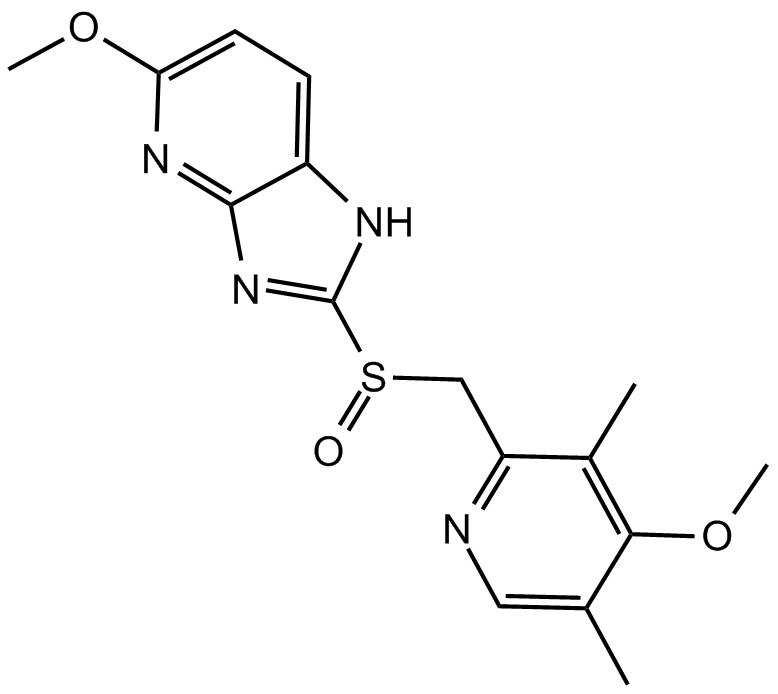
Cas No.: 113712-98-4
Sample solution is provided at 25 µL, 10mM.
_1-3.$$$39978408@51.jpg');)
_1-9.$$$38538795@65.jpg');)
_1-9.$$$39112701@51.jpg');)
_1-7.$$$37316672@70.jpg');)
_366-372.$$$36198801@70.jpg');)
.$$$38565142@65.jpg');)
_1867-1883.$$$33248023@67.jpg');)
_eads6055.$$$39977546@45.jpg');)
_eadm9805.$$$40080571@45.jpg');)
_eadj3020.$$$39666821@45.jpg');)
_1-20.$$$39757301@28.jpg');)
_1-24.$$$38898113@28.jpg');)
_273-287.$$$36806353@46.jpg');)
_1-16.$$$37156877@44.jpg');)
_1-19.$$$37460805@44.jpg');)
_1291-1307.$$$34518654@46.jpg');)
Tenatoprazole sodium (TU-199 sodium) is a proton pump inhibitor; inhibits hog gastric H+/K+-ATPase with an IC50 of 6.2 μM.
Tenatoprazole inhibits hog gastric H+/K+-ATPase activity with almost equal potency to that of omeprazole (IC50=6.2 and 4.2 microM, respectively)[1]. Tenatoprazole is a prodrug of the proton pump inhibitor class. Tenatoprazole is converted to the active sulfenamide or sulfenic acid by acid in the secretory canaliculus of the stimulated parietal cell of the stomach. This active species binds to luminally accessible cysteines of the gastric H+/K+-ATPase resulting in disulfide formation and acid secretion inhibition. Tenatoprazole binds at the catalytic subunit of the gastric acid pump with a stoichiometry of 2.6 nmol/mg of the enzyme[2].
Tenatoprazole inhibits basal gastric acid secretion in pylorus-ligated rats in a dose-dependent manner (ED50=4.2 mg/kg p.o.). In gastric fistula rats, tenatoprazole (2.5 and 5 mg/kg i.d.) also inhibits gastric acid secretion stimulated by histamine, carbachol or tetragastrin. Furthermore, tenatoprazole prevents the formation of water-immersion restraint stress-, pylorus ligation- and indomethacin-induced gastric lesions, and mepirizole-induced duodenal ulcer in rats[1]. Maximum binding of tenatoprazole is 2.9 nmol/mg of the enzyme at 2 h after IV administration. The binding sites of tenatoprazole are in the TM5/6 region at Cys813 and Cys822. The bioavailability of tenatoprazole is two-fold greater in the (S)-tenatoprazole sodium salt hydrate form as compared to the free form in dogs[2].
References:
[1]. Shin JM, et al. Characterization of the inhibitory activity of tenatoprazole on the gastric H+,K+ -ATPase in vitro and in vivo. Biochem Pharmacol. 2006 Mar 14;71(6):837-49.
[2]. https://www.ncbi.nlm.nih.gov/pubmed/16405921
|
Kinase experiment: |
The enzyme suspension (20 mg/mL) is incubated at 37°C in a buffer composed of 5 mM Pipes/Tris (pH 6.95), 2 mM MgCl2, 150 mM KCl, 3 mg/mL of valinomycin, 1 mM acridine orange, in the presence of 0.1 mM glutathione, in a SPEX spectrofluorometer for 5 min. Inhibitor (20 mM), omeprazole or tenatoprazole, is added and fluorescence is measured by excitation at 490 nm and emission at 530 nm. After 60 s, ATP (2 mM) is added to initiate acridine orange uptake as a measure of intra-vesicular acidification[2]. |
|
Animal experiment: |
Rats: (R,S)-Tenatoprazole free form (50 mg/kg) or (S)-tenatoprazole sodium salt hydrate (50 mg/kg) is orally administered to dogs and the plasma level of tenatoprazole is measured as a function of time course. Similarly, (S)-tenatoprazole free form (100 mg/kg) or (S)-tenatoprazole sodium salt hydrate (100 mg/kg) is orally administered to dogs and the plasma level of tenatoprazole is measured as a function of time[2]. |
|
References: [1]. Shin JM, et al. Characterization of the inhibitory activity of tenatoprazole on the gastric H+,K+ -ATPase in vitro and in vivo. Biochem Pharmacol. 2006 Mar 14;71(6):837-49. |
|
| Cas No. | 113712-98-4 | SDF | |
| Synonyms | TU-199 | ||
| Chemical Name | 5-methoxy-2-[(4-methoxy-3,5-dimethylpyridin-2-yl)methylsulfinyl]-1H-imidazo[4,5-b]pyridine | ||
| Canonical SMILES | CC1=CN=C(C(=C1OC)C)CS(=O)C2=NC3=C(N2)C=CC(=N3)OC | ||
| Formula | C16H18N4O3S | M.Wt | 346.4 |
| Solubility | Methanol: 10 mg/ml | Storage | Store at -20°C |
| General tips | Please select the appropriate solvent to prepare the stock solution according to the
solubility of the product in different solvents; once the solution is prepared, please store it in
separate packages to avoid product failure caused by repeated freezing and thawing.Storage method
and period of the stock solution: When stored at -80°C, please use it within 6 months; when stored
at -20°C, please use it within 1 month. To increase solubility, heat the tube to 37°C and then oscillate in an ultrasonic bath for some time. |
||
| Shipping Condition | Evaluation sample solution: shipped with blue ice. All other sizes available: with RT, or with Blue Ice upon request. | ||
| Prepare stock solution | |||

|
1 mg | 5 mg | 10 mg |
| 1 mM | 2.8868 mL | 14.4342 mL | 28.8684 mL |
| 5 mM | 577.4 μL | 2.8868 mL | 5.7737 mL |
| 10 mM | 288.7 μL | 1.4434 mL | 2.8868 mL |
Step 1: Enter information below (Recommended: An additional animal making an allowance for loss during the experiment)
 g
μL
g
μL
Step 2: Enter the in vivo formulation (This is only the calculator, not formulation. Please contact us first if there is no in vivo formulation at the solubility Section.)
Calculation results:
Working concentration: mg/ml;
Method for preparing DMSO master liquid: mg drug pre-dissolved in μL DMSO ( Master liquid concentration mg/mL, Please contact us first if the concentration exceeds the DMSO solubility of the batch of drug. )
Method for preparing in vivo formulation: Take μL DMSO master liquid, next addμL PEG300, mix and clarify, next addμL Tween 80, mix and clarify, next add μL saline, mix and clarify.
Method for preparing in vivo formulation: Take μL DMSO master liquid, next add μL Corn oil, mix and clarify.
Note: 1. Please make sure the liquid is clear before adding the next solvent.
2. Be sure to add the solvent(s) in order. You must ensure that the solution obtained, in the previous addition, is a clear solution before proceeding to add the next solvent. Physical methods such as vortex, ultrasound or hot water bath can be used to aid dissolving.
3. All of the above co-solvents are available for purchase on the GlpBio website.
Quality Control & SDS
- View current batch:
- Purity: >98.00% Appearance: A solid
- COA (Certificate of Analysis)
- SDS (Safety Data Sheet)
- Datasheet
Average Rating: 5 (Based on Reviews and 32 reference(s) in Google Scholar.)