

Reversine |
Catalog No.GC14651
 One-Click Copy Product Info
|

Reversine is a non-specific, orally active small molecule inhibitor of Aurora A kinase, Aurora B kinase and MPS1 (Monopolar Spindle 1) kinase. Reversine is often used in the study of cell differentiation and various cancer.
Products are for research use only. Not for human use. We do not sell to patients.
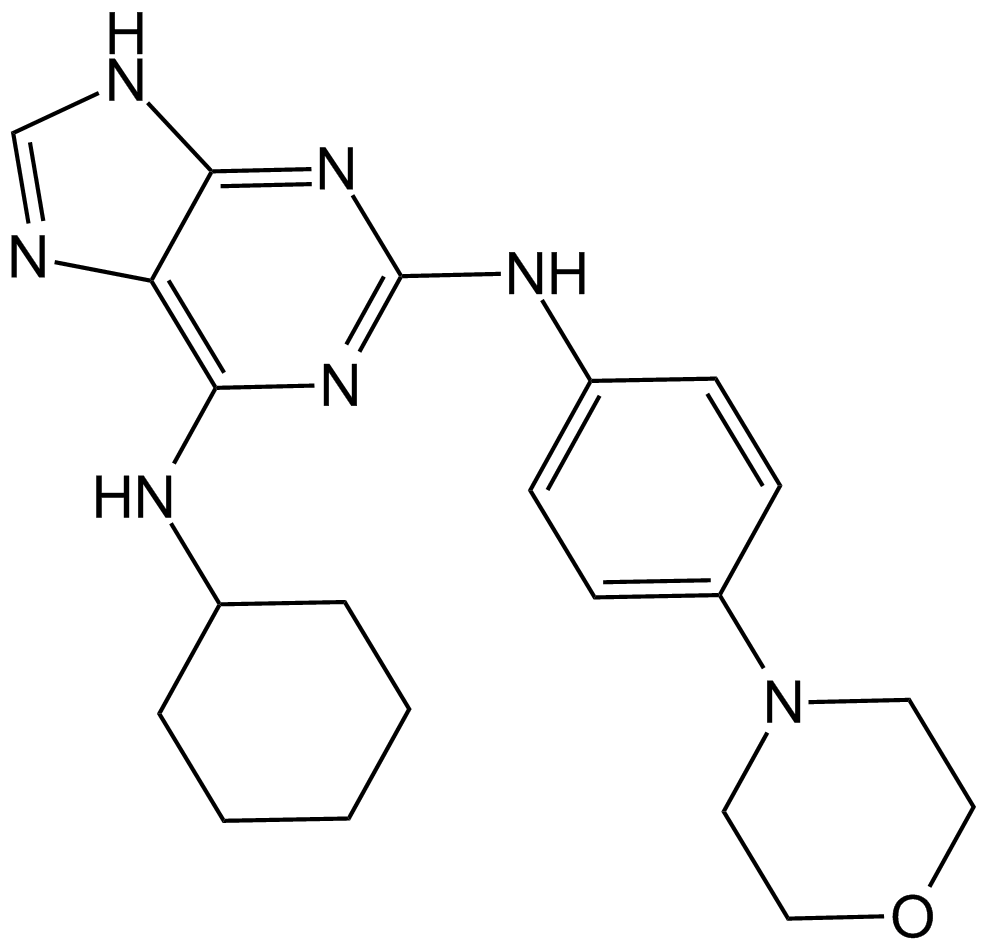
Cas No.: 656820-32-5
Sample solution is provided at 25 µL, 10mM.
_1-3.$$$39978408@51.jpg');)
_1-9.$$$38538795@65.jpg');)
_1-9.$$$39112701@51.jpg');)
_1-7.$$$37316672@70.jpg');)
_366-372.$$$36198801@70.jpg');)
.$$$38565142@65.jpg');)
_1867-1883.$$$33248023@67.jpg');)
_eads6055.$$$39977546@45.jpg');)
_eadm9805.$$$40080571@45.jpg');)
_eadj3020.$$$39666821@45.jpg');)
_1-20.$$$39757301@28.jpg');)
_1-24.$$$38898113@28.jpg');)
_273-287.$$$36806353@46.jpg');)
_1-16.$$$37156877@44.jpg');)
_1-19.$$$37460805@44.jpg');)
_1291-1307.$$$34518654@46.jpg');)
Reversine is a non-specific, orally active small molecule inhibitor of Aurora A kinase, Aurora B kinase and MPS1 (Monopolar Spindle 1) kinase. Reversine is often used in the study of cell differentiation and various cancer[1-8].
Reversine (0.5, 1, 5, 10 and 20μM; 72h) inhibits the growth of A549 and H1299 cells and suppresses the colony formation of human non-small cell lung cancer cells[1]. Reversine (1, 2, 4μM; 24h) significantly inhibited the expression of MEK1 protein in human osteosarcoma cell lines MNNG/HOS, U-2 OS and MG-63, thereby targeting MEK1 protein to exert anti-tumor effects[2]. In HL60 cells, Reversine (5-10μM; 72h) significantly increased the number of CD11b+ and induced cell differentiation[3]. Reversine(5μM; 4d) increases the plasticity of long-term cryopreserved fibroblasts to multipotent progenitor cells through activation of Oct4[4]. Reversine((0, 1, 5, 10µM; 24h) induces cell cycle arrest and apoptosis via upregulation of the Fas and DR5 signaling pathways in SW480 and HCT116 cells[5].
In the rat bile duct ligation model of ductal reactivity, Reversine (20mg/kg; every 3 days for 2 weeks; ip) attenuated rat cholestatic ductal reactivity and fibrosis and reduced bile duct formation associated with Dlk1/Notch/Sox9 signaling[6]. In the mice MDA-MB-231 cell xenograft model, Reversine (1.0mg/kg; every 7 days for 3 weeks; po) and miR-21-5p inhibitor synergistically exerted tumor suppressive effects on HBC cells by targeting SPRY2[7]. In the highly metastatic MDA231-M2 Orthotopic breast cancer mouse models, 10 and 30mg/kg Reversine treatment significantly reduced the mean number of lung surface metastases by 50% and 70%, respectively[8].
References:
[1]. Lu Y C, Lee Y R, Liao J D, et al. Reversine induced multinucleated cells, cell apoptosis and autophagy in human non-small cell lung cancer cells[J]. PloS one, 2016, 11(7): e0158587.
[2]. Chen X, Zhong Y, Wang S, et al. Reversine inhibits proliferation and induces apoptosis of human osteosarcoma cells through targeting MEK1[J]. Journal of Bone Oncology, 2024, 46: 100601.
[3]. D'Alise A M, Amabile G, Iovino M, et al. Reversine, a novel Aurora kinases inhibitor, inhibits colony formation of human acute myeloid leukemia cells[J]. Molecular cancer therapeutics, 2008, 7(5): 1140-1149.
[4]. Li X, Guo Y, Yao Y, et al. Reversine increases the plasticity of long-term cryopreserved fibroblasts to multipotent progenitor cells through activation of Oct4[J]. International Journal of Biological Sciences, 2016, 12(1): 53.
[5]. Park Y L, Ha S Y, Park S Y, et al. Reversine induces cell cycle arrest and apoptosis via upregulation of the Fas and DR5 signaling pathways in human colorectal cancer cells[J]. International journal of oncology, 2019, 54(5): 1875-1883.
[6]. Huang D, Tang L, Li T, et al. Reversine attenuates cholestatic ductular reaction in rats[J]. FEBS Open bio, 2023, 13(5): 898-911.
[7]. Zhang Y, Wang Y, Xue J, et al. Co-treatment with miR-21-5p inhibitor and Aurora kinase inhibitor reversine suppresses breast cancer progression by targeting sprouty RTK signaling antagonist 2[J]. Bioengineered, 2022, 13(1): 455-468.
[8]. Bijian K, Lougheed C, Su J, et al. Targeting focal adhesion turnover in invasive breast cancer cells by the purine derivative reversine[J]. British journal of cancer, 2013, 109(11): 2810-2818.
| Kinase experiment [1]: | |
Preparation Method | In vitro kinase assay was carried out using human recombinant full-length FAK incubated in kinase buffer containing ATP and the substrate for 4 h at room temperature with or without the presence of Reversine at a final concentration of 1μM. The remaining ATP in solution was then quantified utilising the Kinase-Gloluminescence kit. |
Reaction Conditions | 1μM; 4h |
Applications | Reversine at a concentration of 1μM inhibited the kinase activity of FAK and its homolog Pyk2 by 70% and 82%, respectively. |
| Cell experiment [1]: | |
Cell lines | MDA-MB-231 cells |
Preparation Method | Cells were seeded on LabTek2 multiwell coverslips at approximately 25% confluence and incubated for 24h. Cells were transfected with 1μg of green fluorescent protein-Paxillin using Lipofectamine LTX. Cells were serum starved for 24h and then stimulated with 20ng/ml epidermal growth factor in the presence or absence of 1μM Reversine or 1μM ret Reversine in DMSO. |
Reaction Conditions | 1μM; 24h |
Applications | In Reversine-treated MDA231-M2 cells, the activation of the FAK Y397 autophosphorylation site was decreased in a dose-dependent manner. |
| Animal experiment [1]: | |
Animal models | Orthotopic breast cancer mouse models |
Preparation Method | For primary tumors, MDA-MB-231 cells were implanted subcutaneously into the mammary fat pad of female SCID mice. Three weeks later, mice were injected intraperitoneally with Reversine (DMSO stock solution further diluted in vehicle: PEG-400 (35%), 100% ETOH (10%), 0.9% NaCl (55%)) once every two weeks at a dose of 10 or 30mg/kg for 4 weeks and stopped 1 week before the end of the study. |
Dosage form | 10, 30mg/kg; ip; 4 weeks |
Applications | In the highly metastatic MDA231-M2 model, 10 and 30mg/kg Reversine treatment significantly reduced the mean number of lung surface metastases by 50% and 70%, respectively. |
References: | |
| Cas No. | 656820-32-5 | SDF | |
| Chemical Name | 6-N-cyclohexyl-2-N-(4-morpholin-4-ylphenyl)-7H-purine-2,6-diamine | ||
| Canonical SMILES | C1CCC(CC1)NC2=NC(=NC3=C2NC=N3)NC4=CC=C(C=C4)N5CCOCC5 | ||
| Formula | C21H27N7O | M.Wt | 393.49 |
| Solubility | ≥ 19.65 mg/mL in DMSO, ≥ 6.69 mg/mL in EtOH with ultrasonic and warming | Storage | Store at -20°C |
| General tips | Please select the appropriate solvent to prepare the stock solution according to the
solubility of the product in different solvents; once the solution is prepared, please store it in
separate packages to avoid product failure caused by repeated freezing and thawing.Storage method
and period of the stock solution: When stored at -80°C, please use it within 6 months; when stored
at -20°C, please use it within 1 month. To increase solubility, heat the tube to 37°C and then oscillate in an ultrasonic bath for some time. |
||
| Shipping Condition | Evaluation sample solution: shipped with blue ice. All other sizes available: with RT, or with Blue Ice upon request. | ||
| Prepare stock solution | |||

|
1 mg | 5 mg | 10 mg |
| 1 mM | 2.5414 mL | 12.7068 mL | 25.4136 mL |
| 5 mM | 508.3 μL | 2.5414 mL | 5.0827 mL |
| 10 mM | 254.1 μL | 1.2707 mL | 2.5414 mL |
Step 1: Enter information below (Recommended: An additional animal making an allowance for loss during the experiment)
 g
μL
g
μL
Step 2: Enter the in vivo formulation (This is only the calculator, not formulation. Please contact us first if there is no in vivo formulation at the solubility Section.)
Calculation results:
Working concentration: mg/ml;
Method for preparing DMSO master liquid: mg drug pre-dissolved in μL DMSO ( Master liquid concentration mg/mL, Please contact us first if the concentration exceeds the DMSO solubility of the batch of drug. )
Method for preparing in vivo formulation: Take μL DMSO master liquid, next addμL PEG300, mix and clarify, next addμL Tween 80, mix and clarify, next add μL saline, mix and clarify.
Method for preparing in vivo formulation: Take μL DMSO master liquid, next add μL Corn oil, mix and clarify.
Note: 1. Please make sure the liquid is clear before adding the next solvent.
2. Be sure to add the solvent(s) in order. You must ensure that the solution obtained, in the previous addition, is a clear solution before proceeding to add the next solvent. Physical methods such as vortex, ultrasound or hot water bath can be used to aid dissolving.
3. All of the above co-solvents are available for purchase on the GlpBio website.
Quality Control & SDS
- View current batch:
- Purity: >98.00% Appearance: A solid
- COA (Certificate of Analysis)
- SDS (Safety Data Sheet)
- Datasheet
Average Rating: 5 (Based on Reviews and 30 reference(s) in Google Scholar.)