
Tirbanibulin Mesylate (KX2-391 (Mesylate)) (Synonyms: KX2-391 Mesylate; KX01 Mesylate) |
| Catalog No.GC34109 |
Tirbanibulin Mesylate (KX2-391 (Mesylate)) (KX2-391 Mesylate) is an inhibitor of Src that targets the peptide substrate site of Src, with GI50 of 9-60 nM in cancer cell lines.
Products are for research use only. Not for human use. We do not sell to patients.
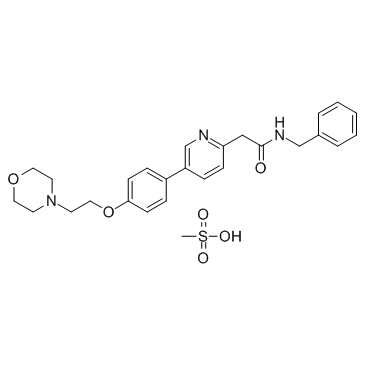
Cas No.: 1080645-95-9
Sample solution is provided at 25 µL, 10mM.
Tirbanibulin (Mesylate) (KX2-391 (Mesylate)) is an inhibitor of Src that targets the peptide substrate site of Src, with GI50 of 9-60 nM in cancer cell lines.
Tirbanibulin (KX2-391) is a Src inhibitor that is directed to the Src substrate pocket. Tirbanibulin (KX2-391) shows steep dose-response curves against Huh7 (GI50=9 nM), PLC/PRF/5 (GI50=13 nM), Hep3B (GI50=26 nM), and HepG2 (GI50=60 nM), four hepatic cell cancer (HCC) cell lines[1]. Tirbanibulin (KX2-391) is found to inhibit certain leukemia cells that are resistant to current commercially available drugs, such as those derived from chronic leukemia cells with the T3151 mutation. Tirbanibulin (KX2-391) is evaluated in engineered Src driven cell growth assays inNIH3T3/c-Src527F and SYF/c-Src527F cells and exhibits GI50 with 23 nM and 39 nM, respectively[2].
Orally administered Tirbanibulin (KX2-391) is shown to inhibit primary tumor growth and to suppress metastasis, in pre-clinical animal models of cancer[2].
[1]. Lau GM, et al. Expression of Src and FAK in hepatocellular carcinoma and the effect of Src inhibitors on hepatocellular carcinoma in vitro. Dig Dis Sci, 2009, 54(7), 1465-1474. [2]. Fallah-Tafti A, et al. Thiazolyl N-benzyl-substituted acetamide derivatives: synthesis, Src kinase inhibitory and anticancer activities. Eur J Med Chem, 2011, 46(10), 4853-4858.

Cell experiment: | Liver cell lines including Huh7, PLC/PRF/5, Hep3B, and HepG2 are routinely cultured and maintained in basal medium containing 2% fetal bovine serum (FBS) at 37°C and 5% CO2. Cells are seeded at 4.0×10³/190 μL and 8.0×10³/190 μL per well of 96-well plate in basal medium containing 1.5% FBS. These are cultured overnight at 37°C and 5% CO2 prior to the addition of Tirbanibulin (KX2-391), at concentrations ranging from 6,564 to 0.012 nM in triplicates. Treated cells are incubated for 3 days. Ten μLs of 3-(4,5-dimethylthiazol- 2-yl)-2,5-diphenyltetrazolium bromide (MTT) solution (5 mg/mL) is then added to each well on day 3 and cells incubated for 4 hours. The formazan product is dissolved with 10% SDS in dilute HCl. Optical density at 570 nm is measured. For comparison of activity and potency, parallel experiments are performed using Tirbanibulin (KX2-391). Growth inhibition curves, 50% inhibition concentration (GI50), and 80% inhibition concentration (GI80) are determined using GraphPad Prism 5 statistical software. Data are normalized to represent percentage of maximum response as well as reported in optical density at wavelength of 570 nm (OD570) signal format. |
References: [1]. Lau GM, et al. Expression of Src and FAK in hepatocellular carcinoma and the effect of Src inhibitors on hepatocellular carcinoma in vitro. Dig Dis Sci, 2009, 54(7), 1465-1474. | |
| Cas No. | 1080645-95-9 | SDF | |
| Synonyms | KX2-391 Mesylate; KX01 Mesylate | ||
| Canonical SMILES | O=C(NCC1=CC=CC=C1)CC2=NC=C(C3=CC=C(OCCN4CCOCC4)C=C3)C=C2.CS(=O)(O)=O | ||
| Formula | C27H33N3O6S | M.Wt | 527.63 |
| Solubility | DMSO : ≥ 57 mg/mL (108.03 mM) | Storage | Store at -20°C, protect from light, stored under nitrogen |
| General tips | Please select the appropriate solvent to prepare the stock solution according to the
solubility of the product in different solvents; once the solution is prepared, please store it in
separate packages to avoid product failure caused by repeated freezing and thawing.Storage method
and period of the stock solution: When stored at -80°C, please use it within 6 months; when stored
at -20°C, please use it within 1 month. To increase solubility, heat the tube to 37°C and then oscillate in an ultrasonic bath for some time. |
||
| Shipping Condition | Evaluation sample solution: shipped with blue ice. All other sizes available: with RT, or with Blue Ice upon request. | ||
| Prepare stock solution | |||
|
1 mg | 5 mg | 10 mg |
| 1 mM | 1.8953 mL | 9.4763 mL | 18.9527 mL |
| 5 mM | 379.1 μL | 1.8953 mL | 3.7905 mL |
| 10 mM | 189.5 μL | 947.6 μL | 1.8953 mL |
Step 1: Enter information below (Recommended: An additional animal making an allowance for loss during the experiment)
Step 2: Enter the in vivo formulation (This is only the calculator, not formulation. Please contact us first if there is no in vivo formulation at the solubility Section.)
Calculation results:
Working concentration: mg/ml;
Method for preparing DMSO master liquid: mg drug pre-dissolved in μL DMSO ( Master liquid concentration mg/mL, Please contact us first if the concentration exceeds the DMSO solubility of the batch of drug. )
Method for preparing in vivo formulation: Take μL DMSO master liquid, next addμL PEG300, mix and clarify, next addμL Tween 80, mix and clarify, next add μL ddH2O, mix and clarify.
Method for preparing in vivo formulation: Take μL DMSO master liquid, next add μL Corn oil, mix and clarify.
Note: 1. Please make sure the liquid is clear before adding the next solvent.
2. Be sure to add the solvent(s) in order. You must ensure that the solution obtained, in the previous addition, is a clear solution before proceeding to add the next solvent. Physical methods such as vortex, ultrasound or hot water bath can be used to aid dissolving.
3. All of the above co-solvents are available for purchase on the GlpBio website.
Quality Control & SDS
- View current batch:
- Purity: >99.50%
- COA (Certificate Of Analysis)
- SDS (Safety Data Sheet)
- Datasheet
Average Rating: 5 (Based on Reviews and 27 reference(s) in Google Scholar.)
GLPBIO products are for RESEARCH USE ONLY. Please make sure your review or question is research based.
Required fields are marked with *


