
TLR7-agonist-1 |
| Catalog No.GC19357 |
TLR7-agonist-1 is a potent and selective Toll-like Receptor 7 (TLR7) agonist with a LEC of 0.4 μM.
Products are for research use only. Not for human use. We do not sell to patients.
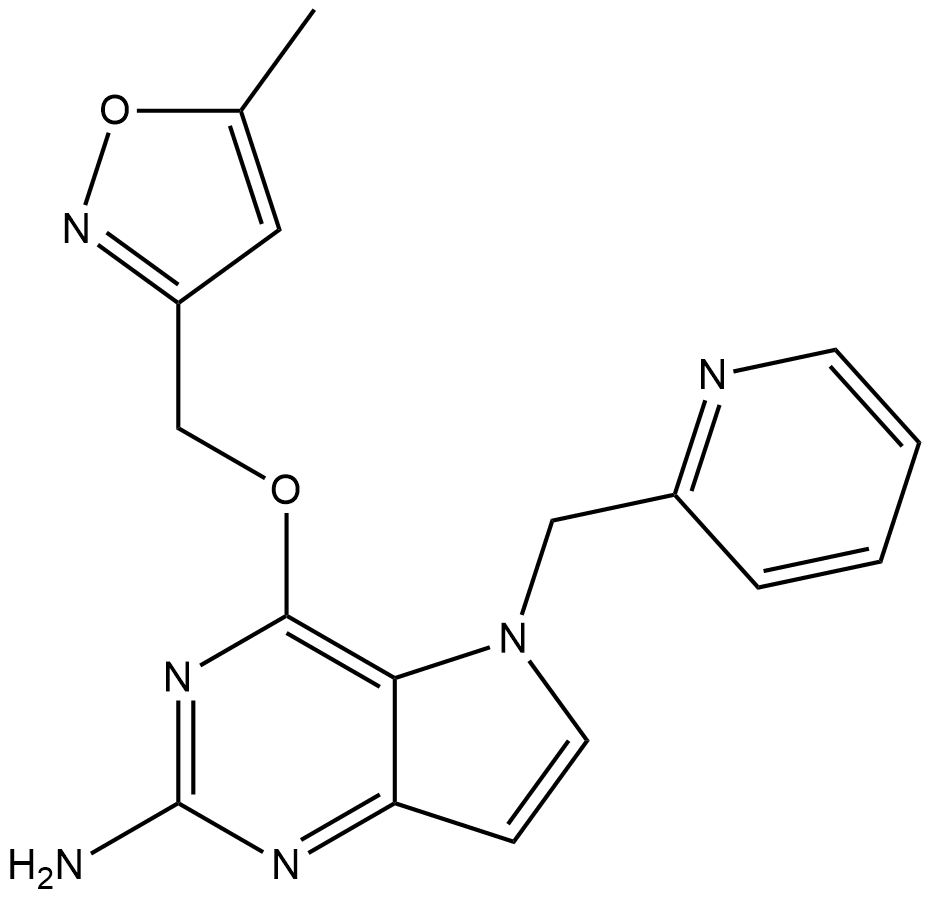
Cas No.: 1642857-69-9
Sample solution is provided at 25 µL, 10mM.
TLR7-agonist-1 is a potent and selective Toll-like Receptor 7 (TLR7) agonist with a LEC of 0.4 uM.
TLR7-agonist-1 is a potent and selective Toll-like Receptor 7 (TLR7) agonist with a lowest effective concentration (LEC) of 0.4 uM in HEK293 cell. TLR7-agonist-1 is found to be selective for TLR7 over TLR8 with LEC of >100 uM for human TLR8. TLR7-agonist-1 demonstrates low inhibition across five CYP450 isozymes (IC50 >10 uM) and is also not a time dependent inhibitor of CYP450 3A4. TLR7-agonist-1 has limited inhibition of the hERG potassium ion channel 3H-dofetilide binding in vitro (IC50 >50 uM)[1].
TLR7-agonist-1 is found to be rapidly cleared in conjunction with our target profile. Both Cmax and AUC increase less than dose proportionally between 0.3 and 3 mg/kg and more than dose-proportionally between 3 and 10 mg/kg. TLR7-agonist-1 can induce an antiviral interferon stimulated gene (ISG) response without inducing an IFNα response at a low dose. TLR7-agonist-1 also induces a 2.7 log decrease in serum HBV viral load from 0.3 mg/kg, and a maximum 3.1 log decrease is observed for doses between 1 and 5 mg/kg[1].
References:
[1]. McGowan DC, et al. Identification and Optimization of Pyrrolo[3,2-d]pyrimidine Toll-like Receptor 7 (TLR7) Selective Agonists for the Treatment of Hepatitis B. J Med Chem. 2017 Jul 27;60(14):6137-6151.

Cell experiment: | The ability of TLR7 agonist 2 to activate human TLR7 and/or TLR8 is assessed by using HEK293 cells. Briefly, HEK293 cells are grown in culture medium (DMEM supplemented with 10% FCS and 2 mM Glutamine). Transfected cells are then detached with Trypsin-EDTA, washed in PBS and resuspended in medium to a density of 1.67×10⁵ cells/mL. Thirty microliters of cells are then dispensed into each well in 384-well plates, where 10 μL of TLR7-agonist-1 in 4% DMSO is already present. Following 6 hours incubation at 37°C, 5% CO2, the luciferase activity is determined by adding 15 μL of Steady Lite Plus substrate to each well and readout performed on a microplate imager. Lowest effective concentrations (LEC) values are determined for TLR7-agonist-1[1]. |
Animal experiment: | A mouse in vivo model is used to demonstrate the initial proof of concept to induce endogenous IFNα. Single oral administration of 0.3, 1, 3, and 10 mg/kg doses of TLR7 agonist 2 is given to healthy, female, fasted C57Bl/6 mice. Concentrations of TLR7 agonist 2 and mouse-IFN via ELISA are measured from the plasma and compare to vehicle[1]. |
References: [1]. McGowan DC, et al. Identification and Optimization of Pyrrolo[3,2-d]pyrimidine Toll-like Receptor 7 (TLR7) Selective Agonists for the Treatment of Hepatitis B. J Med Chem. 2017 Jul 27;60(14):6137-6151. | |
| Cas No. | 1642857-69-9 | SDF | |
| Canonical SMILES | CC1=CC(COC2=C(N(CC3=NC=CC=C3)C=C4)C4=NC(N)=N2)=NO1 | ||
| Formula | C17H16N6O2 | M.Wt | 336.35 |
| Solubility | DMSO : 160 mg/mL (475.69 mM) | Storage | Store at -20°C |
| General tips | Please select the appropriate solvent to prepare the stock solution according to the
solubility of the product in different solvents; once the solution is prepared, please store it in
separate packages to avoid product failure caused by repeated freezing and thawing.Storage method
and period of the stock solution: When stored at -80°C, please use it within 6 months; when stored
at -20°C, please use it within 1 month. To increase solubility, heat the tube to 37°C and then oscillate in an ultrasonic bath for some time. |
||
| Shipping Condition | Evaluation sample solution: shipped with blue ice. All other sizes available: with RT, or with Blue Ice upon request. | ||
| Prepare stock solution | |||
|
1 mg | 5 mg | 10 mg |
| 1 mM | 2.9731 mL | 14.8655 mL | 29.7309 mL |
| 5 mM | 594.6 μL | 2.9731 mL | 5.9462 mL |
| 10 mM | 297.3 μL | 1.4865 mL | 2.9731 mL |
Step 1: Enter information below (Recommended: An additional animal making an allowance for loss during the experiment)
Step 2: Enter the in vivo formulation (This is only the calculator, not formulation. Please contact us first if there is no in vivo formulation at the solubility Section.)
Calculation results:
Working concentration: mg/ml;
Method for preparing DMSO master liquid: mg drug pre-dissolved in μL DMSO ( Master liquid concentration mg/mL, Please contact us first if the concentration exceeds the DMSO solubility of the batch of drug. )
Method for preparing in vivo formulation: Take μL DMSO master liquid, next addμL PEG300, mix and clarify, next addμL Tween 80, mix and clarify, next add μL ddH2O, mix and clarify.
Method for preparing in vivo formulation: Take μL DMSO master liquid, next add μL Corn oil, mix and clarify.
Note: 1. Please make sure the liquid is clear before adding the next solvent.
2. Be sure to add the solvent(s) in order. You must ensure that the solution obtained, in the previous addition, is a clear solution before proceeding to add the next solvent. Physical methods such as vortex, ultrasound or hot water bath can be used to aid dissolving.
3. All of the above co-solvents are available for purchase on the GlpBio website.
Quality Control & SDS
- View current batch:
- Purity: >99.00%
- COA (Certificate Of Analysis)
- SDS (Safety Data Sheet)
- Datasheet
Average Rating: 5 (Based on Reviews and 5 reference(s) in Google Scholar.)
GLPBIO products are for RESEARCH USE ONLY. Please make sure your review or question is research based.
Required fields are marked with *


