

Tofacitinib (CP-690550,Tasocitinib) |
Catalog No.GC16828
 One-Click Copy Product Info
|

Tofacitinib (CP-690550,Tasocitinib) is a Janus kinase (JAK) inhibitor for rheumatoid arthritis, psoriatic arthritis, ankylosing spondylitis, polyarticular course juvenile idiopathic arthritis, and ulcerative colitis treatment.
Products are for research use only. Not for human use. We do not sell to patients.
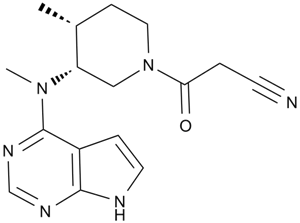
Cas No.: 477600-75-2
Sample solution is provided at 25 µL, 10mM.
Tofacitinib (CP-690550,Tasocitinib) is a Janus kinase (JAK) inhibitor for rheumatoid arthritis, psoriatic arthritis, ankylosing spondylitis, polyarticular course juvenile idiopathic arthritis, and ulcerative colitis treatment[1]. Tofacitinib targets the JAK-STAT pathway by inhibiting Janus kinase 1 (JAK1), Janus kinase 2, and Janus kinase 3 (JAK 3), impacting DNA transcription[2]. Tofacitinib interacts with all JAKs at the ATP-binding site at residue 839–1045 in JAK1, 839–1000 in JAK2, and 815–990 in JAK3 via electrostatic attraction, hydrogen bond formation, and in particular van der Waals interaction, and the Tofacitinib inhibits JAKs with an IC50 value of 3.3nM, 2.8nM, 19nM and 323nM for JAK1, JAK2, Tyk2 and JAK3 respectively[3].
In vitro, Tofacitinib (50nM; overnight) supresses natural killer cells to prolong amyotrophic lateral sclerosis (ALS) progression[4]. Tofacitinib (30μM, 60μM and 90μM; 4h) promotes functional recovery after spinal cord injury by regulating microglial polarization via JAK/STAT signaling pathway[5]. Tofacitinib (50μM; 3h) rescues intestinal barrier defects caused by disrupted epithelial-macrophage interactions[6].
In vivo, Tofacitinib (10mg/kg/day; 5-6 weeks; administrate with drinking water) fails to prevent T cell transfer colitis in mice[7]. Tofacitinib (10, 30, and 100mg/kg; 2 weeks; oral administration) enhances remyelination and improves myelin integrity in cuprizone-induced mice[8].
References:
[1] Berekmeri, Anna et al. “Tofacitinib for the treatment of psoriasis and psoriatic arthritis.” *Expert review of clinical immunology* vol. 14,9 (2018): 719-730. doi:10.1080/1744666X.2018.1512404
[2] Palmroth, Maaria et al. “Tofacitinib Suppresses Several JAK-STAT Pathways in Rheumatoid Arthritis *In Vivo* and Baseline Signaling Profile Associates With Treatment Response.” *Frontiers in immunology* vol. 12 738481. 24 Sep. 2021, doi:10.3389/fimmu.2021.738481
[3] Furumoto, Yasuko, and Massimo Gadina. “The arrival of JAK inhibitors: advancing the treatment of immune and hematologic disorders.” BioDrugs : clinical immunotherapeutics, biopharmaceuticals and gene therapy vol. 27,5 (2013): 431-8. doi:10.1007/s40259-013-0040-7
[4] Figueroa-Romero, Claudia et al. “Tofacitinib Suppresses Natural Killer Cells *In Vitro* and *In Vivo*: Implications for Amyotrophic Lateral Sclerosis.” *Frontiers in immunology* vol. 13 773288. 7 Feb. 2022, doi:10.3389/fimmu.2022.773288
[5] Ma, Hongdao et al. “Tofacitinib Promotes Functional Recovery after Spinal Cord Injury by Regulating Microglial Polarization via JAK/STAT Signaling Pathway.” *International journal of biological sciences* vol. 19,15 4865-4882. 11 Sep. 2023, doi:10.7150/ijbs.84564
[6] Spalinger, Marianne R et al. “The JAK Inhibitor Tofacitinib Rescues Intestinal Barrier Defects Caused by Disrupted Epithelial-macrophage Interactions.” *Journal of Crohn's & colitis* vol. 15,3 (2021): 471-484. doi:10.1093/ecco-jcc/jjaa182
[7] Subramanyam, Sudheendra Hebbar et al. “Tofacitinib fails to prevent T cell transfer colitis in mice but ameliorates disease activity.” *Scientific reports* vol. 13,1 3762. 7 Mar. 2023, doi:10.1038/s41598-023-30616-w
[8] Günaydın, Caner et al. “Tofacitinib enhances remyelination and improves myelin integrity in cuprizone-induced mice.” *Immunopharmacology and immunotoxicology* vol. 43,6 (2021): 790-798. doi:10.1080/08923973.2021.1986063
| Cell experiment [1]: | |
Cell lines | NK-92 NK cell line |
Preparation Method | NK-92 cells were cultured using two IL-15/Tofacitinib paradigms. NK-92 cells were cultured for two hours with 2.33nM IL-15 in serum-free NK media prior to overnight treatment with 50nM Tofacitinib. NK-92 cells were cultured overnight with 50nM Tofacitinib in serum-free NK media prior to two-hour culture with 2.33nM IL-15. 50nM concentration of Tofacitinib was used based on previous in vitro immune studies. For each treatment paradigm, three groups of NK-92 cells were generated: cells receiving no IL-15 and no Tofacitinib (Unstimulated), cells receiving only IL-15 (Stimulated) or cells receiving IL-15 stimulation and Tofacitinib treatment (Treated). NK-92 cells were then collected, washed, and analyzed for STAT1 phosphorylation (P-STAT), cytotoxicity towards K-562 cells, granzyme B and perforin expression, or cytokine gene expression. |
Reaction Conditions | 50nM; overnight |
Applications | Tofacitinib suppressed IL-15-induced activation as measured by STAT1 phosphorylation, cytotoxicity, pro-inflammatory gene expression, and pro-inflammatory cytokine secretion in both an NK cell line and primary NK cells. |
| Animal experiment [2]: | |
Animal models | 8-12 week old C57BL/6 mice |
Preparation Method | For soluble Tofacitinib treatment, mice received of Tofacitinib or 0.2mg/ml dissolved in drinking water resulting in a dosage of 40mg/kg/day of Tofacitinib until end of experiments. |
Dosage form | 40mg/kg/day; 5–6 weeks; administrate with drinking water |
Applications | Treatment with Tofacitinib immediately after transfer resulted in an enhanced expansion of CD4+ T cells and did not prevent occurrence of colitis, treatment after start of symptoms of colitis ameliorated disease activity on a clinical basis and in histological analyses. |
References: | |
| Cas No. | 477600-75-2 | SDF | |
| Chemical Name | 3-[(3R,4R)-4-methyl-3-[methyl(7H-pyrrolo[2,3-d]pyrimidin-4-yl)amino]piperidin-1-yl]-3-oxopropanenitrile | ||
| Canonical SMILES | CC1CCN(CC1N(C)C2=NC=NC3=C2C=CN3)C(=O)CC#N | ||
| Formula | C16H20N6O | M.Wt | 312.37 |
| Solubility | ≥ 15.6 mg/mL in DMSO | Storage | Store at -20°C |
| General tips | Please select the appropriate solvent to prepare the stock solution according to the
solubility of the product in different solvents; once the solution is prepared, please store it in
separate packages to avoid product failure caused by repeated freezing and thawing.Storage method
and period of the stock solution: When stored at -80°C, please use it within 6 months; when stored
at -20°C, please use it within 1 month. To increase solubility, heat the tube to 37°C and then oscillate in an ultrasonic bath for some time. |
||
| Shipping Condition | Evaluation sample solution: shipped with blue ice. All other sizes available: with RT, or with Blue Ice upon request. | ||
| Prepare stock solution | |||

|
1 mg | 5 mg | 10 mg |
| 1 mM | 3.2013 mL | 16.0067 mL | 32.0133 mL |
| 5 mM | 640.3 μL | 3.2013 mL | 6.4027 mL |
| 10 mM | 320.1 μL | 1.6007 mL | 3.2013 mL |
Step 1: Enter information below (Recommended: An additional animal making an allowance for loss during the experiment)
 g
μL
g
μL
Step 2: Enter the in vivo formulation (This is only the calculator, not formulation. Please contact us first if there is no in vivo formulation at the solubility Section.)
Calculation results:
Working concentration: mg/ml;
Method for preparing DMSO master liquid: mg drug pre-dissolved in μL DMSO ( Master liquid concentration mg/mL, Please contact us first if the concentration exceeds the DMSO solubility of the batch of drug. )
Method for preparing in vivo formulation: Take μL DMSO master liquid, next addμL PEG300, mix and clarify, next addμL Tween 80, mix and clarify, next add μL saline, mix and clarify.
Method for preparing in vivo formulation: Take μL DMSO master liquid, next add μL Corn oil, mix and clarify.
Note: 1. Please make sure the liquid is clear before adding the next solvent.
2. Be sure to add the solvent(s) in order. You must ensure that the solution obtained, in the previous addition, is a clear solution before proceeding to add the next solvent. Physical methods such as vortex, ultrasound or hot water bath can be used to aid dissolving.
3. All of the above co-solvents are available for purchase on the GlpBio website.
Quality Control & SDS
- View current batch:
- Purity: >98.00% Appearance: A solid
- COA (Certificate of Analysis)
- SDS (Safety Data Sheet)
- Datasheet
Average Rating: 5 (Based on Reviews and 30 reference(s) in Google Scholar.)