

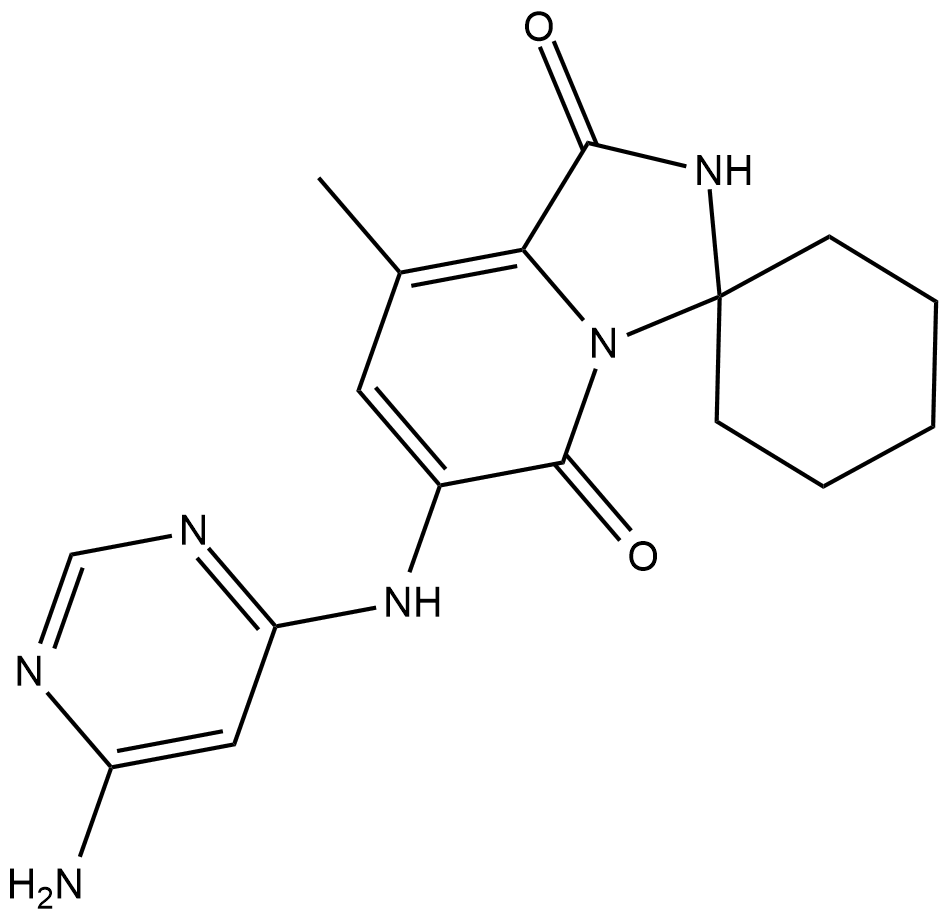
Tomivosertib |
Catalog No.GC19131
 One-Click Copy Product Info
|

Tomivosertib is an orally active MNK1/2 inhibitor (IC50 = 1–2nM).
Products are for research use only. Not for human use. We do not sell to patients.
Cas No.: 1849590-01-7
Sample solution is provided at 25 µL, 10mM.
_1-3.$$$39978408@51.jpg');)
_1-9.$$$38538795@65.jpg');)
_1-9.$$$39112701@51.jpg');)
_1-7.$$$37316672@70.jpg');)
_366-372.$$$36198801@70.jpg');)
.$$$38565142@65.jpg');)
_1867-1883.$$$33248023@67.jpg');)
_eads6055.$$$39977546@45.jpg');)
_eadm9805.$$$40080571@45.jpg');)
_eadj3020.$$$39666821@45.jpg');)
_1-20.$$$39757301@28.jpg');)
_1-24.$$$38898113@28.jpg');)
_273-287.$$$36806353@46.jpg');)
_1-16.$$$37156877@44.jpg');)
_1-19.$$$37460805@44.jpg');)
_1291-1307.$$$34518654@46.jpg');)
Tomivosertib is an orally active MNK1/2 inhibitor (IC50 = 1–2nM). Tomivosertib specifically downregulates the translation of key oncogenic factors (Cyclin D1 and c-Myc) and immune checkpoint proteins (PD-L1) by inhibiting the phosphorylation of eIF4E at serine 209. Tomivosertib can be used in research related to acute myeloid leukemia, breast cancer, lymphoma, non‑small cell lung cancer, and prostate cancer[1-4].
In vitro, Tomivosertib (0–100nM) treated breast cancer cell lines (MDA‑MB‑231, MDA‑MB‑468, MCF7, T47D, SUM149) for 24 hours. Tomivosertib significantly inhibited the expression of PD‑L1 and PD‑L2, suppressed eIF4E phosphorylation, inhibited global translation, and increased chemosensitivity[5]. Tomivosertib (0.1–10μM) treated acute myeloid leukemia cell lines such as U937, MV411, and MM6 for 1–4 hours. Tomivosertib significantly inhibited phosphorylation of eIF4E at serine 209, reduced cell viability, and impaired clonogenic capacity[6].
In vivo, Tomivosertib (10mg/kg; five days per week) was administered orally to pancreatic cancer mouse models, combined with a ketogenic diet, for two weeks. Tomivosertib significantly suppressed pancreatic tumor growth, lowered blood β‑hydroxybutyrate levels, and inhibited the translation of PPARα and Hmgcs2 in the liver[7]. Tomivosertib (10mg/kg; daily oral administration) was given to C57BL/6J wild‑type (WT) mice, 4EKI mice, or MNK1 knockout (KO) mice that had undergone spared nerve injury (SNI) surgery, for 7 days. Tomivosertib reversed the deficits in rule-shifting tasks, spontaneous pain in SNI mice, and rescued the shortening of the axon initial segment (AIS) in the medial prefrontal cortex (mPFC)[8].
References:
[1] Kevin R. Webster, Vikas K Goel, et al. eFT508, a Potent and Selective Mitogen-Activated Protein Kinase Interacting Kinase (MNK) 1 and 2 Inhibitor, Is Efficacious in Preclinical Models of Diffuse Large B-Cell Lymphoma (DLBCL). Blood 2015; 126 (23): 1554.
[2] Xu Y, Poggio M, Jin HY, et al. Translation control of the immune checkpoint in cancer and its therapeutic targeting. Nat Med. 2019 Feb;25(2):301-311.
[3] Li Y, Uhelski ML, North RY, et al. Tomivosertib reduces ectopic activity in dorsal root ganglion neurons from patients with radiculopathy. Brain. 2024 Sep 3;147(9):2991-2997.
[4] Yang X, Liu Z, Yin X, et al. Inhibition MNK-eIF4E-β-catenin preferentially sensitizes gastric cancer to chemotherapy. Fundam Clin Pharmacol. 2022 Aug;36(4):712-720.
[5] Yang ZY, Jiang CW, Zhang WL, et al. Treatment with eFT-508 increases chemosensitivity in breast cancer cells by modulating the tumor microenvironment. J Transl Med. 2022 Jun 18;20(1):276.
[6] Suarez M, Blyth GT, Mina AA, et al. Inhibitory effects of Tomivosertib in acute myeloid leukemia. Oncotarget. 2021 May 11;12(10):955-966.
[7] Yang H, Zingaro VA, Lincoff J, et al. Remodelling of the translatome controls diet and its impact on tumorigenesis. Nature. 2024 Sep;633(8028):189-197.
[8] Shiers S, Mwirigi J, Pradhan G, et al. Reversal of peripheral nerve injury-induced neuropathic pain and cognitive dysfunction via genetic and tomivosertib targeting of MNK. Neuropsychopharmacology. 2020 Feb;45(3):524-533.
| Cell experiment [1]: | |
Cell lines | U937, MV411, MM6, KG-1, and THP-1 acute myeloid leukemia (AML) cell lines, as well as primary leukemic precursors from AML patients |
Preparation Method | Cells were cultured as previously described. For viability and clonogenic assays, cells were treated with Tomivosertib at indicated doses. For eIF4E phosphorylation assessment, cells were treated with increasing doses of Tomivosertib. |
Reaction Conditions | 0.1μM to 10μM; 1-4h |
Applications | Tomivosertib abrogated phosphorylation of eIF4E on serine 209 at 0.1μM, demonstrating potent inhibition of MNK1/2 activity. Tomivosertib resulted in dose-dependent inhibition of cellular viability in AML cell lines, with greatest suppressive activity against MV411, MM6 and KG-1 cells. Tomivosertib significantly inhibited leukemic progenitor (CFU-L) colony formation in KG-1, MV411, and MM6 cells, and also showed inhibitory effects on primary leukemic precursors from AML patients. Combination of Tomivosertib with Venetoclax resulted in synergistic inhibitory effects on cellular viability and CFU-L growth. |
| Animal experiment [2]: | |
Animal models | C57BL/6J wild-type (WT) mice, 4EKI mice (with a mutation at the MNK1/2 phosphorylation site of eIF4E), and MNK1 knockout (KO) mice |
Preparation Method | Mice underwent spared nerve injury (SNI) surgery (ligation and cutting of the tibial and peroneal branches of the left sciatic nerve) or sham surgery. For rule-shifting, marble burying, von Frey, and histology experiments, Tomivosertib was administered orally (p.o.) daily for 7 days, with the last injection 1 hour before behavioral testing. For the conditioned place preference (CPP) experiment, Tomivosertib was administered intraperitoneally (i.p.). Rule-shifting was assessed on day 21 post-SNI. Mice were perfused at 3 weeks post-surgery for immunohistochemistry. |
Dosage form | 10mg/kg; oral (p.o.); daily for 7 days |
Applications | Tomivosertib reversed PNI-induced deficits in an attentional rule-shifting task (a measure of cognitive flexibility), reversed spontaneous pain as assessed by conditioned place preference (CPP), and rescued maladaptive shortening of axon initial segments (AIS) in the medial prefrontal cortex (mPFC) of PNI mice. Tomivosertib had no effect on mechanical withdrawal thresholds (mechanical allodynia). |
References: | |
| Cas No. | 1849590-01-7 | SDF | |
| Canonical SMILES | O=C(C1=C(C)C=C(NC2=NC=NC(N)=C2)C(N13)=O)NC43CCCCC4 | ||
| Formula | C17H20N6O2 | M.Wt | 340.38 |
| Solubility | DMSO : 4.35 mg/mL (12.78 mM);Water : < 0.1 mg/mL (insoluble) | Storage | Store at -20°C |
| General tips | Please select the appropriate solvent to prepare the stock solution according to the
solubility of the product in different solvents; once the solution is prepared, please store it in
separate packages to avoid product failure caused by repeated freezing and thawing.Storage method
and period of the stock solution: When stored at -80°C, please use it within 6 months; when stored
at -20°C, please use it within 1 month. To increase solubility, heat the tube to 37°C and then oscillate in an ultrasonic bath for some time. |
||
| Shipping Condition | Evaluation sample solution: shipped with blue ice. All other sizes available: with RT, or with Blue Ice upon request. | ||
| Prepare stock solution | |||

|
1 mg | 5 mg | 10 mg |
| 1 mM | 2.9379 mL | 14.6895 mL | 29.3789 mL |
| 5 mM | 587.6 μL | 2.9379 mL | 5.8758 mL |
| 10 mM | 293.8 μL | 1.4689 mL | 2.9379 mL |
Step 1: Enter information below (Recommended: An additional animal making an allowance for loss during the experiment)
 g
μL
g
μL
Step 2: Enter the in vivo formulation (This is only the calculator, not formulation. Please contact us first if there is no in vivo formulation at the solubility Section.)
Calculation results:
Working concentration: mg/ml;
Method for preparing DMSO master liquid: mg drug pre-dissolved in μL DMSO ( Master liquid concentration mg/mL, Please contact us first if the concentration exceeds the DMSO solubility of the batch of drug. )
Method for preparing in vivo formulation: Take μL DMSO master liquid, next addμL PEG300, mix and clarify, next addμL Tween 80, mix and clarify, next add μL saline, mix and clarify.
Method for preparing in vivo formulation: Take μL DMSO master liquid, next add μL Corn oil, mix and clarify.
Note: 1. Please make sure the liquid is clear before adding the next solvent.
2. Be sure to add the solvent(s) in order. You must ensure that the solution obtained, in the previous addition, is a clear solution before proceeding to add the next solvent. Physical methods such as vortex, ultrasound or hot water bath can be used to aid dissolving.
3. All of the above co-solvents are available for purchase on the GlpBio website.
Quality Control & SDS
- View current batch:
- Purity: >98.00% Appearance: A solid
- COA (Certificate of Analysis)
- SDS (Safety Data Sheet)
- Datasheet
Average Rating: 5 (Based on Reviews and 23 reference(s) in Google Scholar.)