

VAS2870 |
Catalog No.GC32443
 One-Click Copy Product Info
|

A pan-NADPH oxidase inhibitor
Products are for research use only. Not for human use. We do not sell to patients.
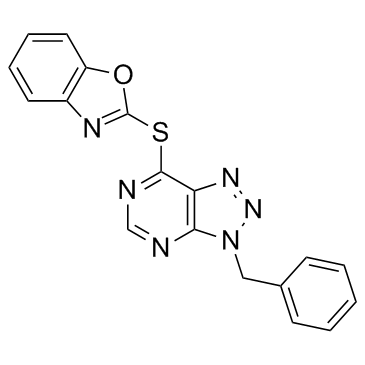
Cas No.: 722456-31-7
Sample solution is provided at 25 µL, 10mM.
VAS2870 is a NADPH oxidase (NOX) inhibitor.
VAS2870 is effective to suppress PDGF-BB-dependent activation of NADPH oxidase and subsequent production of intracellular ROS. Furthermore, VAS2870 suppresses PDGF-BB-dependent chemotaxis, but not DNA synthesis. Preincubation with VAS2870 (10 and 20 μM) completely abolishes PDGF-mediated NADPH oxidase activation and ROS production. Preincubation with VAS2870 (0.1-20 μM) does not affect PDGF-induced cell cycle progression. However, it abolishes PDGF-dependent chemotaxis of VSMC in a concentration-dependent manner (100% inhibition at 10 μM)[1]. VAS2870 inhibits dose-dependently autocrine increase of cell number in FaO rat hepatoma cells, and almost completely blocked ROS production and thymidine incorporation when used at 25 mM. VAS2870 blocks serum-dependent cell growth of FaO rat hepatoma cells. VAS2870 inhibits proliferation of different human hepatocellular carcinoma (HCC) cell lines. VAS2870 pretreatment enhances TGF-b-mediated apoptosis of FaO rat hepatoma cells[2].
[1]. ten Freyhaus H, et al. Novel Nox inhibitor VAS2870 attenuates PDGF-dependent smooth muscle cell chemotaxis, but not proliferation. Cardiovasc Res. 2006 Jul 15;71(2):331-41. [2]. Sancho P, et al. The NADPH oxidase inhibitor VAS2870 impairs cell growth and enhances TGF-β-induced apoptosis of liver tumor cells. Biochem Pharmacol. 2011 Apr 1;81(7):917-24.
|
Kinase experiment: |
NADPH oxidase activity is measured by lucigenin-enhanced chemiluminescence in a 50 mM phosphate buffer (buffer A), pH 7.0, containing 1 mM EGTA, protease inhibitors, 150 mM sucrose, 5 μM lucigenin, and 250 μM NADPH as substrate. Quiescent cells are starved by serum deprivation for 24 h and treated as indicated, ished twice with ice-cold phosphate buffered saline (PBS), pH 7.4, and harvested. After low spin centrifugation, the pellet is re-suspended in ice-cold buffer A, lacking lucigenin and substrate. Then, the cells are lysed and total protein concentration is determined using a Bradford assay and adjusted to 1 mg/mL. 100 μL aliquots of the protein sample are measured over 6 min in quadruplicates using NADPH (100 μM) as substrate in a scintillation counter. Data are collected at 2 min intervals in order to measure relative changes in NADPH oxidase activity[1]. |
|
Cell experiment: |
To test autocrine growth, cells are serum deprived at 40% confluence and, when indicated, the NADPH oxidase inhibitors Apocynin (300 mM) or VAS2870 are added 30 min before serum deprivation and maintained along the experiment. For TGF-b experiments, cells at 70% confluence are serum deprived for 16 h and treated with 2 ng/mL TGF-β in the presence or absence of the EGFR inhibitor AG1478 (20 mM) or VAS2870 (25 mM), which are added 30 min prior to TGF-β[2]. |
|
References: [1]. ten Freyhaus H, et al. Novel Nox inhibitor VAS2870 attenuates PDGF-dependent smooth muscle cell chemotaxis, but not proliferation. Cardiovasc Res. 2006 Jul 15;71(2):331-41. |
|
| Cas No. | 722456-31-7 | SDF | |
| Canonical SMILES | C1(N(CC2=CC=CC=C2)N=N3)=C3C(SC4=NC5=C(C=CC=C5)O4)=NC=N1 | ||
| Formula | C18H12N6OS | M.Wt | 360.39 |
| Solubility | DMSO : 83.3 mg/mL (231.14 mM) | Storage | Store at -20°C |
| General tips | Please select the appropriate solvent to prepare the stock solution according to the
solubility of the product in different solvents; once the solution is prepared, please store it in
separate packages to avoid product failure caused by repeated freezing and thawing.Storage method
and period of the stock solution: When stored at -80°C, please use it within 6 months; when stored
at -20°C, please use it within 1 month. To increase solubility, heat the tube to 37°C and then oscillate in an ultrasonic bath for some time. |
||
| Shipping Condition | Evaluation sample solution: shipped with blue ice. All other sizes available: with RT, or with Blue Ice upon request. | ||
| Prepare stock solution | |||

|
1 mg | 5 mg | 10 mg |
| 1 mM | 2.7748 mL | 13.8739 mL | 27.7477 mL |
| 5 mM | 555 μL | 2.7748 mL | 5.5495 mL |
| 10 mM | 277.5 μL | 1.3874 mL | 2.7748 mL |
Step 1: Enter information below (Recommended: An additional animal making an allowance for loss during the experiment)
 g
μL
g
μL
Step 2: Enter the in vivo formulation (This is only the calculator, not formulation. Please contact us first if there is no in vivo formulation at the solubility Section.)
Calculation results:
Working concentration: mg/ml;
Method for preparing DMSO master liquid: mg drug pre-dissolved in μL DMSO ( Master liquid concentration mg/mL, Please contact us first if the concentration exceeds the DMSO solubility of the batch of drug. )
Method for preparing in vivo formulation: Take μL DMSO master liquid, next addμL PEG300, mix and clarify, next addμL Tween 80, mix and clarify, next add μL saline, mix and clarify.
Method for preparing in vivo formulation: Take μL DMSO master liquid, next add μL Corn oil, mix and clarify.
Note: 1. Please make sure the liquid is clear before adding the next solvent.
2. Be sure to add the solvent(s) in order. You must ensure that the solution obtained, in the previous addition, is a clear solution before proceeding to add the next solvent. Physical methods such as vortex, ultrasound or hot water bath can be used to aid dissolving.
3. All of the above co-solvents are available for purchase on the GlpBio website.
Quality Control & SDS
- View current batch:
- Purity: >98.50% Appearance: A solid
- COA (Certificate of Analysis)
- SDS (Safety Data Sheet)
- Datasheet
Average Rating: 5 (Based on Reviews and 32 reference(s) in Google Scholar.)