

Zanamivir (Synonyms: GG 167, GR 121167X) |
Catalog No.GC10984
 One-Click Copy Product Info
|

Influenza A/B virus neuraminidases inhibitor
Products are for research use only. Not for human use. We do not sell to patients.
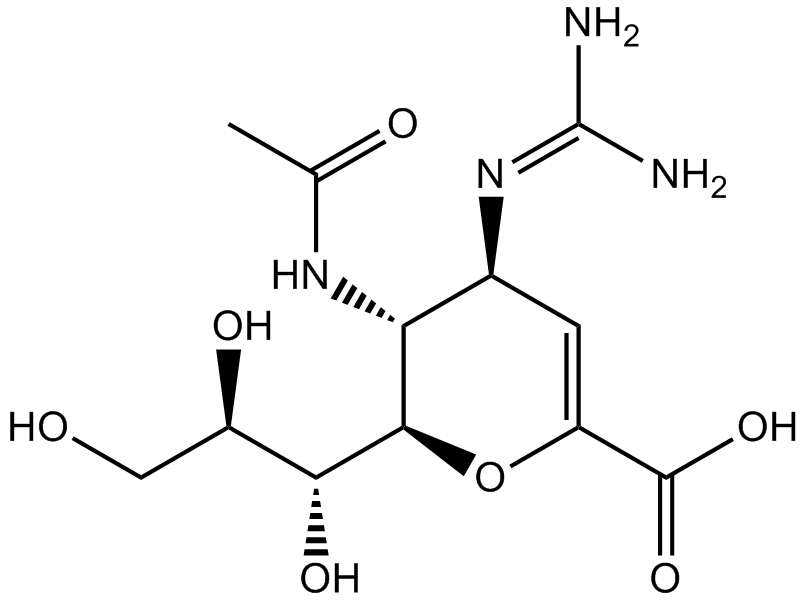
Cas No.: 139110-80-8
Sample solution is provided at 25 µL, 10mM.
_1-3.$$$39978408@51.jpg');)
_1-9.$$$38538795@65.jpg');)
_1-9.$$$39112701@51.jpg');)
_1-7.$$$37316672@70.jpg');)
_366-372.$$$36198801@70.jpg');)
.$$$38565142@65.jpg');)
_1867-1883.$$$33248023@67.jpg');)
_eads6055.$$$39977546@45.jpg');)
_eadm9805.$$$40080571@45.jpg');)
_eadj3020.$$$39666821@45.jpg');)
_1-20.$$$39757301@28.jpg');)
_1-24.$$$38898113@28.jpg');)
_273-287.$$$36806353@46.jpg');)
_1-16.$$$37156877@44.jpg');)
_1-19.$$$37460805@44.jpg');)
_1291-1307.$$$34518654@46.jpg');)
Zanamivir is a selective inhibitor of influenza A and B virus neuraminidases with IC50 values of 0.64-7.9nM [1].
Influenza A and B viruses are negative-strand RNA viruses. Neuraminidase is one of the two glycoproteins present on the surface of the virus. It is important to the pathogenicity and infectivity of the virus. The neuraminidases inhibitor, zanamivir, is a sialic acid analogue. It inhibits neuraminidases to cleave sialic acid on the surface of host cells and influenza viral envelope. In the in vitro assay, zanamivir suppresses the growth of influenza A and B viruses with IC50 values ranging from 5nM to 14nM for laboratory-passaged strains and from 20nM to 16μM for clinical isolates. In animal models infected with influenza A and B, treatment of zanamivir reduces the mortality and viral titres in lung homogenates and improves lung consolidation scores [1].
References:
[1] Elliott M. Zanamivir: from drug design to the clinic. Philos Trans R Soc Lond B Biol Sci, 2001, 356(1416): 1885-93.
| Cell experiment [1,2]: | |
|
Cell lines |
HeLa-CD4-LTR-βgal cells and HeLa-tat cell, CV-1 cell |
|
Preparation method |
The solubility of this compound in DMSO is >16.6mg/mL. General tips for obtaining a higher concentration: Please warm the tube at 37 ℃ for 10 minutes and/or shake it in the ultrasonic bath for a while. Stock solution can be stored below -20℃ for several months. |
|
Reacting condition |
5 nM-10 mM |
|
Applications |
In HeLa-CD4-LTR-βgal cells, zananivir interfered with cell-cell fusion with the IC50 of 0.19 mM. In CV-1 cell monolayers, zananivir (0.5 mM) reduced plaque area by 97%. Zananivir caused a concentration-dependent inhibition of hemadsorption. Zananivir (5 mM) strikingly reduced lipid mixing. zanamivir suppressed the growth of influenza A and B viruses with IC50 values of 5 nM-14 nM for laboratory-passaged strains and from 20 nM-16 μM for clinical isolates. |
| Animal experiment [2]: | |
|
Animal models |
Mice infected with influenza A |
|
Dosage form |
Intranasal, 0.01-4 mg/kg |
|
Application |
Intranasal zananivir treatment given prophylactically plus twice daily over days 0 to 3 in mice infected with influenza A reduced mortality and viral titres in lung homogenated and improved lung consolidation scores over 10 days. |
|
Other notes |
Please test the solubility of all compounds indoor, and the actual solubility may slightly differ with the theoretical value. This is caused by an experimental system error and it is normal. |
|
References: [1]. Greengard O, Poltoratskaia N, Leikina E, et al. The anti-influenza virus agent 4-GU-DANA (zanamivir) inhibits cell fusion mediated by human parainfluenza virus and influenza virus HA[J]. Journal of virology, 2000, 74(23): 11108-11114. [2]. Elliott M. Zanamivir: from drug design to the clinic[J]. Philosophical Transactions of the Royal Society of London. Series B, 2001, 356(1416): 1885. |
|
| Cas No. | 139110-80-8 | SDF | |
| Synonyms | GG 167, GR 121167X | ||
| Chemical Name | (2R,3R,4S)-3-acetamido-4-(diaminomethylideneamino)-2-[(1R,2R)-1,2,3-trihydroxypropyl]-3,4-dihydro-2H-pyran-6-carboxylic acid | ||
| Canonical SMILES | CC(=O)NC1C(C=C(OC1C(C(CO)O)O)C(=O)O)N=C(N)N | ||
| Formula | C12H20N4O7 | M.Wt | 332.31 |
| Solubility | ≥ 8.99 mg/mL in Water; 66 mg/mL in DMSO ( Need ultrasonic) | Storage | Store at -20°C |
| General tips | Please select the appropriate solvent to prepare the stock solution according to the
solubility of the product in different solvents; once the solution is prepared, please store it in
separate packages to avoid product failure caused by repeated freezing and thawing.Storage method
and period of the stock solution: When stored at -80°C, please use it within 6 months; when stored
at -20°C, please use it within 1 month. To increase solubility, heat the tube to 37°C and then oscillate in an ultrasonic bath for some time. |
||
| Shipping Condition | Evaluation sample solution: shipped with blue ice. All other sizes available: with RT, or with Blue Ice upon request. | ||
| Prepare stock solution | |||

|
1 mg | 5 mg | 10 mg |
| 1 mM | 3.0092 mL | 15.0462 mL | 30.0924 mL |
| 5 mM | 601.8 μL | 3.0092 mL | 6.0185 mL |
| 10 mM | 300.9 μL | 1.5046 mL | 3.0092 mL |
Step 1: Enter information below (Recommended: An additional animal making an allowance for loss during the experiment)
 g
μL
g
μL
Step 2: Enter the in vivo formulation (This is only the calculator, not formulation. Please contact us first if there is no in vivo formulation at the solubility Section.)
Calculation results:
Working concentration: mg/ml;
Method for preparing DMSO master liquid: mg drug pre-dissolved in μL DMSO ( Master liquid concentration mg/mL, Please contact us first if the concentration exceeds the DMSO solubility of the batch of drug. )
Method for preparing in vivo formulation: Take μL DMSO master liquid, next addμL PEG300, mix and clarify, next addμL Tween 80, mix and clarify, next add μL saline, mix and clarify.
Method for preparing in vivo formulation: Take μL DMSO master liquid, next add μL Corn oil, mix and clarify.
Note: 1. Please make sure the liquid is clear before adding the next solvent.
2. Be sure to add the solvent(s) in order. You must ensure that the solution obtained, in the previous addition, is a clear solution before proceeding to add the next solvent. Physical methods such as vortex, ultrasound or hot water bath can be used to aid dissolving.
3. All of the above co-solvents are available for purchase on the GlpBio website.
Quality Control & SDS
- View current batch:
- Purity: >98.00% Appearance: A solid
- COA (Certificate of Analysis)
- SDS (Safety Data Sheet)
- Datasheet
Average Rating: 5 (Based on Reviews and 29 reference(s) in Google Scholar.)