

Galanthamine (Synonyms: Galanthamine, NSC 100058) |
Catalog No.GC16573
 One-Click Copy Product Info
|

An alkaloid with AChE inhibitory and nAChR potentiating activities
Products are for research use only. Not for human use. We do not sell to patients.
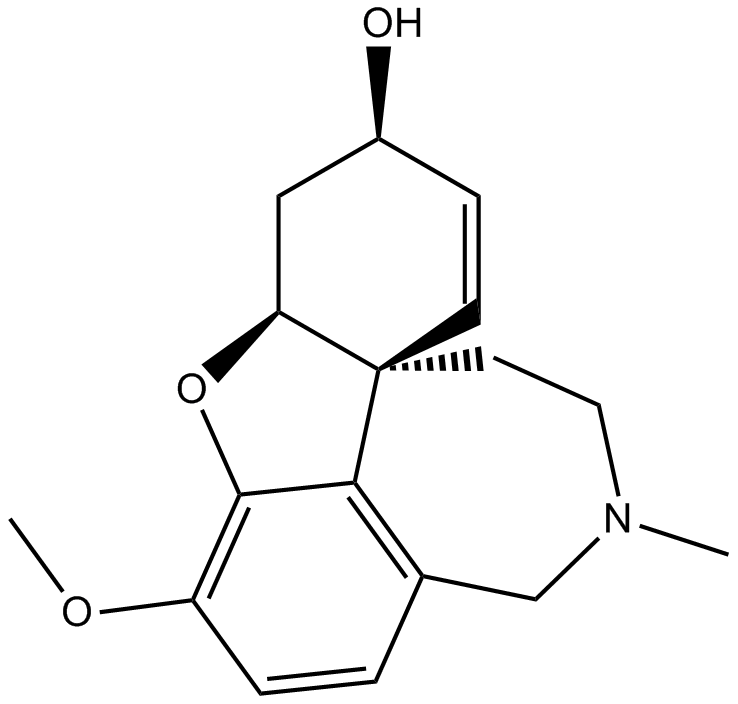
Cas No.: 357-70-0
Sample solution is provided at 25 µL, 10mM.
_1-3.$$$39978408@51.jpg');)
_1-9.$$$38538795@65.jpg');)
_1-9.$$$39112701@51.jpg');)
_1-7.$$$37316672@70.jpg');)
_366-372.$$$36198801@70.jpg');)
.$$$38565142@65.jpg');)
_1867-1883.$$$33248023@67.jpg');)
_eads6055.$$$39977546@45.jpg');)
_eadm9805.$$$40080571@45.jpg');)
_eadj3020.$$$39666821@45.jpg');)
_1-20.$$$39757301@28.jpg');)
_1-24.$$$38898113@28.jpg');)
_273-287.$$$36806353@46.jpg');)
_1-16.$$$37156877@44.jpg');)
_1-19.$$$37460805@44.jpg');)
_1291-1307.$$$34518654@46.jpg');)
Galantamine is a potent inhibitor of acetylcholinesterase (AChE) with IC50 value of 410 nM. [1]
Acetylcholinesterase is a hydrolase. It belongs to carboxylesterase family of enzymes It hydrolyzes the neurotransmitter acetylcholine and has very high catalytic activity. AChE exits in many types of conducting tissue: nerve and muscle, motor and sensory fibers and central and peripheral tissues. AChE located on the post-synaptic membrane. It stops the signal transmission by hydrolyzing ACh. Ach plays an important role in neurotransmission. ACh is released into the synaptic cleft then binds to ACh receptors which located on the post-synaptic membrane. Inhibition the activity of AChE will result in impeded neurotransmission by leading to accumulation of ACh in the synaptic cleft. AChE also is an important target for Alzheimer disease.[1]
Galantamine significantly decreased apoptotic effect induced by thapsigargin at 300 nM in SH-SY5Y cells. Galantamine can more significantly increase cell viability in LDH assays at 10 nM in neuroblastoma cells. Galantamine at 300 nM increase the cell viability treated with Aβ. Galantamine significantly increaseed the expression level of Bcl-2 by 3.1 fold at 300nM in chromaffin cells.[1]
Galantamine can significantly incrase the mRNAs level of IGF2 at 3mg/kg in the mice hippoc ampus. Galantamine also transient decrease the BDNF mRNA levels and increase the FGF2 mRNA levels. Galantamine significantly increased the expression of IGF2 protein levels at 3 mg/kg in the hippocampus of mice.[2]
References:
[1]. Arias E, Ales E, Gabilan NH, Cano-Abad MF, Villarroya M, Garcia AG, Lopez MG: Galantamine prevents apoptosis induced by beta-amyloid and thapsigargin: involvement of nicotinic acetylcholine receptors. Neuropharmacology 2004, 46(1):103-114.
[2]. Kita Y, Ago Y, Takano E, Fukada A, Takuma K, Matsuda T: Galantamine increases hippocampal insulin-like growth factor 2 expression via alpha7 nicotinic acetylcholine receptors in mice. Psychopharmacology (Berl), 225(3):543-551.
| Cell experiment [1-3]: | |
|
Cell lines |
Post-mortem human brain frontal cortex and hippocampus region, M10 cells, Rat pheochromocytoma (PC12) cells |
|
Preparation method |
Soluble in DMSO. General tips for obtaining a higher concentration: Please warm the tube at 37 ℃ for 10 minutes and/or shake it in the ultrasonic bath for a while. Stock solution can be stored below -20℃ for several months. |
|
Reacting condition |
0.35 μM |
|
Applications |
Galanthamine inhibited the activity of acetylcholinesterase with the IC50 of 14 nM and 15 nM on AChE in post-mortem human brain frontal cortex and the hippocampus region. Red-cell cholinesterase activity in blood samples from the neurosurgery patients was 10 times more strongly inhibited by Galanthamine in brain tissue samples. Galanthamine (1 μM) activated single channels in outside-out patches excised from dexamethasone mouse fibroblasts (M10 cells). Galanthamine acts as noncompetitive nicotinic receptor agonists' on clonal rat pheochromocytoma (PC12) cells. Galanthamine (50 μM) activated single-channel currents in outside-out patches excised from clonal PC12 cells. |
| Animal experiment [4]: | |
|
Animal models |
Male ddY mice |
|
Dosage form |
Intraperitoneal injection, 0.3-3 mg/kg |
|
Application |
Acute administration of Galantamine (0.3-3 mg/kg, i.p.) increased IGF2 mRNA levels in time- and dose-dependent manner. Galantamine (3 mg/kg, i.p.) increased fibroblast growth factor 2 mRNA levels and decreased brain-derived neurotrophic factor mRNA levels in the hippocampus. Galantamine increased hippocampal IGF2 protein. |
|
Other notes |
Please test the solubility of all compounds indoor, and the actual solubility may slightly differ with the theoretical value. This is caused by an experimental system error and it is normal. |
|
References: [1]. Thomsen T, Kaden B, Fischer J P, et al. Inhibition of acetylcholinesterase activity in human brain tissue and erythrocytes by galanthamine, physostigmine and tacrine[J]. Clinical Chemistry and Laboratory Medicine, 1991, 29(8): 487-492. [2]. Pereira E F, Alkondon M, Reinhardt S, et al. Physostigmine and galanthamine: probes for a novel binding site on the alpha 4 beta 2 subtype of neuronal nicotinic acetylcholine receptors stably expressed in fibroblast cells[J]. Journal of Pharmacology and Experimental Therapeutics, 1994, 270(2): 768-778. [3]. Storch A, Schrattenholz A, Cooper J C, et al. Physostigmine, galanthamine and codeine act as ‘noncompetitive nicotinic receptor agonists’ on clonal rat pheochromocytoma cells[J]. European Journal of Pharmacology: Molecular Pharmacology, 1995, 290(3): 207-219. [4]. Kita Y, Ago Y, Takano E, et al. Galantamine increases hippocampal insulin-like growth factor 2 expression via α7 nicotinic acetylcholine receptors in mice[J]. Psychopharmacology, 2013, 225(3): 543-551. | |
| Cas No. | 357-70-0 | SDF | |
| Synonyms | Galanthamine, NSC 100058 | ||
| Chemical Name | (4aS,6R,8aS)-3-methoxy-11-methyl-5,6,9,10,11,12-hexahydro-4aH-benzo[2,3]benzofuro[4,3-cd]azepin-6-ol | ||
| Canonical SMILES | [H][C@@]([C@@]1(C([H])=C2[H])C3=C(C([H])=C4[H])C([H])([H])N(C([H])([H])[H])C([H])([H])C1([H])[H])(C([H])([H])[C@@]2([H])O[H])OC3=C4OC([H])([H])[H] | ||
| Formula | C17H21NO3 | M.Wt | 287.35 |
| Solubility | ≥ 14.4 mg/mL in DMSO, ≥ 45 mg/mL in EtOH with gentle warming, ≥ 14.43 mg/mL in Water with gentle warming | Storage | Store at -20°C |
| General tips | Please select the appropriate solvent to prepare the stock solution according to the
solubility of the product in different solvents; once the solution is prepared, please store it in
separate packages to avoid product failure caused by repeated freezing and thawing.Storage method
and period of the stock solution: When stored at -80°C, please use it within 6 months; when stored
at -20°C, please use it within 1 month. To increase solubility, heat the tube to 37°C and then oscillate in an ultrasonic bath for some time. |
||
| Shipping Condition | Evaluation sample solution: shipped with blue ice. All other sizes available: with RT, or with Blue Ice upon request. | ||
| Prepare stock solution | |||

|
1 mg | 5 mg | 10 mg |
| 1 mM | 3.4801 mL | 17.4004 mL | 34.8008 mL |
| 5 mM | 696 μL | 3.4801 mL | 6.9602 mL |
| 10 mM | 348 μL | 1.74 mL | 3.4801 mL |
Step 1: Enter information below (Recommended: An additional animal making an allowance for loss during the experiment)
 g
μL
g
μL
Step 2: Enter the in vivo formulation (This is only the calculator, not formulation. Please contact us first if there is no in vivo formulation at the solubility Section.)
Calculation results:
Working concentration: mg/ml;
Method for preparing DMSO master liquid: mg drug pre-dissolved in μL DMSO ( Master liquid concentration mg/mL, Please contact us first if the concentration exceeds the DMSO solubility of the batch of drug. )
Method for preparing in vivo formulation: Take μL DMSO master liquid, next addμL PEG300, mix and clarify, next addμL Tween 80, mix and clarify, next add μL saline, mix and clarify.
Method for preparing in vivo formulation: Take μL DMSO master liquid, next add μL Corn oil, mix and clarify.
Note: 1. Please make sure the liquid is clear before adding the next solvent.
2. Be sure to add the solvent(s) in order. You must ensure that the solution obtained, in the previous addition, is a clear solution before proceeding to add the next solvent. Physical methods such as vortex, ultrasound or hot water bath can be used to aid dissolving.
3. All of the above co-solvents are available for purchase on the GlpBio website.
Quality Control & SDS
- View current batch:
- Purity: >99.00% Appearance: A solid
- COA (Certificate of Analysis)
- SDS (Safety Data Sheet)
- Datasheet
Average Rating: 5 (Based on Reviews and 30 reference(s) in Google Scholar.)