

Zinquin |
Catalog No.GC30566
 One-Click Copy Product Info
|

Zinquin is a quinoline-based, cell-permeable fluorescent probe for zinc ions (excitation/emission wavelengths = 368/490nm).
Products are for research use only. Not for human use. We do not sell to patients.
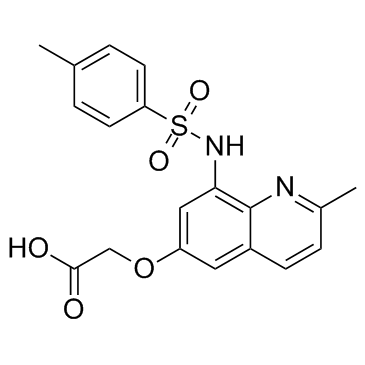
Cas No.: 151606-29-0
Sample solution is provided at 25 µL, 10mM.
_1-3.$$$39978408@51.jpg');)
_1-9.$$$38538795@65.jpg');)
_1-9.$$$39112701@51.jpg');)
_1-7.$$$37316672@70.jpg');)
_366-372.$$$36198801@70.jpg');)
.$$$38565142@65.jpg');)
_1867-1883.$$$33248023@67.jpg');)
_eads6055.$$$39977546@45.jpg');)
_eadm9805.$$$40080571@45.jpg');)
_eadj3020.$$$39666821@45.jpg');)
_1-20.$$$39757301@28.jpg');)
_1-24.$$$38898113@28.jpg');)
_273-287.$$$36806353@46.jpg');)
_1-16.$$$37156877@44.jpg');)
_1-19.$$$37460805@44.jpg');)
_1291-1307.$$$34518654@46.jpg');)
Zinquin is a quinoline-based, cell-permeable fluorescent probe for zinc ions (excitation/emission wavelengths = 368/490nm). Zinquin can bind to Zn²⁺ to form a fluorescent complex for detecting intracellular zinc ions, thereby revealing processes such as apoptosis[1-4].
References:
[1] Colvin RA, Laskowski M, Fontaine CP. Zinquin identifies subcellular compartmentalization of zinc in cortical neurons. Relation to the trafficking of zinc and the mitochondrial compartment. Brain Res. 2006 Apr 26;1085(1):1-10.
[2] Nowakowski AB, Petering DH. Reactions of the fluorescent sensor, Zinquin, with the zinc-proteome: adduct formation and ligand substitution. Inorg Chem. 2011 Oct 17;50(20):10124-33.
[3] Snitsarev V, Budde T, Stricker TP, et al. Fluorescent detection of Zn(2+)-rich vesicles with Zinquin: mechanism of action in lipid environments. Biophys J. 2001 Mar;80(3):1538-46.
[4] Kimura E, Takasawa R, Tanuma S, et al. Monitoring apoptosis with fluorescent Zn2+-indicators. Sci STKE. 2004 Mar 2;2004(223):PL7.
Zinquin Detection of Apoptosis[1]
This protocol is adapted from research data and provided for reference only. Adjustments may be necessary based on specific experimental requirements.
1. Reagent Preparation: Zinquin is dissolved in dimethyl sulfoxide (DMSO) at a concentration of 5mM and stored at -20°C. Before use, Zinquin is diluted to the working concentration (e.g., 25μM) with Hanks' Balanced Salt Solution (HBSS, pH=7.4, containing 1.3mM Ca²⁺, 0.9mM Mg²⁺, 4.2mM NaHCO₃). Other reagents include ZnSO₄·7H₂O, sodium pyrithione (a zinc ionophore), TPEN (a zinc chelator).
2. Cell Preparation: Cells (5×10⁶ cells/mL) are incubated at 37°C with 25μM ZnSO₄ and a specified concentration (typically 1–4μM) of sodium pyrithione for 40min, followed by three washes with HBSS to remove extracellular zinc. Alternatively, cells are incubated with different concentrations (0–100μM) of TPEN in culture medium for periods ranging from tens of minutes to several hours to reduce intracellular labile zinc levels.
3. Zinquin Labeling and Fluorescence Detection: Treated cells are incubated with Zinquin (25μM) in HBSS at 37°C for 30min. After incubation, cells are collected, and the fluorescence intensity of Zinquin is measured using a microplate reader (excitation/emission wavelengths = 368/490nm).
Precautions:
(1) Zinquin is specific for Zn²⁺ (Cd²⁺ can also enhance fluorescence, but its content in biological tissues is extremely low; Ca²⁺ and Mg²⁺ have almost no effect; Cu²⁺ and Fe²⁺ quench fluorescence). Zinquin mainly forms 1:1 and 1:2 complexes with Zn²⁺, with relatively low binding constants (approximately 10⁶L/mol), and may not detect zinc tightly bound to the active sites of metalloenzymes.
(2) The free acid form of Zinquin can passively cross membranes without requiring esterase hydrolysis. At high concentrations, Zinquin may transport zinc in a 1 Zn²⁺ exchange for 2 H⁺ manner, a process inhibited by transmembrane pH gradients.
(3) The fluorescence signal remains stable for 1–2 hours; washing after labeling does not affect fluorescence intensity, indicating that the probe is effectively trapped within the cells.
(4) For your safety and health, please wear a lab coat and disposable gloves during operation.
References:
[1] Zalewski PD, Forbes IJ, Betts WH. Correlation of apoptosis with change in intracellular labile Zn(II) using zinquin [(2-methyl-8-p-toluenesulphonamido-6-quinolyloxy)acetic acid], a new specific fluorescent probe for Zn(II). Biochem J. 1993 Dec 1;296 ( Pt 2)(Pt 2):403-8.
| Cas No. | 151606-29-0 | SDF | |
| Canonical SMILES | O=C(O)COC1=CC(NS(=O)(C2=CC=C(C)C=C2)=O)=C3N=C(C)C=CC3=C1 | ||
| Formula | C19H18N2O5S | M.Wt | 386.42 |
| Solubility | DMSO: 50 mg/mL (129.39 mM) | Storage | Store at -20°C,protect from light |
| General tips | Please select the appropriate solvent to prepare the stock solution according to the
solubility of the product in different solvents; once the solution is prepared, please store it in
separate packages to avoid product failure caused by repeated freezing and thawing.Storage method
and period of the stock solution: When stored at -80°C, please use it within 6 months; when stored
at -20°C, please use it within 1 month. To increase solubility, heat the tube to 37°C and then oscillate in an ultrasonic bath for some time. |
||
| Shipping Condition | Evaluation sample solution: shipped with blue ice. All other sizes available: with RT, or with Blue Ice upon request. | ||
| Prepare stock solution | |||

|
1 mg | 5 mg | 10 mg |
| 1 mM | 2.5879 mL | 12.9393 mL | 25.8786 mL |
| 5 mM | 517.6 μL | 2.5879 mL | 5.1757 mL |
| 10 mM | 258.8 μL | 1.2939 mL | 2.5879 mL |
Step 1: Enter information below (Recommended: An additional animal making an allowance for loss during the experiment)
 g
μL
g
μL
Step 2: Enter the in vivo formulation (This is only the calculator, not formulation. Please contact us first if there is no in vivo formulation at the solubility Section.)
Calculation results:
Working concentration: mg/ml;
Method for preparing DMSO master liquid: mg drug pre-dissolved in μL DMSO ( Master liquid concentration mg/mL, Please contact us first if the concentration exceeds the DMSO solubility of the batch of drug. )
Method for preparing in vivo formulation: Take μL DMSO master liquid, next addμL PEG300, mix and clarify, next addμL Tween 80, mix and clarify, next add μL saline, mix and clarify.
Method for preparing in vivo formulation: Take μL DMSO master liquid, next add μL Corn oil, mix and clarify.
Note: 1. Please make sure the liquid is clear before adding the next solvent.
2. Be sure to add the solvent(s) in order. You must ensure that the solution obtained, in the previous addition, is a clear solution before proceeding to add the next solvent. Physical methods such as vortex, ultrasound or hot water bath can be used to aid dissolving.
3. All of the above co-solvents are available for purchase on the GlpBio website.
Quality Control & SDS
- View current batch:
- Purity: >99.00% Appearance: A solid
- COA (Certificate of Analysis)
- SDS (Safety Data Sheet)
- Datasheet
Average Rating: 5 (Based on Reviews and 1 reference(s) in Google Scholar.)