

Zotiraciclib |
Catalog No.GC62112
 One-Click Copy Product Info
|

Products are for research use only. Not for human use. We do not sell to patients.
Cas No.: 1204918-72-8
Sample solution is provided at 25 µL, 10mM.
_1-3.$$$39978408@51.jpg');)
_1-9.$$$38538795@65.jpg');)
_1-9.$$$39112701@51.jpg');)
_1-7.$$$37316672@70.jpg');)
_366-372.$$$36198801@70.jpg');)
.$$$38565142@65.jpg');)
_1867-1883.$$$33248023@67.jpg');)
_eads6055.$$$39977546@45.jpg');)
_eadm9805.$$$40080571@45.jpg');)
_eadj3020.$$$39666821@45.jpg');)
_1-20.$$$39757301@28.jpg');)
_1-24.$$$38898113@28.jpg');)
_273-287.$$$36806353@46.jpg');)
_1-16.$$$37156877@44.jpg');)
_1-19.$$$37460805@44.jpg');)
_1291-1307.$$$34518654@46.jpg');)
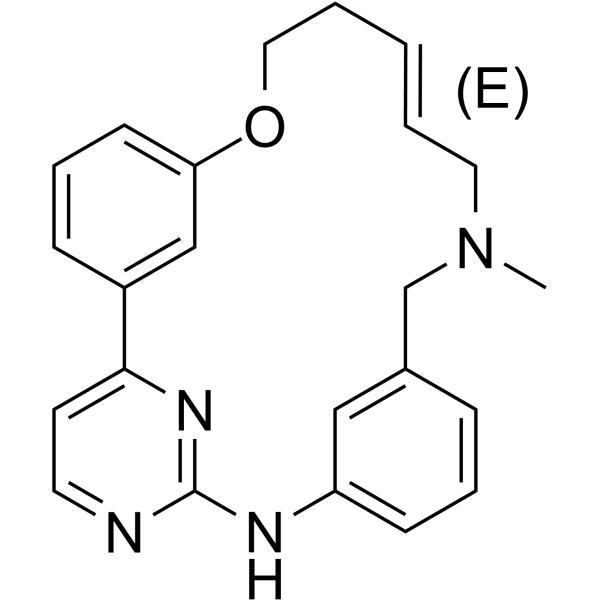
Zotiraciclib (TG02; SB1317) is a potent inhibitor of CDK2, JAK2, and FLT3 for the treatment of cancer, with IC50s of 13, 73, and 56 nM for CDK2, JAK2 and FLT3, respectively.
Zotiraciclib (SB1317) has a highly novel kinase inhibitory spectrum inhibiting 17 kinases from a panel of 63, 11 of which are CDK/JAK/FLT family members. The others, Lck, Fyn, Fms, TYRO3, ERK5, and p38δ, are implicated in inflammatory and proliferative processes. Human CYP1A2, 3A4, 2C9, and 2C19 isoforms are not inhibited by Zotiraciclib at the highest tested concentration of 25 μM, but Zotiraciclib inhibits CYP2D6 with IC50=0.95 μM, approximately at the plasma Cmax observed at the maximum tolerated dose. Zotiraciclib inhibits cell proliferation concentrations in HCT-116 (IC50=0.079 μM) and HL-60 (IC50=0.059 μM)[1]. Zotiraciclib (SB1317) is a novel small molecule potent CDK/JAK2/FLT3 inhibitor. Zotiraciclib is mainly metabolized by CYP3A4 and CY1A2 in vitro. Zotiraciclib does not inhibit any of the major human CYPs in vitro except CYP2D6 (IC50=1 μM). Zotiraciclib does not significantly induce CYP1A and CYP3A4 in human hepatocytes in vitro[2].
Treatment with Zotiraciclib (SB1317) at 75 mg/kg po q.d. 3×/week significantly inhibits the growth of tumors with a mean TGI of 82%, while the lower dose of 50 mg/kg po 3×/week is marginally effective. Treatment with Zotiraciclib using either regime significantly inhibits the growth of tumors with mean TGIs of 42% and 63% for the oral and ip delivery methods, respectively[1]. In pharmacokinetic studies Zotiraciclib shows moderate to high systemic clearance (relative to liver blood flow), high volume of distribution (>0.6 L/kg), oral bioavailability of 24%, ~4 and 37% in mice, rats and dogs, respectively; and extensive tissue distribution in mice[2].
[1]. William AD, et al. Discovery of kinase spectrum selective macrocycle (16E)-14-methyl-20-oxa-5,7,14,26-tetraazatetracyclo[19.3.1.1(2,6).1(8,12)]heptacosa-1(25),2(26),3,5,8(27),9,11,16,21,23-decaene (SB1317/TG02), a potent inhibitor of cyclin dependent kina
[2]. Pasha MK, et al. Preclinical metabolism and pharmacokinetics of SB1317 (TG02), a potent CDK/JAK2/FLT3 inhibitor. Drug Metab Lett. 2012 Mar;6(1):33-42.
All cell lines are obtained from the American Type Culture Collection and cultured. For proliferation assays in 96-well plates, 20 000 cells are seeded in 100 μL of medium and treated the following day with compounds (e.g., Zotiraciclib) (in triplicate) at concentrations up to 10 μM for 48 h. Cell viability is monitored using the CellTiter-96 Aqueous One solution cell proliferation assay. Dose-response curves are plotted to determine IC50 values for the compounds using the XL-fit software[1].
Mice and Rats[1] Male BALB/c mice (aged ~10-12 weeks and weighing 17-22 g), male Beagle dogs (~6-7 months of age, weighing 10-14 kg), and male Wistar rats (aged 6-8 weeks, weighing 239-249 g) are used in this study. The oral doses for mice, dogs, and rats are 75, 10, and 10 mg/kg, respectively. The doses are administered by gavage as suspensions (0.5% methylcellulose and 0.1% Tween 80) to mice and rats, and as gelatin capsules (12 Torpac) to dogs. Following oral dosing serial blood samples are collected (cardiac puncture in mice, jugular vein in dogs, and superior vena cava in rats) at different time points (0-24 h) in tubes containing K3EDTA as anticoagulant, centrifuged, and plasma is separated and stored at -70°C until analysis. Plasma samples are processed and analyzed by LC-MS/MS. Pharmacokinetic parameters are estimated by noncompartmental methods using WinNonlin.
[1]. William AD, et al. Discovery of kinase spectrum selective macrocycle (16E)-14-methyl-20-oxa-5,7,14,26-tetraazatetracyclo[19.3.1.1(2,6).1(8,12)]heptacosa-1(25),2(26),3,5,8(27),9,11,16,21,23-decaene (SB1317/TG02), a potent inhibitor of cyclin dependent kina
[2]. Pasha MK, et al. Preclinical metabolism and pharmacokinetics of SB1317 (TG02), a potent CDK/JAK2/FLT3 inhibitor. Drug Metab Lett. 2012 Mar;6(1):33-42.
| Cas No. | 1204918-72-8 | SDF | |
| Formula | C23H24N4O | M.Wt | 372.46 |
| Solubility | DMSO : 26.5 mg/mL (71.15 mM; Need ultrasonic and warming) | Storage | Store at -20°C |
| General tips | Please select the appropriate solvent to prepare the stock solution according to the
solubility of the product in different solvents; once the solution is prepared, please store it in
separate packages to avoid product failure caused by repeated freezing and thawing.Storage method
and period of the stock solution: When stored at -80°C, please use it within 6 months; when stored
at -20°C, please use it within 1 month. To increase solubility, heat the tube to 37°C and then oscillate in an ultrasonic bath for some time. |
||
| Shipping Condition | Evaluation sample solution: shipped with blue ice. All other sizes available: with RT, or with Blue Ice upon request. | ||
| Prepare stock solution | |||

|
1 mg | 5 mg | 10 mg |
| 1 mM | 2.6849 mL | 13.4243 mL | 26.8485 mL |
| 5 mM | 537 μL | 2.6849 mL | 5.3697 mL |
| 10 mM | 268.5 μL | 1.3424 mL | 2.6849 mL |
Step 1: Enter information below (Recommended: An additional animal making an allowance for loss during the experiment)
 g
μL
g
μL
Step 2: Enter the in vivo formulation (This is only the calculator, not formulation. Please contact us first if there is no in vivo formulation at the solubility Section.)
Calculation results:
Working concentration: mg/ml;
Method for preparing DMSO master liquid: mg drug pre-dissolved in μL DMSO ( Master liquid concentration mg/mL, Please contact us first if the concentration exceeds the DMSO solubility of the batch of drug. )
Method for preparing in vivo formulation: Take μL DMSO master liquid, next addμL PEG300, mix and clarify, next addμL Tween 80, mix and clarify, next add μL saline, mix and clarify.
Method for preparing in vivo formulation: Take μL DMSO master liquid, next add μL Corn oil, mix and clarify.
Note: 1. Please make sure the liquid is clear before adding the next solvent.
2. Be sure to add the solvent(s) in order. You must ensure that the solution obtained, in the previous addition, is a clear solution before proceeding to add the next solvent. Physical methods such as vortex, ultrasound or hot water bath can be used to aid dissolving.
3. All of the above co-solvents are available for purchase on the GlpBio website.
Quality Control & SDS
- View current batch:
- Purity: >99.00% Appearance: A solid
- COA (Certificate of Analysis)
- SDS (Safety Data Sheet)
- Datasheet
Average Rating: 5 (Based on Reviews and 37 reference(s) in Google Scholar.)