

ZSTK474 |
Catalog No.GC13617
 One-Click Copy Product Info
|

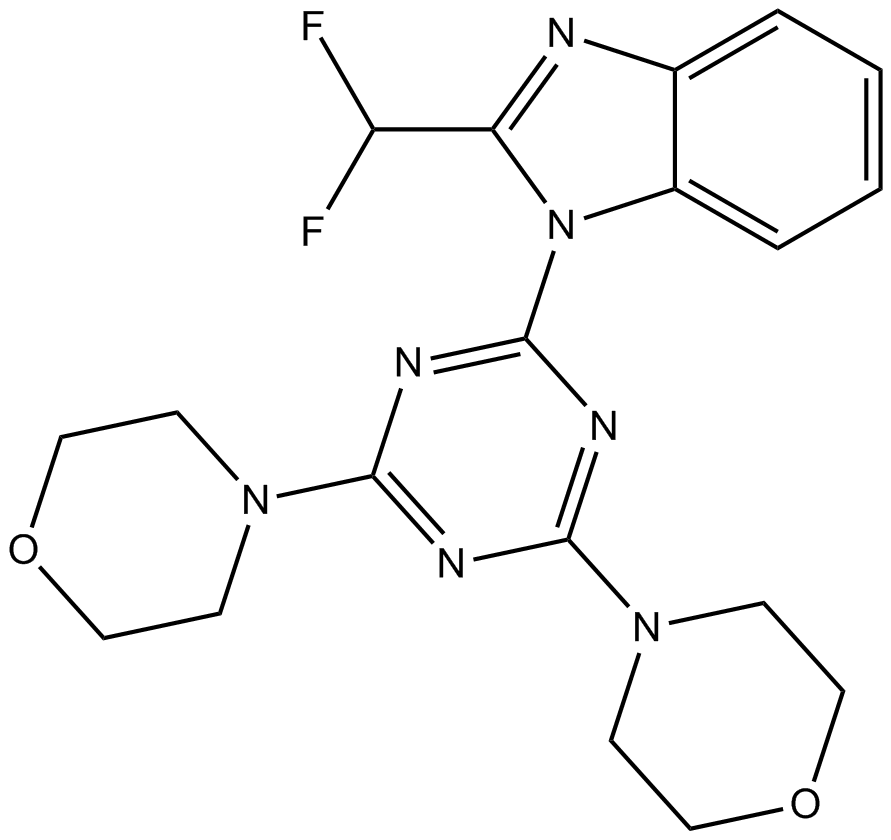
ZSTK474 is an ATP-competitive pan-class I PI3K inhibitor that exhibits inhibitory activity against PI3Kα (IC₅₀=16nM), PI3Kβ (IC₅₀=44nM), PI3Kδ (IC₅₀=4.6nM), and PI3Kγ (IC₅₀=49nM) subtypes.
Products are for research use only. Not for human use. We do not sell to patients.
Cas No.: 475110-96-4
Sample solution is provided at 25 µL, 10mM.
_1-3.$$$39978408@51.jpg');)
_1-9.$$$38538795@65.jpg');)
_1-9.$$$39112701@51.jpg');)
_1-7.$$$37316672@70.jpg');)
_366-372.$$$36198801@70.jpg');)
.$$$38565142@65.jpg');)
_1867-1883.$$$33248023@67.jpg');)
_eads6055.$$$39977546@45.jpg');)
_eadm9805.$$$40080571@45.jpg');)
_eadj3020.$$$39666821@45.jpg');)
_1-20.$$$39757301@28.jpg');)
_1-24.$$$38898113@28.jpg');)
_273-287.$$$36806353@46.jpg');)
_1-16.$$$37156877@44.jpg');)
_1-19.$$$37460805@44.jpg');)
_1291-1307.$$$34518654@46.jpg');)
ZSTK474 is an ATP-competitive pan-class I PI3K inhibitor that exhibits inhibitory activity against PI3Kα (IC₅₀=16nM), PI3Kβ (IC₅₀=44nM), PI3Kδ (IC₅₀=4.6nM), and PI3Kγ (IC₅₀=49nM) subtypes[1-2]. By inhibiting the PI3K/Akt signaling pathway, ZSTK474 downregulates phosphorylated Akt and GSK-3β, thereby inducing tumor cell apoptosis and suppressing inflammatory responses[3-4].
In vitro, treatment of sarcoma cells (RD-ES, A673), alveolar rhabdomyosarcoma cells (SJCRH30), or synovial sarcoma cells (SYO-1, Aska-SS, Yamato-SS) with ZSTK474 (0.0039–1μM) for 6–48 hours significantly inhibited the phosphorylation of PI3K downstream signaling proteins AKT (S473/T308) and ribosomal S6 protein (S235/236), while increasing the expression of cleaved PARP and inducing apoptosis[5]. Pre-treatment of human glioblastoma cells (SF295, U87) with ZSTK474 (0.4–1.2μM) for 48 hours, followed by temozolomide (TMZ; 120–180μM) for an additional 48 hours, significantly suppressed cell proliferation, induced apoptosis, and increased DNA double-strand break damage[6].
In vivo, daily oral administration of ZSTK474 (25–100mg/kg) for 14 days in BALB/C nude mice bearing subcutaneous Wilms tumor WiT49 cell xenografts. ZSTK474 significantly inhibited tumor growth and reduced tumor volume and weight[7]. Intravenous administration of ZSTK474 (2mg/kg/day) in combination with oncolytic vesicular stomatitis virus (VSV△51; 2.5×10⁷pfu/kg/day) in BALB/c-nu/nu mice bearing 143B osteosarcoma cell xenografts. ZSTK474 significantly suppressed subcutaneous tumor growth and reduced tumor volume and weight after six treatments[8].
References:
[1] Kong DX, Yamori T. ZSTK474, a novel phosphatidylinositol 3-kinase inhibitor identified using the JFCR39 drug discovery system. Acta Pharmacol Sin. 2010 Sep;31(9):1189-97. doi: 10.1038/aps.2010.150.
[2] Kong D, Yamori T. ZSTK474 is an ATP-competitive inhibitor of class I phosphatidylinositol 3 kinase isoforms. Cancer Sci. 2007 Oct;98(10):1638-42.
[3] Dan S, Okamura M, Mukai Y, et al. ZSTK474, a specific phosphatidylinositol 3-kinase inhibitor, induces G1 arrest of the cell cycle in vivo. Eur J Cancer. 2012 Apr;48(6):936-43.
[4] Yaguchi S, Fukui Y, Koshimizu I, et al. Antitumor activity of ZSTK474, a new phosphatidylinositol 3-kinase inhibitor. J Natl Cancer Inst. 2006 Apr 19;98(8):545-56.
[5] Namatame N, Tamaki N, Yoshizawa Y, et al. Antitumor profile of the PI3K inhibitor ZSTK474 in human sarcoma cell lines. Oncotarget. 2018 Oct 12;9(80):35141-35161.
[6] Jiao W, Zhu S, Shao J, et al. ZSTK474 Sensitizes Glioblastoma to Temozolomide by Blocking Homologous Recombination Repair. Biomed Res Int. 2022 Jul 13;2022:8568528.
[7] Li M, Liu J, Jin L, et al. ZSTK474 targeting PIK3R3 inhibits the Wilms' tumor through G0 / G1 phase arrest. PLoS One. 2024 Oct 28;19(10):e0312178.
[8] Jiang J, Wang W, Xiang W, et al. The phosphoinositide 3-kinase inhibitor ZSTK474 increases the susceptibility of osteosarcoma cells to oncolytic vesicular stomatitis virus VSVΔ51 via aggravating endoplasmic reticulum stress. Bioengineered. 2021 Dec;12(2):11847-11857.
| Cell experiment [1]: | |
Cell lines | Human glioblastoma cell lines (SF295, U87, U251) |
Preparation Method | Cells were cultured in DMEM or RPMI 1640 medium supplemented with 10% fetal bovine serum at 37°C, 5% CO₂. Cells were pre-treat with ZSTK474 at concentrations ranging from 0.01 to 2μM for 48 hours, followed by treatment with temozolomide (TMZ; 120–180μM) for an additional 48 hours. |
Reaction Conditions | 0.01 to 2μM; pre-treat 48h. |
Applications | ZSTK474 synergistically enhanced temozolomide (TMZ)-induced cytotoxicity by suppressing homologous recombination repair. ZSTK474 significantly increased DNA double-strand breaks (DSBs), as evidenced by elevated γ-H2AX foci and comet assay results. ZSTK474 inhibited key HR repair proteins (BRCA1/2, Rad51, and p-ATM) and induced G0/G1 cell cycle arrest. Apoptosis was markedly enhanced in combination therapy, with cleaved PARP and caspase-3 levels upregulated. ZSTK474 also blocked PI3K/Akt pathway activation, further sensitizing glioblastoma cells to TMZ. |
| Animal experiment [2]: | |
Animal models | BALB/C nude mice bearing WiT49 cell xenografts |
Preparation Method | Mice were orally administered daily doses of ZSTK474 at 25, 50, and 100mg/kg for 14 days after tumor volume reached 90–100mm³. Tumor size and body weight were monitored every 2–3 days. |
Dosage form | 25–100mg/kg; p.o.; Daily for 14 days. |
Applications | ZSTK474 administration significantly inhibited subcutaneous tumor growth in a dose-dependent manner, reducing tumor volume and weight. Immunofluorescence analysis showed decreased expression of proliferation marker PCNA, invasion markers MMP2/MMP9, and angiogenesis marker VEGF in tumor tissues. ZSTK474 treatment also induced G0/G1 phase arrest in tumor cells by downregulating cyclin D and CDK4, and upregulating P21 expression, without causing significant toxicity or body weight changes. |
References: | |
| Cas No. | 475110-96-4 | SDF | |
| Chemical Name | 4-[4-[2-(difluoromethyl)benzimidazol-1-yl]-6-morpholin-4-yl-1,3,5-triazin-2-yl]morpholine | ||
| Canonical SMILES | C1COCCN1C2=NC(=NC(=N2)N3C4=CC=CC=C4N=C3C(F)F)N5CCOCC5 | ||
| Formula | C19H21F2N7O2 | M.Wt | 417.41 |
| Solubility | ≥ 20.85mg/mL in DMSO | Storage | Store at -20°C |
| General tips | Please select the appropriate solvent to prepare the stock solution according to the
solubility of the product in different solvents; once the solution is prepared, please store it in
separate packages to avoid product failure caused by repeated freezing and thawing.Storage method
and period of the stock solution: When stored at -80°C, please use it within 6 months; when stored
at -20°C, please use it within 1 month. To increase solubility, heat the tube to 37°C and then oscillate in an ultrasonic bath for some time. |
||
| Shipping Condition | Evaluation sample solution: shipped with blue ice. All other sizes available: with RT, or with Blue Ice upon request. | ||
| Prepare stock solution | |||

|
1 mg | 5 mg | 10 mg |
| 1 mM | 2.3957 mL | 11.9786 mL | 23.9573 mL |
| 5 mM | 479.1 μL | 2.3957 mL | 4.7915 mL |
| 10 mM | 239.6 μL | 1.1979 mL | 2.3957 mL |
Step 1: Enter information below (Recommended: An additional animal making an allowance for loss during the experiment)
 g
μL
g
μL
Step 2: Enter the in vivo formulation (This is only the calculator, not formulation. Please contact us first if there is no in vivo formulation at the solubility Section.)
Calculation results:
Working concentration: mg/ml;
Method for preparing DMSO master liquid: mg drug pre-dissolved in μL DMSO ( Master liquid concentration mg/mL, Please contact us first if the concentration exceeds the DMSO solubility of the batch of drug. )
Method for preparing in vivo formulation: Take μL DMSO master liquid, next addμL PEG300, mix and clarify, next addμL Tween 80, mix and clarify, next add μL saline, mix and clarify.
Method for preparing in vivo formulation: Take μL DMSO master liquid, next add μL Corn oil, mix and clarify.
Note: 1. Please make sure the liquid is clear before adding the next solvent.
2. Be sure to add the solvent(s) in order. You must ensure that the solution obtained, in the previous addition, is a clear solution before proceeding to add the next solvent. Physical methods such as vortex, ultrasound or hot water bath can be used to aid dissolving.
3. All of the above co-solvents are available for purchase on the GlpBio website.
Quality Control & SDS
- View current batch:
- Purity: >98.00% Appearance: A solid
- COA (Certificate of Analysis)
- SDS (Safety Data Sheet)
- Datasheet
Average Rating: 5 (Based on Reviews and 30 reference(s) in Google Scholar.)