

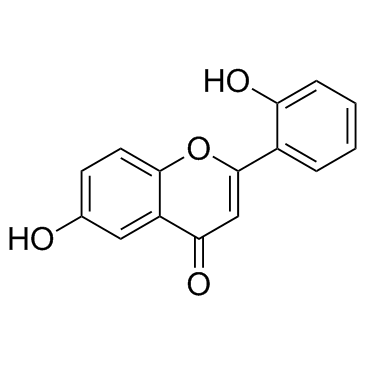
6,2'-Dihydroxyflavone |
Catalog No.GC30943
 One-Click Copy Product Info
|

6,2'-Dihydroxyflavone is a novel antagonist of GABAA receptor.
Products are for research use only. Not for human use. We do not sell to patients.
Cas No.: 92439-20-8
Sample solution is provided at 25 µL, 10mM.
_1-3.$$$39978408@51.jpg');)
_1-9.$$$38538795@65.jpg');)
_1-9.$$$39112701@51.jpg');)
_1-7.$$$37316672@70.jpg');)
_366-372.$$$36198801@70.jpg');)
.$$$38565142@65.jpg');)
_1867-1883.$$$33248023@67.jpg');)
_eads6055.$$$39977546@45.jpg');)
_eadm9805.$$$40080571@45.jpg');)
_eadj3020.$$$39666821@45.jpg');)
_1-20.$$$39757301@28.jpg');)
_1-24.$$$38898113@28.jpg');)
_273-287.$$$36806353@46.jpg');)
_1-16.$$$37156877@44.jpg');)
_1-19.$$$37460805@44.jpg');)
_1291-1307.$$$34518654@46.jpg');)
6,2'-Dihydroxyflavone is a novel antagonist of GABAA receptor.
6,2'-Dihydroxyflavone is a novel antagonist of GABAA receptor. 6,2'-Dihydroxyflavone inhibits [3H]-flunitrazepam binding to the rat cerebral cortex membranes with a Ki of 37.2±4.5 nM. The current elicited with the EC50 concentration of GABA is decreased to 73.6±1.9% of control by co-application of 5 μM 6,2'-Dihydroxyflavone (n=5), compare to a decrease to 65.9±3.0% by 1 μM FG-7142 (n=5). The EC50 for GABA dose response increases from 47.6 to 59.7 μM upon co-application of 5 μM 6,2'-Dihydroxyflavone, and the maximal GABA-current is decreased[1].
6,2'-Dihydroxyflavone-treated mice exhibit significant differences from control mice with respect to the percentage of open arms entries [F(4,73)=8.01, P<0.0001] and the percentage of time spent in open arms [F (4,73)=5.19, P<0.002], but not the number of entries to closed arms [F(4,73)= 0.79,P=0.54]. The post-hoc NewmaneKeuls' tests confirm that 6,2'-Dihydroxyflavone significantly decreases the percentage of open arm entries and time spent in open arms at the doses of 8 and 16 mg/kg. 6,2'-Dihydroxyflavone treatment similarly increases step-through latency [F(4,75)=4.71, P<0.002], suggesting enhanced cognitive performance[1].
[1]. Wang F, et al. 6,2'-Dihydroxyflavone, a subtype-selective partial inverse agonist of GABAA receptor benzodiazepine site. Neuropharmacology. 2007 Sep;53(4):574-82.
|
Cell experiment: |
Membranes from HEK 293T cell are used in this study. Briefly, aliquots of membranes are incubated with 1 nM [3H]-flunitrazepam or 8 nM [3H]-Ro15-4513 at 4°C for 90 min in the presence or absence of 6,2'-Dihydroxyflavone. After incubation, the mixtures are filtered onto Whatman GF/B filters with a Brandel 24-well harvester. Each filter is incubated for at least 1 h with 4 mL scintillation cocktail before measurement of radioactivity in a Beckman-Coulter LS 6500 scintillation counter. For saturation analysis, the membranes are incubated with increasing concentrations of [3H]-flunitrazepam or [3H]-Ro15-4513. Binding affinity is determined by nonlinear regression analysis[1]. |
|
Animal experiment: |
Male ICR mice are randomized into six groups (n=12 to 16/group), and receive 0.4 mg/kg scopolamine (i.p.) 45 min prior to training, followed with vehicle (dd water, pH 9.0, p.o.), 2, 4, 8 or 16 mg/kg 6,2'-Dihydroxyflavone (p.o.), or 30 mg/kg FG-7142 (i.p.) 30 min prior to training. On the training trials, each mouse is placed into the lighted chamber of a two-compartment box, and the door leading to the dark chamber is opened 10 s later. Once the mouse enters the dark compartment, the door is closed and an inescapable electric foot-shock (0.4 mA, 1 s) is delivered from the grid floor. The mouse is removed from the apparatus 10 s later. The step-through latency is recorded, with the cut-off step-through latency set at 300 s[1]. |
|
References: [1]. Wang F, et al. 6,2'-Dihydroxyflavone, a subtype-selective partial inverse agonist of GABAA receptor benzodiazepine site. Neuropharmacology. 2007 Sep;53(4):574-82. |
|
| Cas No. | 92439-20-8 | SDF | |
| Canonical SMILES | O=C1C=C(C2=CC=CC=C2O)OC3=CC=C(O)C=C13 | ||
| Formula | C15H10O4 | M.Wt | 254.24 |
| Solubility | DMSO : 155 mg/mL (609.66 mM) | Storage | Store at -20°C |
| General tips | Please select the appropriate solvent to prepare the stock solution according to the
solubility of the product in different solvents; once the solution is prepared, please store it in
separate packages to avoid product failure caused by repeated freezing and thawing.Storage method
and period of the stock solution: When stored at -80°C, please use it within 6 months; when stored
at -20°C, please use it within 1 month. To increase solubility, heat the tube to 37°C and then oscillate in an ultrasonic bath for some time. |
||
| Shipping Condition | Evaluation sample solution: shipped with blue ice. All other sizes available: with RT, or with Blue Ice upon request. | ||
| Prepare stock solution | |||

|
1 mg | 5 mg | 10 mg |
| 1 mM | 3.9333 mL | 19.6665 mL | 39.3329 mL |
| 5 mM | 786.7 μL | 3.9333 mL | 7.8666 mL |
| 10 mM | 393.3 μL | 1.9666 mL | 3.9333 mL |
Step 1: Enter information below (Recommended: An additional animal making an allowance for loss during the experiment)
 g
μL
g
μL
Step 2: Enter the in vivo formulation (This is only the calculator, not formulation. Please contact us first if there is no in vivo formulation at the solubility Section.)
Calculation results:
Working concentration: mg/ml;
Method for preparing DMSO master liquid: mg drug pre-dissolved in μL DMSO ( Master liquid concentration mg/mL, Please contact us first if the concentration exceeds the DMSO solubility of the batch of drug. )
Method for preparing in vivo formulation: Take μL DMSO master liquid, next addμL PEG300, mix and clarify, next addμL Tween 80, mix and clarify, next add μL saline, mix and clarify.
Method for preparing in vivo formulation: Take μL DMSO master liquid, next add μL Corn oil, mix and clarify.
Note: 1. Please make sure the liquid is clear before adding the next solvent.
2. Be sure to add the solvent(s) in order. You must ensure that the solution obtained, in the previous addition, is a clear solution before proceeding to add the next solvent. Physical methods such as vortex, ultrasound or hot water bath can be used to aid dissolving.
3. All of the above co-solvents are available for purchase on the GlpBio website.
Quality Control & SDS
- View current batch:
- Purity: >98.00% Appearance: A solid
- COA (Certificate of Analysis)
- SDS (Safety Data Sheet)
- Datasheet
Average Rating: 5 (Based on Reviews and 22 reference(s) in Google Scholar.)