

6-gingerol |
Catalog No.GN10093
 One-Click Copy Product Info
|

6-gingerol is an active compound isolated from Ginger with anticancer, anti-inflammation, and anti-oxidation activities.
Products are for research use only. Not for human use. We do not sell to patients.
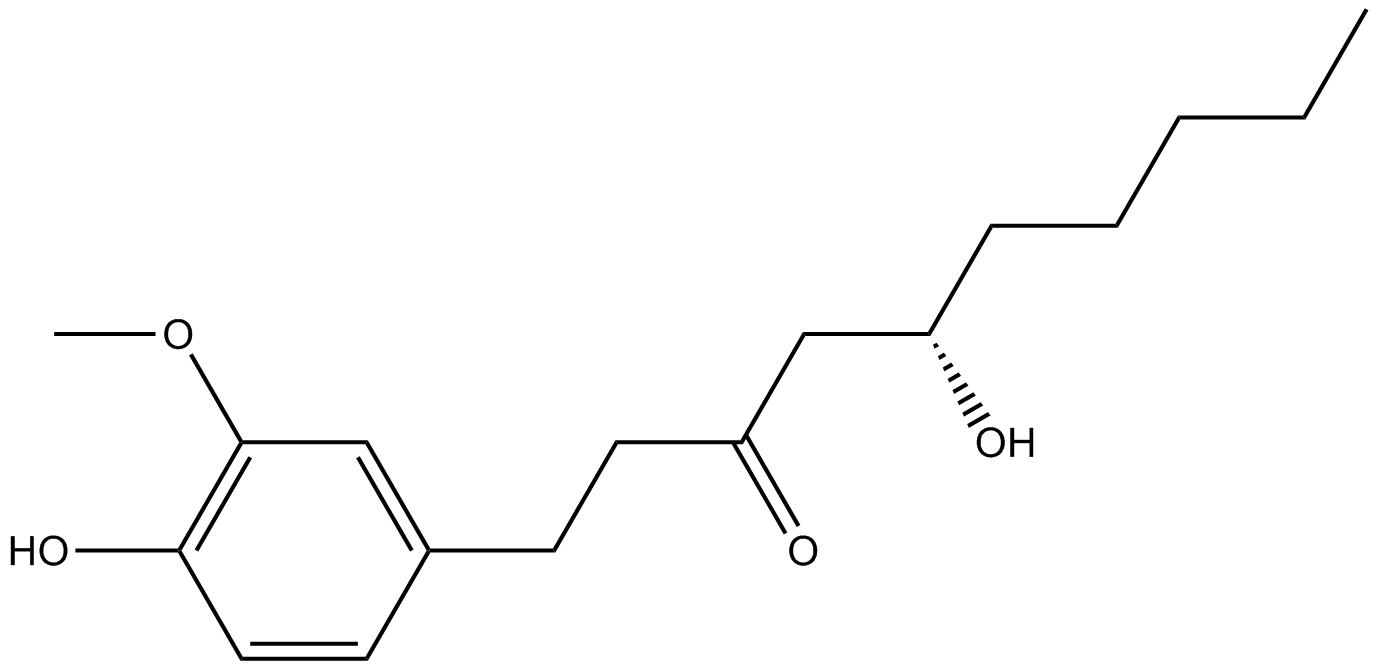
Cas No.: 23513-14-6
Sample solution is provided at 25 µL, 10mM.
_1-3.$$$39978408@51.jpg');)
_1-9.$$$38538795@65.jpg');)
_1-9.$$$39112701@51.jpg');)
_1-7.$$$37316672@70.jpg');)
_366-372.$$$36198801@70.jpg');)
.$$$38565142@65.jpg');)
_1867-1883.$$$33248023@67.jpg');)
_eads6055.$$$39977546@45.jpg');)
_eadm9805.$$$40080571@45.jpg');)
_eadj3020.$$$39666821@45.jpg');)
_1-20.$$$39757301@28.jpg');)
_1-24.$$$38898113@28.jpg');)
_273-287.$$$36806353@46.jpg');)
_1-16.$$$37156877@44.jpg');)
_1-19.$$$37460805@44.jpg');)
_1291-1307.$$$34518654@46.jpg');)
6-gingerol is an active compound isolated from Ginger with anticancer, anti-inflammation, and anti-oxidation activities [1]. 6-gingerol increases levels of antioxidant enzymes and inhibits inflammation and apoptosis through suppression of the signaling pathways of TLR4/ MAPK/ NF-κB[2]. 6-gingerol has been widely used to inhibit the growth of various cancer cells and to prevent lung metastasis in mice with melanoma[3].
In vitro, 6-gingerol treatment for 72 hours significantly inhibited the proliferation of SW-480 cells and HCT-116 cells, with IC50 values of 205μM and 283μM, respectively[4]. Treatment with 10μM 6-gingerol for 48 hours significantly inhibited the migration of MDA-MB-231 cells, accompanied by a decrease in the expression of MMP-2 and MMP-9[5]. Treatment with 10μM 6-gingerol for 24 hours protected SH-SY5Y cells from the cytotoxicity and apoptosis induced by Aβ25-35 (20μM), and up-regulated cellular antioxidant defense capacity via activation of Nrf2[6].
In vivo, 6-gingerol treatment via oral administration at a dose of 20mg/kg/day for 15 weeks significantly attenuated chronic mild stress-accelerated atherosclerosis and improved behavioral changes in ApoE−/− mice [7]. Daily administration of 6-gingerol at a dose of 250mg/kg for 2 weeks significantly reduced dextran sulfate sodium (DSS)-induced body weight loss and alleviated inflammatory injury in mice with ulcerative colitis[8].
References:
[1] Wang S, Zhang C, Yang G, et al. Biological properties of 6-gingerol: a brief review[J]. Natural product communications, 2014, 9(7): 1934578X1400900736.
[2] Promdam N, Panichayupakaranant P. [6]-Gingerol: a narrative review of its beneficial effect on human health[J]. Food Chemistry Advances, 2022, 1: 100043.
[3] Oyagbemi A A, Saba A B, Azeez O I. Molecular targets of [6]‐gingerol: Its potential roles in cancer chemoprevention[J]. Biofactors, 2010, 36(3): 169-178.
[4] Radhakrishnan E K, Bava S V, Narayanan S S, et al. [6]-Gingerol induces caspase-dependent apoptosis and prevents PMA-induced proliferation in colon cancer cells by inhibiting MAPK/AP-1 signaling[J]. PloS one, 2014, 9(8): e104401.
[5] Lee H S, Seo E Y, Kang N E, et al. [6]-Gingerol inhibits metastasis of MDA-MB-231 human breast cancer cells[J]. The Journal of nutritional biochemistry, 2008, 19(5): 313-319.
[6] Lee C, Park G H, Kim C Y, et al. [6]-Gingerol attenuates β-amyloid-induced oxidative cell death via fortifying cellular antioxidant defense system[J]. Food and chemical toxicology, 2011, 49(6): 1261-1269.
[7] Wang S, Tian M, Yang R, et al. 6-Gingerol ameliorates behavioral changes and atherosclerotic lesions in ApoE−/− mice exposed to chronic mild stress[J]. Cardiovascular Toxicology, 2018, 18(5): 420-430.
[8] Sheng Y, Wu T, Dai Y, et al. 6-gingerol alleviates inflammatory injury in DSS-induced ulcerative colitis mice by regulating NF-κB signaling[J]. Annals of Palliative Medicine, 2020, 9(4): 1944952-1941952.
| Cell experiment [1]: | |
Cell lines | SW-480 cells |
Preparation Method | SW-480 cells were cultured in Dulbecco's Modified Eagle's Medium (DMEM) supplemented with 10% Fetal Bovine Serum (FBS) along with 100U/ml penicillin, 50mg/ml streptomycin and 1mg/ml of amphotericin B in a 5% CO2 incubator at 37°C. 5×10³ cells/well of SW-480 cells were seeded in 96-well plates for 24h. Different concentrations of 6-gingerol (0, 5, 10, 25, 50, 100, 200, and 300μM) were added and incubated at 37°C with 5% CO2 for 72h. Cell viability was measured. |
Reaction Conditions | 0, 5, 10, 25, 50, 100, 200, and 300μM; 72h |
Applications | 6-gingerol treatment significantly decreased cell viability of SW-480 cells in a dose-dependent manner. |
| Animal experiment [2]: | |
Animal models | Male BALB/c mice |
Preparation Method | Male BALB/c mice (6 weeks old) were housed in an environmentally controlled room (12h light-dark cycle, 50%±10% relative humidity) at 23±2°C at a facility with free access to water and food. The mice were orally administered 4% DSS-containing drinking water for one week, and then were orally administered 250mg/kg of 6-gingerol daily for two weeks. The body weight of the mice was analyzed, and the intestinal tissues of the mice were collected for analysis. |
Dosage form | 250mg/kg/day for 2 weeks; p.o. |
Applications | 6-gingerol treatment reduced inflammatory injury of intestinal tissues and weight loss caused by DSS in mouse models. |
References: | |
| Cas No. | 23513-14-6 | SDF | |
| Chemical Name | (5S)-5-hydroxy-1-(4-hydroxy-3-methoxyphenyl)decan-3-one | ||
| Canonical SMILES | CCCCCC(CC(=O)CCC1=CC(=C(C=C1)O)OC)O | ||
| Formula | C17H26O4 | M.Wt | 294.39 |
| Solubility | ≥ 29.4mg/mL in DMSO | Storage | Store at -20°C |
| General tips | Please select the appropriate solvent to prepare the stock solution according to the
solubility of the product in different solvents; once the solution is prepared, please store it in
separate packages to avoid product failure caused by repeated freezing and thawing.Storage method
and period of the stock solution: When stored at -80°C, please use it within 6 months; when stored
at -20°C, please use it within 1 month. To increase solubility, heat the tube to 37°C and then oscillate in an ultrasonic bath for some time. |
||
| Shipping Condition | Evaluation sample solution: shipped with blue ice. All other sizes available: with RT, or with Blue Ice upon request. | ||
| Prepare stock solution | |||

|
1 mg | 5 mg | 10 mg |
| 1 mM | 3.3969 mL | 16.9843 mL | 33.9685 mL |
| 5 mM | 679.4 μL | 3.3969 mL | 6.7937 mL |
| 10 mM | 339.7 μL | 1.6984 mL | 3.3969 mL |
Step 1: Enter information below (Recommended: An additional animal making an allowance for loss during the experiment)
 g
μL
g
μL
Step 2: Enter the in vivo formulation (This is only the calculator, not formulation. Please contact us first if there is no in vivo formulation at the solubility Section.)
Calculation results:
Working concentration: mg/ml;
Method for preparing DMSO master liquid: mg drug pre-dissolved in μL DMSO ( Master liquid concentration mg/mL, Please contact us first if the concentration exceeds the DMSO solubility of the batch of drug. )
Method for preparing in vivo formulation: Take μL DMSO master liquid, next addμL PEG300, mix and clarify, next addμL Tween 80, mix and clarify, next add μL saline, mix and clarify.
Method for preparing in vivo formulation: Take μL DMSO master liquid, next add μL Corn oil, mix and clarify.
Note: 1. Please make sure the liquid is clear before adding the next solvent.
2. Be sure to add the solvent(s) in order. You must ensure that the solution obtained, in the previous addition, is a clear solution before proceeding to add the next solvent. Physical methods such as vortex, ultrasound or hot water bath can be used to aid dissolving.
3. All of the above co-solvents are available for purchase on the GlpBio website.
Quality Control & SDS
- View current batch:
- Purity: >98.00% Appearance: A solid
- COA (Certificate of Analysis)
- SDS (Safety Data Sheet)
- Datasheet
Average Rating: 5 (Based on Reviews and 30 reference(s) in Google Scholar.)