

8-Chloroadenosine |
Catalog No.GC12777
 One-Click Copy Product Info
|

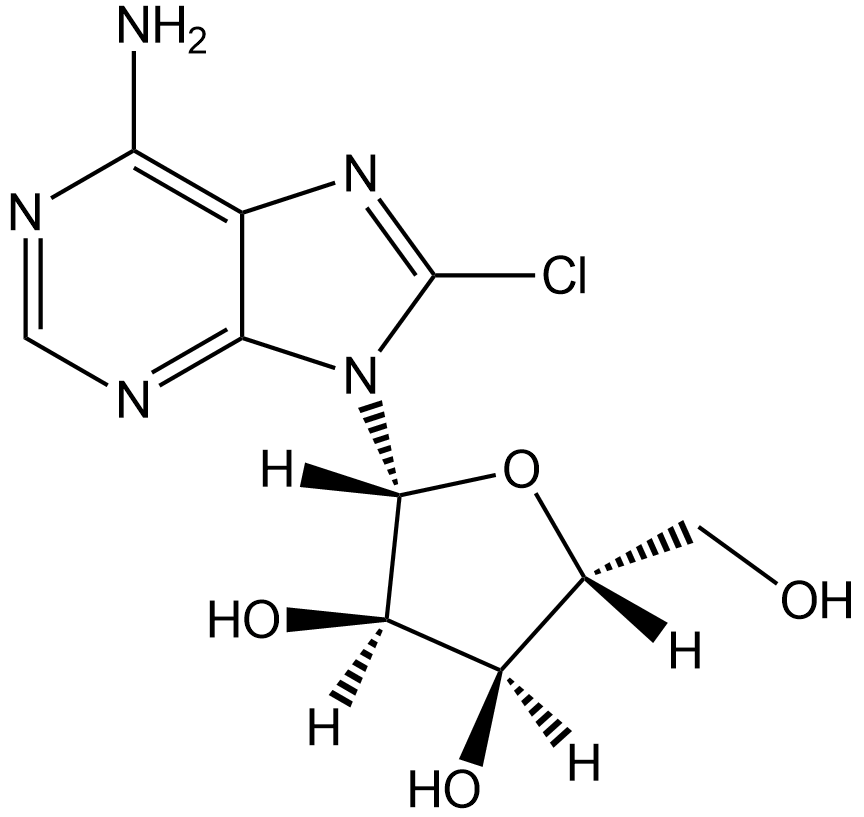
8-Chloroadenosine is an RNA-directed purine nucleoside analog that induces apoptotic cell death by either inhibiting the transcription of anti-apoptotic proteins or reducing the concentration of intracellular ATP.
Products are for research use only. Not for human use. We do not sell to patients.
Cas No.: 34408-14-5
Sample solution is provided at 25 µL, 10mM.
_1-3.$$$39978408@51.jpg');)
_1-9.$$$38538795@65.jpg');)
_1-9.$$$39112701@51.jpg');)
_1-7.$$$37316672@70.jpg');)
_366-372.$$$36198801@70.jpg');)
.$$$38565142@65.jpg');)
_1867-1883.$$$33248023@67.jpg');)
_eads6055.$$$39977546@45.jpg');)
_eadm9805.$$$40080571@45.jpg');)
_eadj3020.$$$39666821@45.jpg');)
_1-20.$$$39757301@28.jpg');)
_1-24.$$$38898113@28.jpg');)
_273-287.$$$36806353@46.jpg');)
_1-16.$$$37156877@44.jpg');)
_1-19.$$$37460805@44.jpg');)
_1291-1307.$$$34518654@46.jpg');)
8-Chloroadenosine is an RNA-directed purine nucleoside analog that induces apoptotic cell death by either inhibiting the transcription of anti-apoptotic proteins or reducing the concentration of intracellular ATP[1-3]. 8-Chloroadenosine activity is dependent on adenosine kinase and requires intracellular accumulation of 8-Chloroadenosine as mono-, di-, and tri-phosphates[3].
In vitro, BT-474 cells were treated with 10μM 8-Chloroadenosine for various durations (0, 4, 8, 12, 16, 24, 48, 72 hours for Thr172, and 0, 4, 8, 12, 16, 24 hours for Ser79). The phosphorylation of AMPK (Thr172) was induced in a time-dependent manner and could be detected within 7-12 hours. Meanwhile, Acetyl-CoA Carboxylase (ACC) phosphorylation at Ser79, one of the key downstream substrates of AMPK, was induced within 4 hours of 8-Chloroadenosine treatment[4]. Exposure of human lung cancer cell lines A549 (p53-wt) and H1299 (p53-depleted) to 8-Chloroadenosine (0, 0.02, 0.2, 2, and 20μM; 24, 48, 72, or 96h) induced cell arrest in the G2/M phase, which was accompanied by accumulation of binucleated and polymorphonucleated cells resulting from aberrant mitosis and failed cytokinesis, depending on time and dose[5]. Treatment of H1299 (p53-null) cells with 8-Chloroadenosine (10μM) for 0, 12, 24, and 48 hours led to an increase in γ-H2AX foci and a time-dependent elevation in γ-H2AX protein levels[6].
In vivo, treated female athymic nude mice with 8-Chloroadenosine (100mg/kg; i.p.), the growth of BT-474 tumors was inhibited, and no macroscopically detectable tumors were observed in 9 of the mice after 3 weeks of treatment[4]. In mice bearing ascitic leukemia L-1210, treatment with 8-Chloroadenosine via intraperitoneal (i.p.) and intravenous (i.v.) injection at a dose of 100mg/kg/day for 7 days resulted in life-prolonging rates of 124.0%±22.1% (P<0.01) and 104.2%±20.1% (P<0.01), respectively[7].
References:
[1] Dennison JB, Ayres ML, Kaluarachchi K, Plunkett W, Gandhi V. Intracellular succinylation of 8-chloroadenosine and its effect on fumarate levels. J Biol Chem. 2010;285(11):8022-8030.
[2] Cottrell KA, Torres LS, Dizon MG, Weber JD. 8-azaadenosine and 8-chloroadenosine are not selective inhibitors of ADAR. Cancer Res Commun. 2021;1(2):56-64.
[3] Tang V, Fu S, Rayner BS, Hawkins CL. 8-Chloroadenosine induces apoptosis in human coronary artery endothelial cells through the activation of the unfolded protein response. Redox Biol. 2019;26:101274.
[4] Stellrecht CM, Vangapandu HV, Le XF, Mao W, Shentu S. ATP directed agent, 8-chloro-adenosine, induces AMP activated protein kinase activity, leading to autophagic cell death in breast cancer cells. J Hematol Oncol. 2014;7:23.
[5] Zhang HY, Gu YY, Li ZG, et al. Exposure of human lung cancer cells to 8-chloro-adenosine induces G2/M arrest and mitotic catastrophe. Neoplasia. 2004;6(6):802-812.
[6] Han YY, Zhou Z, Cao JX, et al. E2F1-mediated DNA damage is implicated in 8-Cl-adenosine-induced chromosome missegregation and apoptosis in human lung cancer H1299 cells. Mol Cell Biochem. 2013;384(1-2):187-196.
[7] Fang J, Shi Y, Zhang L. [Antitumor activities of 8-chloroadenosine in vivo and in vitro]. Zhonghua Zhong Liu Za Zhi. 1995;17(1):5–8. pmid:7656789.
| Cell experiment [1]: | |
Cell lines | BT-474 |
Preparation Method | Exponentially growing cells were treated with 10μM 8-Chloroadenosine for various amounts of time, and protein lysates were isolated and analyzed using an Odyssey Infrared Imaging System. |
Reaction Conditions | 10μM; 0, 4, 8, 12, 16, 24, 48, 72h (for Thr172) and 0, 4, 8, 12, 16, 24h (for Ser79) |
Applications | Although 8-Chloroadenosine treatment did not alter the total AMP-activated protein kinase (AMPK) protein levels, the phosphorylation of AMPK (Thr172) was induced in a time-dependent manner and could be detected within 7-12 hours. The phosphorylation of Acetyl-CoA Carboxylase (ACC) at Ser79, one of the key downstream substrates of AMPK, was induced within 4 hours of 8-Chloroadenosine treatment. |
| Animal experiment [1]: | |
Animal models | female athymic nude mice |
Preparation Method | When maximum tumor diameters reached ~3mm, the animals were randomly allocated (8-10 mice per group) for a 3-week i.p. treatment with 8-Chloroadenosine dissolved in Phosphate-Buffered Saline (PBS) (0 or 100mg/kg, 3 days/week). Body weight and tumor growth were assessed 3 days/week, and maximum tumor diameters were recorded. Shortly after the end of the treatment (1-3 days), the mice were sacrificed, tumors were collected, and tumor volumes were calculated in mm3 using the formula length×width×height×π/6. |
Dosage form | 100mg/kg; i.p. |
Applications | 8-Chloroadenosine inhibited the growth of BT-474 tumors, and in 9 of them, no macroscopically detectable tumors were observed after 3 weeks of treatment. |
References: | |
| Cas No. | 34408-14-5 | SDF | |
| Chemical Name | (2R,3R,4R,5S)-2-(6-amino-8-chloro-9H-purin-9-yl)-5-(hydroxymethyl)tetrahydrofuran-3,4-diol | ||
| Canonical SMILES | ClC1=NC2=C(N)N=CN=C2N1[C@@H]([C@@H]3O)O[C@@H](CO)[C@@H]3O | ||
| Formula | C10H12ClN5O4 | M.Wt | 301.69 |
| Solubility | <6.03mg/ml in Water; <30.17mg/ml in DMSO | Storage | Store at -20°C |
| General tips | Please select the appropriate solvent to prepare the stock solution according to the
solubility of the product in different solvents; once the solution is prepared, please store it in
separate packages to avoid product failure caused by repeated freezing and thawing.Storage method
and period of the stock solution: When stored at -80°C, please use it within 6 months; when stored
at -20°C, please use it within 1 month. To increase solubility, heat the tube to 37°C and then oscillate in an ultrasonic bath for some time. |
||
| Shipping Condition | Evaluation sample solution: shipped with blue ice. All other sizes available: with RT, or with Blue Ice upon request. | ||
| Prepare stock solution | |||

|
1 mg | 5 mg | 10 mg |
| 1 mM | 3.3147 mL | 16.5733 mL | 33.1466 mL |
| 5 mM | 662.9 μL | 3.3147 mL | 6.6293 mL |
| 10 mM | 331.5 μL | 1.6573 mL | 3.3147 mL |
Step 1: Enter information below (Recommended: An additional animal making an allowance for loss during the experiment)
 g
μL
g
μL
Step 2: Enter the in vivo formulation (This is only the calculator, not formulation. Please contact us first if there is no in vivo formulation at the solubility Section.)
Calculation results:
Working concentration: mg/ml;
Method for preparing DMSO master liquid: mg drug pre-dissolved in μL DMSO ( Master liquid concentration mg/mL, Please contact us first if the concentration exceeds the DMSO solubility of the batch of drug. )
Method for preparing in vivo formulation: Take μL DMSO master liquid, next addμL PEG300, mix and clarify, next addμL Tween 80, mix and clarify, next add μL saline, mix and clarify.
Method for preparing in vivo formulation: Take μL DMSO master liquid, next add μL Corn oil, mix and clarify.
Note: 1. Please make sure the liquid is clear before adding the next solvent.
2. Be sure to add the solvent(s) in order. You must ensure that the solution obtained, in the previous addition, is a clear solution before proceeding to add the next solvent. Physical methods such as vortex, ultrasound or hot water bath can be used to aid dissolving.
3. All of the above co-solvents are available for purchase on the GlpBio website.
Quality Control & SDS
- View current batch:
- Purity: >95.00% Appearance: A solid
- COA (Certificate of Analysis)
- SDS (Safety Data Sheet)
- Datasheet
Average Rating: 5 (Based on Reviews and 20 reference(s) in Google Scholar.)