

ARN-3236 |
Catalog No.GC33070
 One-Click Copy Product Info
|

ARN-3236 is a selective salt-inducible kinase 2 (SIK2) inhibitor with an IC50 of less than 1nM. ARN-3236 also inhibits the activity of SIK1 (IC50<21.63nM) and SIK3 (IC50<6.63nM).
Products are for research use only. Not for human use. We do not sell to patients.
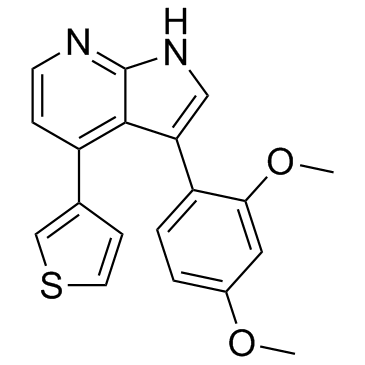
Cas No.: 1613710-01-2
Sample solution is provided at 25 µL, 10mM.
_1-3.$$$39978408@51.jpg');)
_1-9.$$$38538795@65.jpg');)
_1-9.$$$39112701@51.jpg');)
_1-7.$$$37316672@70.jpg');)
_366-372.$$$36198801@70.jpg');)
.$$$38565142@65.jpg');)
_1867-1883.$$$33248023@67.jpg');)
_eads6055.$$$39977546@45.jpg');)
_eadm9805.$$$40080571@45.jpg');)
_eadj3020.$$$39666821@45.jpg');)
_1-20.$$$39757301@28.jpg');)
_1-24.$$$38898113@28.jpg');)
_273-287.$$$36806353@46.jpg');)
_1-16.$$$37156877@44.jpg');)
_1-19.$$$37460805@44.jpg');)
_1291-1307.$$$34518654@46.jpg');)
ARN-3236 is a selective salt-inducible kinase 2 (SIK2) inhibitor with an IC50 of less than 1nM. ARN-3236 also inhibits the activity of SIK1 (IC50<21.63nM) and SIK3 (IC50<6.63nM)[1-2]. By inhibiting SIK2 activity, ARN-3236 blocks centrosome separation, induces cell cycle arrest and apoptosis. ARN-3236 is used in research related to cancer and neuroprotection[3-4].
In vitro, colorectal cancer cells were pretreated with ARN-3236 (5–10µM) for 24 hours and subsequently irradiated with X-rays (2–6Gy). ARN-3236 significantly enhanced cellular radiosensitivity and increased radiation-induced growth inhibition and apoptosis. ARN-3236 dose-dependently reduced the efficiency of homologous recombination repair by inhibiting SIK2 kinase activity[5]. SKOv3, OVCAR8, and other ovarian cancer cells were pretreated with ARN-3236 (0.6–2µM) for 24 hours, followed by treatment with paclitaxel (0–25µM) for 72 hours. By inhibiting SIK2 kinase activity, ARN-3236 blocked centrosome separation and attenuated the AKT/survivin signaling pathway, thereby significantly enhancing the cytotoxicity of paclitaxel while inducing G2/M phase arrest and apoptosis[6].
In vivo, a pulmonary fibrosis model was established in BALB/C mice via intratracheal instillation of bleomycin (5 mg/kg). Starting on the day of modeling, the mice received a daily intraperitoneal injection of ARN-3236 (10–3mg/kg) for 28 days. ARN-3236 dose-dependently alleviated bleomycin-induced body weight loss and increased lung coefficient. ARN-3236 reduced hydroxyproline content, collagen deposition, and the expression of α-smooth muscle actin (α-SMA) and type I collagen (COL1A) in lung tissue, thereby significantly mitigating bleomycin-induced pulmonary fibrosis[7]. A depression model was induced in C57BL/6J mice using chronic social defeat stress (CSDS) or chronic unpredictable mild stress (CUMS). Starting at the end of the stress induction, the mice received a daily intraperitoneal injection of ARN-3236 (10–60mg/kg) for 2 weeks. ARN-3236 ameliorated CSDS-induced social avoidance behavior and produced significant antidepressant-like effects[8].
References:
[1] Lombardi MS, Gilliéron C, Dietrich D, et al. SIK inhibition in human myeloid cells modulates TLR and IL-1R signaling and induces an anti-inflammatory phenotype. J Leukoc Biol. 2016 May;99(5):711-21.
[2] Bon H, Wadhwa K, Schreiner A, et al. Salt-inducible kinase 2 regulates mitotic progression and transcription in prostate cancer. Mol Cancer Res. 2015 Apr;13(4):620-635.
[3] Rong Z, Zhang L, Li Z, et al. SIK2 maintains breast cancer stemness by phosphorylating LRP6 and activating Wnt/β-catenin signaling. Oncogene. 2022 Apr;41(16):2390-2403.
[4] Fang N, Wang Y, Chen Y, et al. SIK2 mediated mitochondrial homeostasis in spinal cord injury: modulating oxidative stress and the AIM2 inflammasome via CRTC1/CREB signaling. J Neuroinflammation. 2025 Dec 3;22(1):283.
[5] Meng Y, Li S, Lu DS, et al. Salt-inducible kinase 2 confers radioresistance in colorectal cancer by facilitating homologous recombination repair. MedComm (2020). 2025 Jan 28;6(2):e70083.
[6] Zhou J, Alfraidi A, Zhang S, et al. A Novel Compound ARN-3236 Inhibits Salt-Inducible Kinase 2 and Sensitizes Ovarian Cancer Cell Lines and Xenografts to Paclitaxel. Clin Cancer Res. 2017 Apr 15;23(8):1945-1954.
[7] Zou L, Hong D, Li K, et al. Salt-inducible kinase 2 (SIK2) inhibitor ARN-3236 attenuates bleomycin-induced pulmonary fibrosis in mice. BMC Pulm Med. 2022 Apr 11;22(1):140.
[8] Liu Y, Tang W, Ji C, et al, The Selective SIK2 Inhibitor ARN-3236 Produces Strong Antidepressant-Like Efficacy in Mice via the Hippocampal CRTC1-CREB-BDNF Pathway. Front Pharmacol. 2021 Jan 14;11:624429.
| Cell experiment [1]: | |
|
Cell lines |
SKOv3, OVCAR8, A2780, HEY, OVCAR3, OVCAR5, OC316, ES-2, IGROV1, UPN251 (human ovarian cancer cell lines) |
|
Preparation Method |
Cells were seeded in 96-well plates and incubated for 16 hours. Cells were then pretreated with DMSO or ARN-3236 for 24 hours, followed by an additional 72 hours incubation with paclitaxel (PTX) at indicated concentrations. Cell viability was measured using the sulforhodamine B (SRB) assay. For mechanistic studies, cells were treated with ARN-3236 (0.6–2μM) alone, and then processed for immunostaining, cell cycle, apoptosis, or western blot analysis. |
|
Reaction Conditions |
0.6–2μM; 24-72h. |
|
Applications |
ARN-3236 inhibited ovarian cancer cell growth and synergistically enhanced sensitivity to paclitaxel in 8 out of 10 cell lines. ARN-3236 induced nuclear-centrosome uncoupling in interphase, blocked centrosome separation in mitosis, caused prometaphase arrest, and led to G2/M cell cycle arrest, apoptosis, and tetraploidy. ARN-3236 also inhibited AKT phosphorylation (at Ser473 and Thr308) and attenuated survivin expression. |
| Animal experiment [2]: | |
|
Animal models |
BALB/C male mice |
|
Preparation Method |
A pulmonary fibrosis model was established by intratracheal instillation of bleomycin (BLM, 5mg/kg in 100μL PBS) on day 0. Mice were then intraperitoneally (i.p.) administered ARN-3236 (10mg/kg and 30mg/kg) or vehicle once daily, starting from the day of BLM instillation. Lung tissues were harvested 28 days after BLM instillation for histological analysis, hydroxyproline assay, and molecular analysis. |
|
Dosage form |
10mg/kg and 30mg/kg; i.p.; Once daily for 28 days. |
|
Applications |
ARN-3236 treatment dose-dependently attenuated bleomycin-induced pulmonary fibrosis in mice. ARN-3236 partly reversed BLM-induced body weight loss and increased lung coefficient, reduced hydroxyproline content in lung tissues, decreased fibrotic scarring and collagen deposition, and suppressed the expression of fibrotic markers α-SMA and COL1A. |
|
References: |
|
| Cas No. | 1613710-01-2 | SDF | |
| Canonical SMILES | COC1=CC=C(C2=CNC3=NC=CC(C4=CSC=C4)=C32)C(OC)=C1 | ||
| Formula | C19H16N2O2S | M.Wt | 336.41 |
| Solubility | DMSO : 130 mg/mL (386.43 mM) | Storage | Store at -20°C |
| General tips | Please select the appropriate solvent to prepare the stock solution according to the
solubility of the product in different solvents; once the solution is prepared, please store it in
separate packages to avoid product failure caused by repeated freezing and thawing.Storage method
and period of the stock solution: When stored at -80°C, please use it within 6 months; when stored
at -20°C, please use it within 1 month. To increase solubility, heat the tube to 37°C and then oscillate in an ultrasonic bath for some time. |
||
| Shipping Condition | Evaluation sample solution: shipped with blue ice. All other sizes available: with RT, or with Blue Ice upon request. | ||
| Prepare stock solution | |||

|
1 mg | 5 mg | 10 mg |
| 1 mM | 2.9726 mL | 14.8628 mL | 29.7256 mL |
| 5 mM | 594.5 μL | 2.9726 mL | 5.9451 mL |
| 10 mM | 297.3 μL | 1.4863 mL | 2.9726 mL |
Step 1: Enter information below (Recommended: An additional animal making an allowance for loss during the experiment)
 g
μL
g
μL
Step 2: Enter the in vivo formulation (This is only the calculator, not formulation. Please contact us first if there is no in vivo formulation at the solubility Section.)
Calculation results:
Working concentration: mg/ml;
Method for preparing DMSO master liquid: mg drug pre-dissolved in μL DMSO ( Master liquid concentration mg/mL, Please contact us first if the concentration exceeds the DMSO solubility of the batch of drug. )
Method for preparing in vivo formulation: Take μL DMSO master liquid, next addμL PEG300, mix and clarify, next addμL Tween 80, mix and clarify, next add μL saline, mix and clarify.
Method for preparing in vivo formulation: Take μL DMSO master liquid, next add μL Corn oil, mix and clarify.
Note: 1. Please make sure the liquid is clear before adding the next solvent.
2. Be sure to add the solvent(s) in order. You must ensure that the solution obtained, in the previous addition, is a clear solution before proceeding to add the next solvent. Physical methods such as vortex, ultrasound or hot water bath can be used to aid dissolving.
3. All of the above co-solvents are available for purchase on the GlpBio website.
Quality Control & SDS
- View current batch:
- Purity: >99.50% Appearance: A solid
- COA (Certificate of Analysis)
- SDS (Safety Data Sheet)
- Datasheet
Average Rating: 5 (Based on Reviews and 4 reference(s) in Google Scholar.)