

Astressin |
Catalog No.GC16218
 One-Click Copy Product Info
|

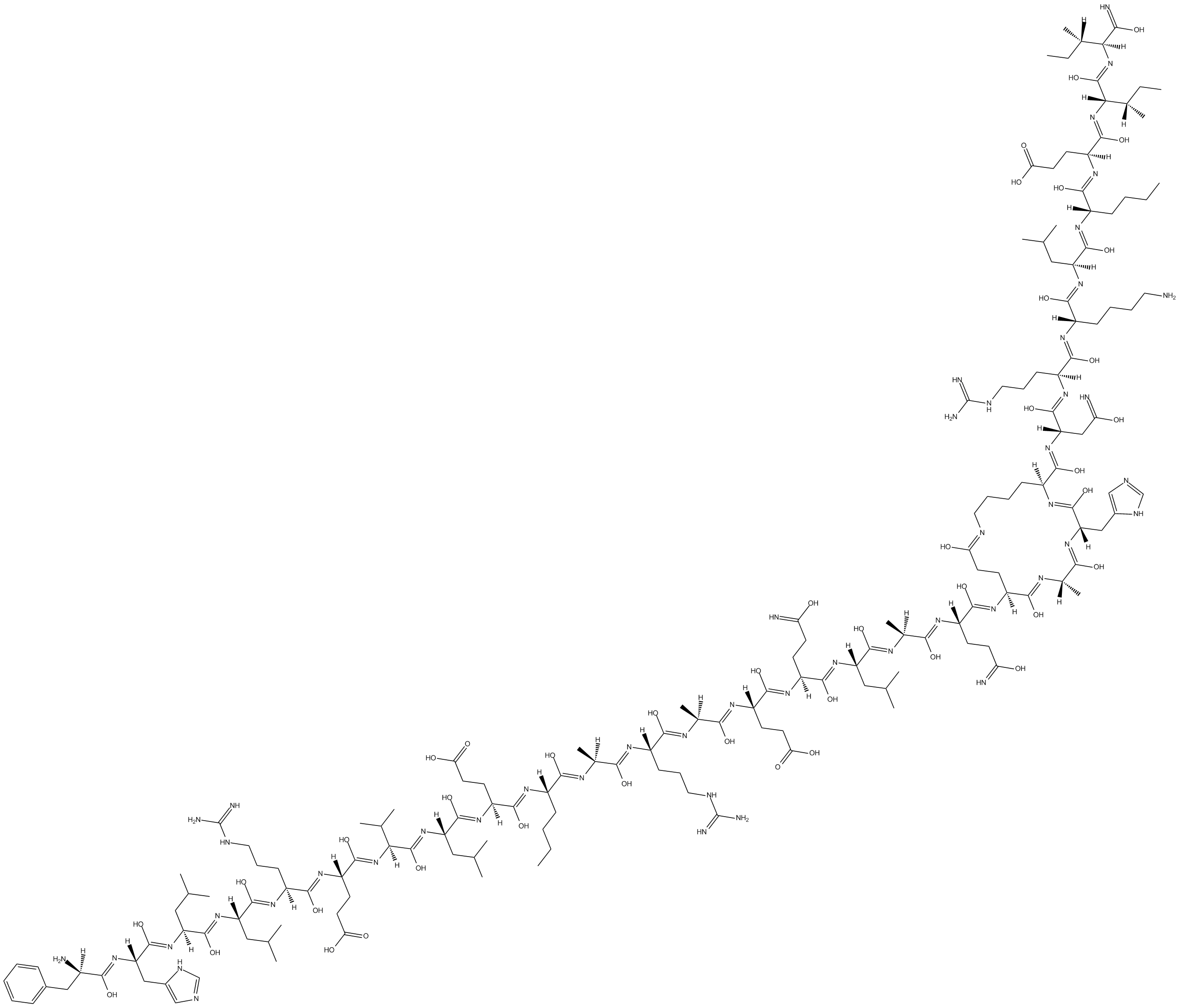
Astressin is an effective non-selective corticotropin-releasing factor (CRF) antagonist, with a low affinity for CRF binding proteins and a high affinity for cloned pituitary receptors (Ki = 2nM).
Products are for research use only. Not for human use. We do not sell to patients.
Cas No.: 170809-51-5
Sample solution is provided at 25 µL, 10mM.
Astressin is an effective non-selective corticotropin-releasing factor (CRF) antagonist, with a low affinity for CRF binding proteins and a high affinity for cloned pituitary receptors (Ki = 2nM) [1]. Astressin can block CRF-induced release of adrenocorticotropic hormone (ACTH) [2]. Astressin can be used as a neuroprotective agent and has an anxiolytic effect [3].
In vitro, treatment with Astressin (200nM; 24h) significantly reduced the secretion of cytokines IL-8 and TNF-α in human HTR-8/SVneo cells co-cultured with corticotropin-releasing hormone (CRH) and lipopolysaccharide (LPS) [4]. Astressin (1, 10, and 100nM; 72h) could increase estrogen (E2) induced proliferation of MCF7 cells in a concentration-dependent manner and reversed the proliferation inhibition of CRH on cells [5].
In vivo, treatment with Astressin (25μg in 4μl saline; intracerebroventricular injection; 30min before and 10min after seizure) effectively protected the neuronal function of rats with excitotoxic epilepsy induced by kainic acid and significantly reduced the damage of hippocampal cells in rats [6]. Treatment with Astressin (5μg/mouse; intraperitoneally; 5 days) could reverse the depigmentation phenotype of CRF overexpressing (OE) alopecia mice, induce pigmentation and hair regrowth, and restored 50–90% hair coverage within 2–4 weeks [7].
References:
[1] Gulyas J, Rivier C, Perrin M, et al. Potent, structurally constrained agonists and competitive antagonists of corticotropin-releasing factor. Proc Natl Acad Sci U S A. 1995;92(23):10575-10579.
[2] Smith S M, Vaughan J M, Donaldson C J, et al. Cocaine-and amphetamine-regulated transcript activates the hypothalamic-pituitary-adrenal axis through a corticotropin-releasing factor receptor-dependent mechanism[J]. Endocrinology, 2004, 145(11): 5202-5209.
[3] Spina M G, Basso A M, Zorrilla E P, et al. Behavioral effects of central administration of the novel CRF antagonist astressin in rats[J]. Neuropsychopharmacology, 2000, 22(3): 230-239.
[4] Wang W, Nan X, Ji P, Dow KE. Corticotropin releasing hormone modulates endotoxin-induced inflammatory cytokine expression in human trophoblast cells. Placenta. 2007;28(10):1032-1038.
[5] Graziani G, Tentori L, Muzi A, et al. Evidence that corticotropin-releasing hormone inhibits cell growth of human breast cancer cells via the activation of CRH-R1 receptor subtype. Mol Cell Endocrinol. 2007;264(1-2):44-49.
[6] Maecker H, Desai A, Dash R, Rivier J, Vale W, Sapolsky R. Astressin, a novel and potent CRF antagonist, is neuroprotective in the hippocampus when administered after a seizure. Brain Res. 1997;744(1):166-170.
[7] Wang L, Million M, Rivier J, et al. CRF receptor antagonist astressin-B reverses and prevents alopecia in CRF over-expressing mice[J]. PLoS One, 2011, 6(2): e16377.
| Cell experiment [1]: | |
Cell lines | Human HTR-8/SVneo cells |
Preparation Method | The HTR-8/SVneo cells were cultured in RPMI 1640 supplemented with 5% heat-inactivated fetal bovine serum, 2% penicillin/streptomycin and 2mM glutamine in a 95% air, 5% CO2 humidified atmosphere at 37°C. The culture medium was changed every 24h until the cells were grown to confluence. Cultured cells were stimulated with lipopolysaccharide (LPS) at different concentrations for 24h. The cells were co-treated with either 100nM corticotropin releasing hormone (CRH), 200nM Astressin or CRH plus Astressin for 24h. Cell culture supernatants were collected and assayed by ELISA and normalised to cell protein. |
Reaction Conditions | 200nM; 24h |
Applications | The treatment with Astressin significantly reduced the secretion of cytokines IL-8 and TNF-α in human HTR-8/SVneo cells co-cultured with corticotropin-releasing hormone (CRH) and lipopolysaccharide (LPS). |
| Animal experiment [2]: | |
Animal models | Sprague–Dawley rats |
Preparation Method | Subjects were male Sprague–Dawley rats (275–325g) housed on a 12:12 light:dark cycle and fed and watered ad libitum. For focal Kainic acid (KA) injection into the dorsal hippocampus, rats were anesthetized with a ketamine/rompun cocktail, placed in a stereotaxic head holder, and the skull exposed along the midline. KA (0.035μg in a volume of 1μl) was injected unilaterally into dorsal hippocampus (stereotaxic coordinates: AP=−3.0 from lambda, ML=2.1; DV=4.0mm). The animals treated with KA exhibited epileptic seizures within the first hour after the injection. Astressin (25μg in 4μl saline) or vehicle control (4μl saline) were administered by injection via an indwelling guide cannula into the lateral ventricle (coordinates: AP=4.1 from bregma, ML=3.0; DV=2.0) over a 2min period at indicated times with respect to the KA administration. Three days post KA administration rats were perfused with 4% paraformaldehyde. Coronal brain sections (30μm) were stained with Cresyl violet and damage was quantified by measuring the length and width of the lesion in each hippocampal cell field with a calibrated ocular grid at ×40 magnification. Areas of damage within successive sections were then integrated into a measure of total volume of damage. |
Dosage form | 25μg in 4μl saline; 30 minutes before and 10 minutes after the seizure; intraventricular injection |
Applications | Astressin treatment effectively protected the neuronal function of rats with excitotoxic epilepsy induced by kainic acid and significantly reduced the damage to hippocampal cells in the rats. |
References: | |
| Cas No. | 170809-51-5 | SDF | |
| Canonical SMILES | CCCC[C@@](/N=C(O)/[C@](/N=C(O)/[C@](/N=C(O)/[C@](/N=C(O)/[C@](/N=C(O)/[C@](/N=C(O)/[C@](/N=C(O)/[C@](/N=C(O)/[C@](/N=C(O)/[C@@](N)([H])CC1=CC=CC=C1)([H])CC2=CN=CN2)([H])CC(C)C)([H])CC(C)C)([H])CCCNC(N)=N)([H])CCC(O)=O)([H])C(C)C)([H])CC(C)C)([H])CCC(O)=O) | ||
| Formula | C161H269N49O42 | M.Wt | 3563.2 |
| Solubility | Soluble to 1 mg/ml in 10% Acetic acid / sterile water | Storage | Store at -20°C,away from moisture and light, under nitrogen |
| General tips | Please select the appropriate solvent to prepare the stock solution according to the
solubility of the product in different solvents; once the solution is prepared, please store it in
separate packages to avoid product failure caused by repeated freezing and thawing.Storage method
and period of the stock solution: When stored at -80°C, please use it within 6 months; when stored
at -20°C, please use it within 1 month. To increase solubility, heat the tube to 37°C and then oscillate in an ultrasonic bath for some time. |
||
| Shipping Condition | Evaluation sample solution: shipped with blue ice. All other sizes available: with RT, or with Blue Ice upon request. | ||
| Prepare stock solution | |||

|
1 mg | 5 mg | 10 mg |
| 1 mM | 280.6 μL | 1.4032 mL | 2.8065 mL |
| 5 mM | 56.1 μL | 280.6 μL | 561.3 μL |
| 10 mM | 28.1 μL | 140.3 μL | 280.6 μL |
Step 1: Enter information below (Recommended: An additional animal making an allowance for loss during the experiment)
 g
μL
g
μL
Step 2: Enter the in vivo formulation (This is only the calculator, not formulation. Please contact us first if there is no in vivo formulation at the solubility Section.)
Calculation results:
Working concentration: mg/ml;
Method for preparing DMSO master liquid: mg drug pre-dissolved in μL DMSO ( Master liquid concentration mg/mL, Please contact us first if the concentration exceeds the DMSO solubility of the batch of drug. )
Method for preparing in vivo formulation: Take μL DMSO master liquid, next addμL PEG300, mix and clarify, next addμL Tween 80, mix and clarify, next add μL saline, mix and clarify.
Method for preparing in vivo formulation: Take μL DMSO master liquid, next add μL Corn oil, mix and clarify.
Note: 1. Please make sure the liquid is clear before adding the next solvent.
2. Be sure to add the solvent(s) in order. You must ensure that the solution obtained, in the previous addition, is a clear solution before proceeding to add the next solvent. Physical methods such as vortex, ultrasound or hot water bath can be used to aid dissolving.
3. All of the above co-solvents are available for purchase on the GlpBio website.
Quality Control & SDS
- View current batch:
- Purity: >98.50% Appearance: A solid
- COA (Certificate of Analysis)
- SDS (Safety Data Sheet)
- Datasheet
Average Rating: 5 (Based on Reviews and 17 reference(s) in Google Scholar.)