

Azobenzene |
Catalog No.GC30634
 One-Click Copy Product Info
|

Azobenzene can be used as an optical trigger for the design and synthesis of a large variety of photoresponsive systems.
Products are for research use only. Not for human use. We do not sell to patients.
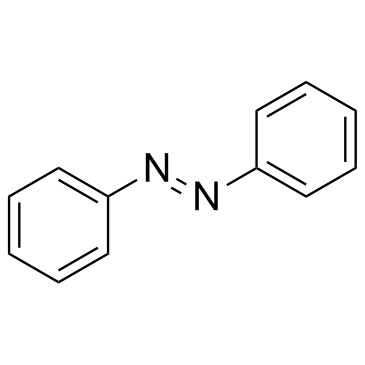
Cas No.: 103-33-3
Sample solution is provided at 25 µL, 10mM.
_1-3.$$$39978408@51.jpg');)
_1-9.$$$38538795@65.jpg');)
_1-9.$$$39112701@51.jpg');)
_1-7.$$$37316672@70.jpg');)
_366-372.$$$36198801@70.jpg');)
.$$$38565142@65.jpg');)
_1867-1883.$$$33248023@67.jpg');)
_eads6055.$$$39977546@45.jpg');)
_eadm9805.$$$40080571@45.jpg');)
_eadj3020.$$$39666821@45.jpg');)
_1-20.$$$39757301@28.jpg');)
_1-24.$$$38898113@28.jpg');)
_273-287.$$$36806353@46.jpg');)
_1-16.$$$37156877@44.jpg');)
_1-19.$$$37460805@44.jpg');)
_1291-1307.$$$34518654@46.jpg');)
Azobenzene can be used as an optical trigger for the design and synthesis of a large variety of photoresponsive systems.
Photochromic compounds that undergo large conformational changes when exposed to light of appropriate wavelength are particularly attractive as molecular switch elements. Azobenzene is a popular choice among the chromophores. The thermodynamically favored trans isomer is rapidly converted to the cis isomer by irradiation at the wavelength of the π-π* transition, whereas the reverse process is achieved either (slowly) by thermal relaxation in the dark or (quickly) by irradiation at the wavelength of the n-π* transition. The azobenzene amino acid (aa) can be used as a photo-inducible conformational switch in polypeptides. A reversible conformational change of the peptide backbone is induced by switching between the cis and trans configurations of the azobenzene moiety by irradiation with light of suitable wavelength[1]. Azobenzene has been the most widely used optical trigger for the synthesis of photoresponsive systems ranging from poly-a-amino acids to innovative materials with light-controlled mechanical and optical properties. Its use in form of appropriate derivatives allow to generate cyclic peptide structures of constraint conformational space and thus to exploit its reversible photoisomerization to induce well defined transitions between different conformational states[2]. Azobenzene photoswitches can be used to drive functional changes in peptides, proteins, nucleic acids, lipids, and carbohydrates[3].
[1]. Aemissegger A, et al. Synthesis and application of an azobenzene amino acid as a light-switchable turn element in polypeptides. Nat Protoc. 2007;2(1):161-7. [2]. Renner C, et al. Azobenzene as photoresponsive conformational switch in cyclic peptides. J Pept Res. 2005 Jan;65(1):4-14. [3]. Beharry AA, et al. Azobenzene photoswitches for biomolecules. Chem Soc Rev. 2011 Aug;40(8):4422-37.
| Cas No. | 103-33-3 | SDF | |
| Canonical SMILES | C1(/N=N/C2=CC=CC=C2)=CC=CC=C1 | ||
| Formula | C12H10N2 | M.Wt | 182.22 |
| Solubility | DMSO : ≥ 150 mg/mL (823.18 mM) | Storage | Store at -20°C |
| General tips | Please select the appropriate solvent to prepare the stock solution according to the
solubility of the product in different solvents; once the solution is prepared, please store it in
separate packages to avoid product failure caused by repeated freezing and thawing.Storage method
and period of the stock solution: When stored at -80°C, please use it within 6 months; when stored
at -20°C, please use it within 1 month. To increase solubility, heat the tube to 37°C and then oscillate in an ultrasonic bath for some time. |
||
| Shipping Condition | Evaluation sample solution: shipped with blue ice. All other sizes available: with RT, or with Blue Ice upon request. | ||
| Prepare stock solution | |||

|
1 mg | 5 mg | 10 mg |
| 1 mM | 5.4879 mL | 27.4394 mL | 54.8787 mL |
| 5 mM | 1.0976 mL | 5.4879 mL | 10.9757 mL |
| 10 mM | 548.8 μL | 2.7439 mL | 5.4879 mL |
Step 1: Enter information below (Recommended: An additional animal making an allowance for loss during the experiment)
 g
μL
g
μL
Step 2: Enter the in vivo formulation (This is only the calculator, not formulation. Please contact us first if there is no in vivo formulation at the solubility Section.)
Calculation results:
Working concentration: mg/ml;
Method for preparing DMSO master liquid: mg drug pre-dissolved in μL DMSO ( Master liquid concentration mg/mL, Please contact us first if the concentration exceeds the DMSO solubility of the batch of drug. )
Method for preparing in vivo formulation: Take μL DMSO master liquid, next addμL PEG300, mix and clarify, next addμL Tween 80, mix and clarify, next add μL saline, mix and clarify.
Method for preparing in vivo formulation: Take μL DMSO master liquid, next add μL Corn oil, mix and clarify.
Note: 1. Please make sure the liquid is clear before adding the next solvent.
2. Be sure to add the solvent(s) in order. You must ensure that the solution obtained, in the previous addition, is a clear solution before proceeding to add the next solvent. Physical methods such as vortex, ultrasound or hot water bath can be used to aid dissolving.
3. All of the above co-solvents are available for purchase on the GlpBio website.
Quality Control & SDS
- View current batch:
- Purity: >98.00% Appearance: A solid
- COA (Certificate of Analysis)
- SDS (Safety Data Sheet)
- Datasheet
Average Rating: 5 (Based on Reviews and 38 reference(s) in Google Scholar.)