

BAM 15 |
Catalog No.GC19056
 One-Click Copy Product Info
|

BAM15 is a novel mitochondrial protonophore uncoupler (2-fluorophenyl){6-[(2-fluorophenyl)amino](1,2,5-oxadiazolo[3,4-e]pyrazin-5-yl)}amine, that does not depolarize the plasma membrane.
Products are for research use only. Not for human use. We do not sell to patients.
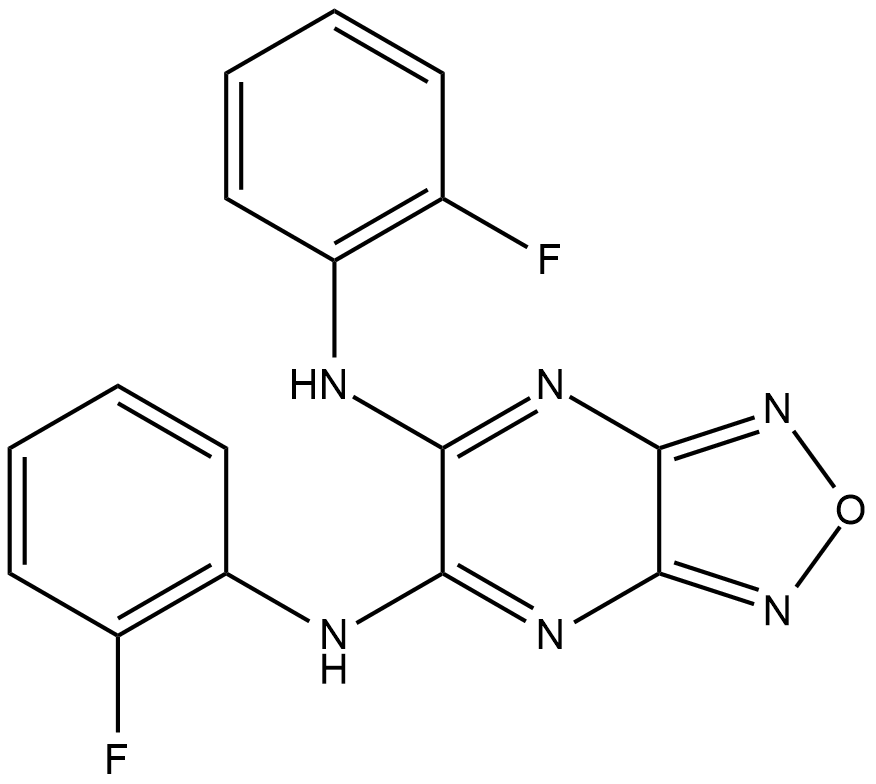
Cas No.: 210302-17-3
Sample solution is provided at 25 µL, 10mM.
_1-3.$$$39978408@51.jpg');)
_1-9.$$$38538795@65.jpg');)
_1-9.$$$39112701@51.jpg');)
_1-7.$$$37316672@70.jpg');)
_366-372.$$$36198801@70.jpg');)
.$$$38565142@65.jpg');)
_1867-1883.$$$33248023@67.jpg');)
_eads6055.$$$39977546@45.jpg');)
_eadm9805.$$$40080571@45.jpg');)
_eadj3020.$$$39666821@45.jpg');)
_1-20.$$$39757301@28.jpg');)
_1-24.$$$38898113@28.jpg');)
_273-287.$$$36806353@46.jpg');)
_1-16.$$$37156877@44.jpg');)
_1-19.$$$37460805@44.jpg');)
_1291-1307.$$$34518654@46.jpg');)
BAM15 is a novel mitochondrial protonophore uncoupler (2-fluorophenyl){6-[(2-fluorophenyl)amino](1,2,5-oxadiazolo[3,4-e]pyrazin-5-yl)}amine, that does not depolarize the plasma membrane[1].
BAM15 has an average EC50 value of 1.4 µM and is capable of maintaining high levels of mitochondrial respiration over a wide concentration range of 3 to 100 µM in OCR[2]. In fully differentiated C2C12 mouse myotubes, BAM15 (100 µM;16h) did not alter cell viability or number,but BAM15 improves cellular respiratory kinetics by sustained mitochondrial uncoupling[3]. Wild-type animals treated with both 50 µM BAM15 showed reduced mechanosensory neuronal defects during aging, which correlates with the maintenance of touch responses and short-term memory during aging in Caenorhabditis elegans[4]. BAM15(1mM) depolarized mitochondrial membrane potential, induced mitochondrial fission, increased mitochondrial ROS production, and increased mitochondrial oxygen consumption rate in A10 cells[5].
BAM15(1 mg/kg; i.p.; 3 hours before injection of LPS) attenuated serum cytokines, organ damage (liver enzymes and serum creatinine) and tissue cytokines (liver and kidney), and reduced inflammatory mononuclear/macrophages in the liver, in part by enhancing phosphorylated αAMPK in LPS-administered mice[6]. BAM15 was seen to reduce mortality after injection at 0, 6 and 12 hours after cecal ligation and puncture (CLP), and reduced kidney damage and spleen apoptosis even after 12 hours when the mice were sick[7].
References:
[1]. Kenwood BM, Weaver JL, et,al. Identification of a novel mitochondrial uncoupler that does not depolarize the plasma membrane. Mol Metab. 2013 Nov 28;3(2):114-23. doi: 10.1016/j.molmet.2013.11.005. PMID: 24634817; PMCID: PMC3953706.
[2]. Alexopoulos SJ, Chen SY, et,al. Mitochondrial uncoupler BAM15 reverses diet-induced obesity and insulin resistance in mice. Nat Commun. 2020 May 14;11(1):2397. doi: 10.1038/s41467-020-16298-2. PMID: 32409697; PMCID: PMC7224297.
[3]. Axelrod CL, King WT, et,al. BAM15-mediated mitochondrial uncoupling protects against obesity and improves glycemic control. EMBO Mol Med. 2020 Jul 7;12(7):e12088. doi: 10.15252/emmm.202012088. Epub 2020 Jun 10. PMID: 32519812; PMCID: PMC7338798.
[4]. Cho I, Song HO, et,al. BAM15 Relieves Neurodegeneration in Aged Caenorhabditis elegans and Extends Lifespan. Metabolites. 2022 Nov 17;12(11):1129. doi: 10.3390/metabo12111129. PMID: 36422268; PMCID: PMC9698188.
[5]. Tai Y, Li L, et,al. Mitochondrial uncoupler BAM15 inhibits artery constriction and potently activates AMPK in vascular smooth muscle cells. Acta Pharm Sin B. 2018 Oct;8(6):909-918. doi: 10.1016/j.apsb.2018.07.010. Epub 2018 Jul 26. PMID: 30505660; PMCID: PMC6251816.
[6]. Dang CP, Issara-Amphorn J, et,al. BAM15, a Mitochondrial Uncoupling Agent, Attenuates Inflammation in the LPS Injection Mouse Model: An Adjunctive Anti-Inflammation on Macrophages and Hepatocytes. J Innate Immun. 2021;13(6):359-375. doi: 10.1159/000516348. Epub 2021 Jun 1. PMID: 34062536; PMCID: PMC8613553.
[7]. Tsuji N, Tsuji T, et,al. BAM15 treats mouse sepsis and kidney injury, linking mortality, mitochondrial DNA, tubule damage, and neutrophils. J Clin Invest. 2023 Feb 9:e152401. doi: 10.1172/JCI152401. Epub ahead of print. PMID: 36757801.
| Cell experiment [1]: | |
|
Cell lines |
Normal murine liver (NMuLi) cells |
|
Preparation Method |
NMuLi cells were seeded in a 96-well seahorse plates and were allowed to adhere overnight. Prior to the assay, media was changed to unbuffered DMEM containing pyruvate and glutamine and the cells were equilibrated for 1 h at 37℃ without CO2. BAM15 were injected during the assay and OCR(Oxygen consumption rate) was measured using 2 min measurement periods. |
|
Reaction Conditions |
0.1-100 µM |
|
Applications |
BAM15 has an average EC50 value of 1.4 µM and is capable of maintaining high levels of mitochondrial respiration over a wide concentration range of 3 to 100 µM in OCR. |
| Animal experiment [2]: | |
|
Animal models |
Male 6-week-old mice |
|
Preparation Method |
BAM15 at 1 mg/kg in 10% of DMSO or 10% DMSO alone was intraperitoneally administered at 3 h prior to the intraperitoneal injection of LPS (4 mg/kg) in PBS or PBS alone. |
|
Dosage form |
1 mg/kg; i.p.; 3 hours before injection of LPS |
|
Applications |
BAM15 attenuated serum cytokines, organ damage (liver enzymes and serum creatinine) and tissue cytokines (liver and kidney), and reduced inflammatory mononuclear/macrophages in the liver, in part by enhancing phosphorylated αAMPK. |
|
References: [1]. Alexopoulos SJ, Chen SY, et,al. Mitochondrial uncoupler BAM15 reverses diet-induced obesity and insulin resistance in mice. Nat Commun. 2020 May 14;11(1):2397. doi: 10.1038/s41467-020-16298-2. PMID: 32409697; PMCID: PMC7224297. |
|
| Cas No. | 210302-17-3 | SDF | |
| Canonical SMILES | FC(C=CC=C1)=C1NC2=NC3=NON=C3N=C2NC4=C(C=CC=C4)F | ||
| Formula | C16H10F2N6O | M.Wt | 340.29 |
| Solubility | DMSO : 75 mg/mL (220.40 mM);Water : < 0.1 mg/mL (insoluble) | Storage | Store at -20°C |
| General tips | Please select the appropriate solvent to prepare the stock solution according to the
solubility of the product in different solvents; once the solution is prepared, please store it in
separate packages to avoid product failure caused by repeated freezing and thawing.Storage method
and period of the stock solution: When stored at -80°C, please use it within 6 months; when stored
at -20°C, please use it within 1 month. To increase solubility, heat the tube to 37°C and then oscillate in an ultrasonic bath for some time. |
||
| Shipping Condition | Evaluation sample solution: shipped with blue ice. All other sizes available: with RT, or with Blue Ice upon request. | ||
| Prepare stock solution | |||

|
1 mg | 5 mg | 10 mg |
| 1 mM | 2.9387 mL | 14.6933 mL | 29.3867 mL |
| 5 mM | 587.7 μL | 2.9387 mL | 5.8773 mL |
| 10 mM | 293.9 μL | 1.4693 mL | 2.9387 mL |
Step 1: Enter information below (Recommended: An additional animal making an allowance for loss during the experiment)
 g
μL
g
μL
Step 2: Enter the in vivo formulation (This is only the calculator, not formulation. Please contact us first if there is no in vivo formulation at the solubility Section.)
Calculation results:
Working concentration: mg/ml;
Method for preparing DMSO master liquid: mg drug pre-dissolved in μL DMSO ( Master liquid concentration mg/mL, Please contact us first if the concentration exceeds the DMSO solubility of the batch of drug. )
Method for preparing in vivo formulation: Take μL DMSO master liquid, next addμL PEG300, mix and clarify, next addμL Tween 80, mix and clarify, next add μL saline, mix and clarify.
Method for preparing in vivo formulation: Take μL DMSO master liquid, next add μL Corn oil, mix and clarify.
Note: 1. Please make sure the liquid is clear before adding the next solvent.
2. Be sure to add the solvent(s) in order. You must ensure that the solution obtained, in the previous addition, is a clear solution before proceeding to add the next solvent. Physical methods such as vortex, ultrasound or hot water bath can be used to aid dissolving.
3. All of the above co-solvents are available for purchase on the GlpBio website.
Quality Control & SDS
- View current batch:
- Purity: >98.00% Appearance: A solid
- COA (Certificate of Analysis)
- SDS (Safety Data Sheet)
- Datasheet
Average Rating: 5 (Based on Reviews and 7 reference(s) in Google Scholar.)